Cybersecurity consulting in 2026 is a $290 billion global market dominated by five kinds of firms: the Big Four (KPMG, Deloitte, PwC, EY), the large technology-aligned specialists (Mandiant, IBM X-Force, Accenture), the independent enterprise consultancies (NCC Group, Optiv), the mid-market PTaaS platforms, and a new wave of growth-stage challengers built specifically for the way modern SaaS companies ship software.
Picking the wrong kind of firm is one of the most expensive mistakes a security leader can make. A $750K Big Four engagement that delivers a 200-page maturity assessment no developer will ever read is not better than a $50K engagement from a firm that finds real flaws and files them directly into your issue tracker. Likewise, a Series A startup trying to hire a global consultancy to remediate a critical finding on a 72-hour deadline is going to be disappointed.
This post covers the ten firms we think most influence how cybersecurity consulting is actually delivered in 2026. We have grouped them by their dominant operating model - enterprise advisory, Big Four, specialized services, or challenger platform - and given honest strengths and caveats for each. Our methodology, ranking criteria, and fit-by-stage framework are at the top; detailed firm profiles follow; a master comparison table and decision framework sit at the end.
How We Picked the Top 10
We considered roughly 80 cybersecurity consulting firms with meaningful global or regional presence in 2026. To make the final list, a firm needed to clear all five of these bars:
- Material revenue from consulting services - not just product sales dressed up as advisory. Firms whose "consulting" is really implementation labor for their own SaaS were filtered out.
- Public client references and case studies - we excluded firms that operate entirely under NDA with no verifiable customer signal.
- Technical practitioner depth - we gave heavy weight to firms with in-house research teams, original vulnerability disclosures, and named practitioners who contribute publicly to the field.
- Compliance and regulatory signal - the firm must be able to deliver work that passes SOC 2, ISO 27001, PCI DSS, HIPAA, or sector-specific audits. Security that doesn't ship a compliant report is incomplete.
- Distinct positioning - we deliberately included one firm per category where similar alternatives existed. A list with five Big Four firms would not be useful.
We evaluated each firm on seven dimensions: breadth of services, depth of technical practitioners, speed of engagement kickoff, quality of deliverables, fit for growth-stage versus enterprise, pricing transparency, and how well their reports actually get used after delivery. We talked to security leaders at 26 organizations across Seed through Fortune 500 during the research window.
Quick Comparison: All 10 Firms at a Glance
Before the detailed profiles, here is how the ten firms line up across the dimensions that matter most for buyers in 2026. Read this table first to orient yourself, then dig into the individual profiles for the firms that look relevant.
| Firm | Type | Best Fit | Typical Engagement | Hourly Range |
|---|---|---|---|---|
| Lorikeet Security | Challenger (PTaaS) | Seed to Series C, modern SaaS | $1,990/yr - $150K (from $165/mo) | Published plans (from $165/mo) |
| Mandiant | Specialist (Google) | Enterprise IR, threat intel | $150K - $2M+ | $350 - $550 |
| KPMG Cyber Security | Big Four | Regulated enterprises, global programs | $250K - $5M+ | $350 - $600 |
| Deloitte Cyber | Big Four | Transformation, multi-region rollouts | $300K - $8M+ | $400 - $650 |
| Accenture Security | Global integrator | Transformation programs, MSSP | $500K - $15M+ | $300 - $600 |
| PwC Cybersecurity | Big Four | Financial services, privacy, governance | $250K - $4M+ | $350 - $650 |
| EY Cybersecurity | Big Four | Cyber M&A diligence, financial services | $200K - $3M+ | $350 - $600 |
| IBM X-Force | Specialist (IBM) | Large enterprises with IBM stack | $200K - $3M+ | $300 - $550 |
| NCC Group | Independent boutique | Technical offensive + cryptography | $60K - $1.5M | $280 - $500 |
| Optiv | US integrator | US mid-market to enterprise | $150K - $5M | $275 - $500 |
A few things to note before you judge these ranges too harshly. First, Big Four and global integrator pricing assumes multi-month engagements with five-to-fifteen named resources; the per-hour rate in isolation misrepresents the actual cost — especially given their $150K+ minimum engagement floors. Second, the hourly figures are blended ranges, not starting rates - a senior partner at Deloitte will bill far above the $650 top of the range, and an apprentice consultant will bill below. Third, Lorikeet Security deliberately does not bill hourly; we quote transparent published annual programs starting at just $165/month ($1,990/year billed annually) for Talon PTaaS Essentials and $25 pay-as-you-go for Lory AI Pentester, up to custom enterprise scopes. That is a disruptive commercial model designed to eliminate six-figure consulting minimums while providing continuous offensive assurance.
1. Lorikeet Security
Lorikeet Security
ChallengerLorikeet Security is a growth-stage-focused offensive security firm built on the bet that the way mid-market and growth-stage SaaS companies buy security has fundamentally changed. Annual point-in-time penetration tests delivered as a static PDF no longer match how modern engineering teams actually ship software. The Lorikeet Security platform bridges this gap through two deeply integrated pillars: Talon PTaaS annual programs and the Lory AI Pentester, coupling continuous autonomous testing with human-certified penetration testing and audit-ready compliance attestations.
Instead of the opaque pricing, six-figure minimums ($150,000+), and endless sales friction typical of Big Four consulting firms, Lorikeet Security publishes clear, predictable subscription and credit pricing starting at just $165 a month.
Talon PTaaS Annual Programs
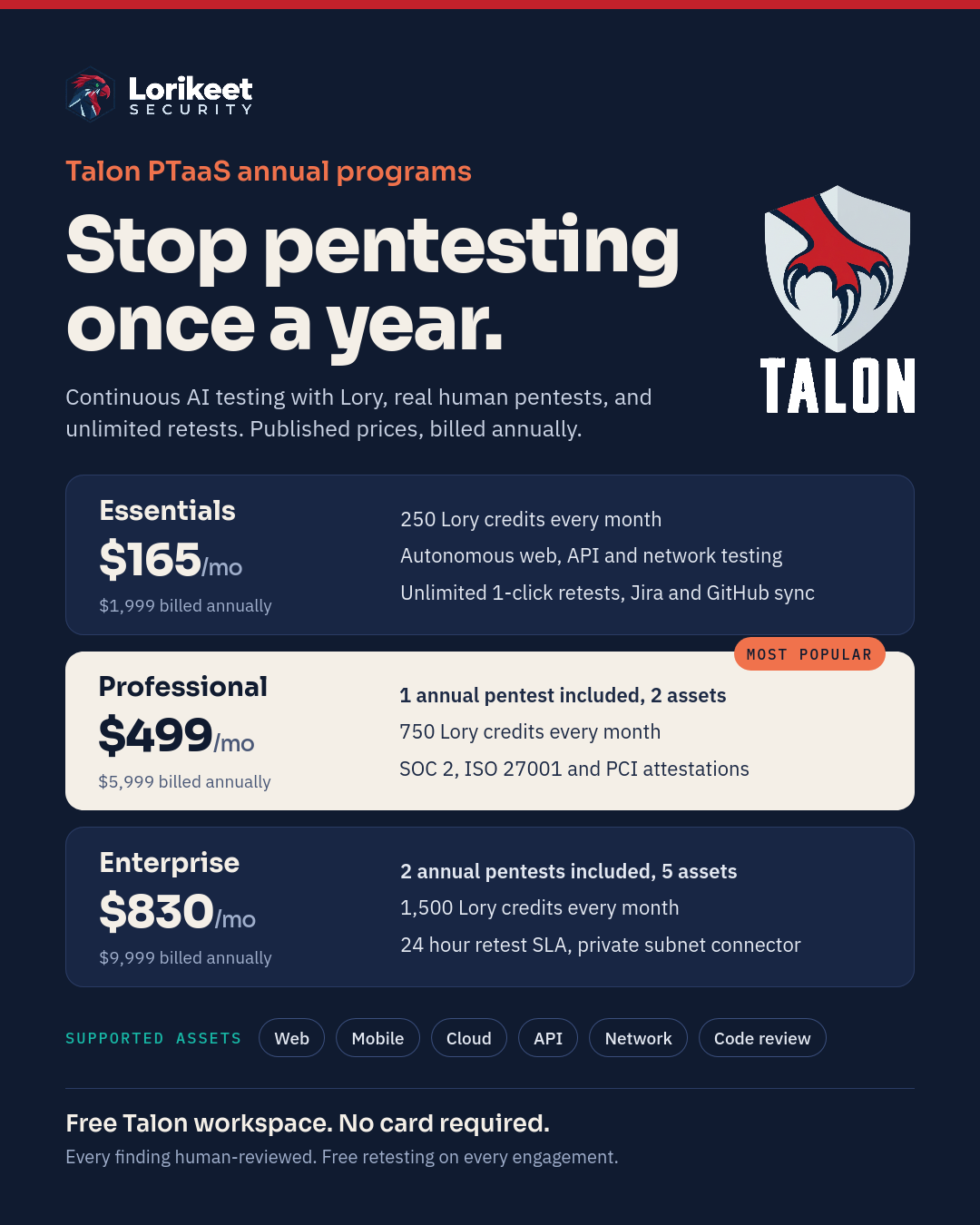
Talon PTaaS replaces the broken "test once a year" ritual with continuous testing, developer issue-tracker sync, and unlimited retests. Programs are offered in three transparent tiers:
- Essentials ($165/mo or $1,990/yr billed annually): 250 Lory credits/mo, autonomous web, API, and network testing, unlimited 1-click retests, and bi-directional Jira/GitHub sync. Perfect for startups establishing a continuous testing baseline.
- Professional ($499/mo or $5,990/yr billed annually): 1 annual pentest included, 2 assets, 750 Lory credits/mo, formal SOC 2, ISO 27001, and PCI attestations, and unlimited 1-click retests. Our most popular program for audit-ready growth companies.
- Enterprise ($830/mo or $9,990/yr billed annually): 2 annual pentests included, 5 assets, 1,500 Lory credits/mo, a guaranteed 24-hr retest SLA, and a private subnet connector for testing behind internal networks and VPCs.
Lory AI Pentester Credit Plans
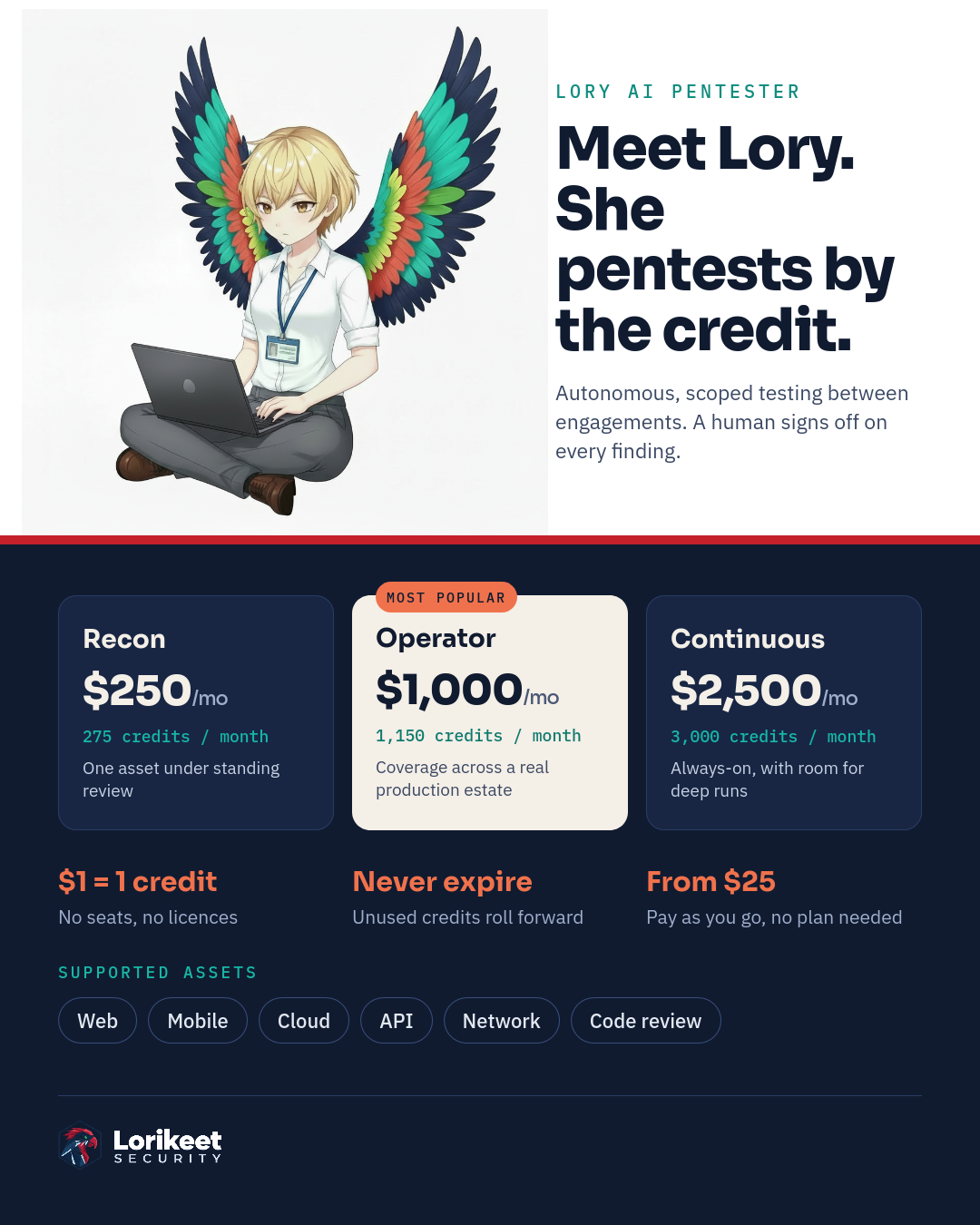
Lory is an autonomous AI pentester capable of executing scoped, multi-stage attacks across your declared surface with human-in-the-loop oversight on every finding. Lory is billed transparently by credit ($1 = 1 credit, credits never expire, no contracts):
- Recon ($250/mo): 250 credits/mo, designed for standing review of a single application or attack surface.
- Operator ($1,000/mo): 1,110 credits/mo, structured for continuous coverage across active staging and production environments.
- Continuous ($2,500/mo): 3,000 credits/mo, built for always-on automated exploitation with room for recurring deep-dive scans.
- Pay-As-You-Go (from $25): Flexible credit packs starting at $25 ($1 = 1 credit, never expire, no contracts or recurring commitments).
Supported Assets: Both Talon PTaaS and Lory AI Pentester support testing across Web, Mobile, Cloud, API, Network, and Code review.
Our deliverables are opinionated toward action. Findings arrive in your issue tracker with CWE, MITRE ATT&CK, and OWASP references, reproduction steps, and remediation guidance your developers can act on directly. Compliance mappings for SOC 2, ISO 27001, HIPAA, PCI DSS, CMMC, and NIS2 are generated automatically from the findings. Retest is included in-scope, not billed as a change order. Lory, our AI security assistant, answers client questions from inside the portal without an email back to the project manager.
We deliberately do not try to compete with Mandiant on APT incident response, with NCC Group on cryptographic review, or with Deloitte on $5M transformation engagements. Those are not our customers. Our customers are engineering leaders, founders, and fractional CISOs at seed-to-Series-C SaaS companies who need real adversarial testing to unlock enterprise sales, pass SOC 2 audits, and keep a security program moving between formal tests - without paying Big Four rates ($150K+ minimums) or waiting six months for availability.
Where Lorikeet Security Wins
- Disruptive published pricing from $165/mo vs Big Four $150k+ minimums
- Talon PTaaS combines continuous AI testing with human-led annual pentests
- Autonomous Lory AI Pentester credit plans from $25 and never-expiring credits
- Broad asset coverage: Web, Mobile, Cloud, API, Network, and Code review
- Unlimited 1-click retests included in-scope (zero change order fees)
- Fast scoping, fast kickoff, fast delivery - days and weeks, not months
- Findings delivered where developers work (Jira, GitHub, Linear, Slack)
- Compliance mappings for SOC 2, ISO, HIPAA, PCI generated automatically
Where to Look Elsewhere
- Not structured for Fortune 500 multi-year IT transformation programs
- Not the call for nation-state breach response - that's Mandiant
- We don't sell third-party product licenses or resell firewalls
- We are newer than the Big Four - if legacy brand-name prestige is a requirement, we are not the pick
2. Mandiant (Google Cloud)
Mandiant
SpecialistMandiant is the name that shows up when a Fortune 500 company has been breached and the board wants the definitive word on what happened. Kevin Mandia's firm built its reputation on APT attribution - the 2013 APT1 report that named PLA Unit 61398 still defines how the industry talks about nation-state actors. Since the Google Cloud acquisition in 2022, Mandiant has been integrated into the Google Threat Intelligence offering while preserving its consulting brand and independence in assessments.
Their core strength is forensic incident response at the hardest end of the market: large breaches, advanced persistent threat campaigns, destructive attacks, and ransomware negotiation where the facts need to hold up in regulator filings and courtroom discovery. The threat intelligence they feed back into the consulting practice is a genuine differentiator - when Mandiant responders arrive on-site, they often already know what the attacker's next move will be because the same group is active at another client.
Their proactive services - red team, purple team, security program assessments, threat-led penetration testing - trade on the same bench. For enterprises that want their offensive testing informed by actual APT tradecraft rather than the OWASP Top 10, Mandiant is hard to beat. The trade-off is cost and accessibility: Mandiant's engagement minimums are high, the named senior consultants are booked months out, and the firm is architected for the Fortune 1000. A 40-person SaaS startup will struggle to even get a call back.
Where Mandiant Wins
- Gold-standard breach and IR work, especially for regulator-facing incidents
- Threat intelligence feeds that actively inform every engagement
- Deep bench for nation-state adversary simulation
- Credible to boards, insurers, regulators, and law enforcement
Where to Look Elsewhere
- Not economical or accessible for companies under $50M ARR
- Long engagement lead times for proactive work
- Reports tend to be written for executives, not developers
- Retainers often feel like insurance premiums rather than active engagement
3. KPMG Cyber Security Services
KPMG
Big FourKPMG's cyber practice is the smallest of the Big Four by headcount but often the most focused - they have leaned hard into risk, third-party assurance, privacy regulations, and critical infrastructure compliance. Their global footprint means a KPMG engagement for a multinational will typically get local partners in every jurisdiction you operate in, with local regulatory expertise baked in. That is very valuable when you are dealing with a patchwork of GDPR, NYDFS, UK DPA, APRA CPS 234, and Singapore MAS all at once.
Where KPMG excels is structured program advisory: you want a three-year security transformation roadmap, a board-level cyber risk quantification, a vendor risk program rollout, or a privacy-by-design implementation across a global organization. The deliverables are polished, the frameworks are thorough, and the partners are comfortable in a boardroom. Their technical penetration testing practice exists but is not the firm's strongest discipline; for pure offensive work, you will get better value elsewhere.
The honest trade-off with any Big Four engagement is leverage. The partner who sold you the deal will not run it day-to-day. Most of the work is delivered by senior managers and consultants whose quality varies significantly. The ones who are great are very great; the ones who are average are expensive. Insist on named resources, bios, and an interview process for the people actually delivering.
Where KPMG Wins
- Global regulatory and privacy program design
- Third-party risk and supply chain assurance at enterprise scale
- Board and audit committee-ready deliverables
- Cross-border engagements with local regulatory grounding
Where to Look Elsewhere
- Technical offensive testing is not their strongest practice
- Leverage-heavy staffing model - partner-sold, manager-delivered
- Can feel slow and documentation-heavy for fast-moving SaaS
- Price-to-value ratio is poor below $50M ARR
4. Deloitte Cyber
Deloitte
Big FourDeloitte has the largest cybersecurity practice in the Big Four and one of the largest in the world. They are built for transformation scale - multi-year enterprise-wide security program rollouts, global SOC implementations, identity and access modernization across 100,000-employee organizations, zero trust architecture design for federal agencies. The firm publishes the "Deloitte Future of Cyber" survey annually, which is a useful pulse check on where enterprise security leaders are investing.
Deloitte's managed services arm (MXDR) is a legitimate alternative to pure-play MSSPs for organizations that want a single vendor relationship that spans strategy, implementation, and run-state operations. Their cyber academy and training programs are well-regarded. And they have real federal and defense sector depth, which is valuable if you sell into government or operate critical infrastructure.
The downsides are the classic Big Four downsides, amplified by scale. Deloitte engagements tend to be long, expensive, and heavy on documentation. The quality of specific teams varies enormously by local office and partner - the Deloitte Financial Services cyber practice in New York is a very different animal from the Deloitte Risk practice in Bengaluru. For technical offensive work, you will again want a specialist. For program leadership, transformation, and run-state, Deloitte can be an excellent choice if you can afford it and your internal politics favor a tier-one name.
Where Deloitte Wins
- Enterprise-wide transformation programs and global rollouts
- Managed services with strategic advisory attached
- Federal, defense, and public sector depth
- Scale - thousands of practitioners across every geography
Where to Look Elsewhere
- Technical offensive testing is not world-class
- Extremely variable quality across offices and partners
- Documentation-heavy deliverables that developers rarely read
- Premium pricing that crowds out experimentation
5. Accenture Security
Accenture Security
Global IntegratorAccenture is the largest global systems integrator, and Accenture Security is the largest cybersecurity practice inside any non-Big-Four firm. The Symantec consulting acquisition in 2020 gave them depth in threat intelligence and managed services; subsequent acquisitions of Innotec, Context, and Revolutionary Security expanded their capability across offensive, OT, and industrial cyber. Their managed security services arm competes directly with Deloitte MXDR, IBM, and pure-play MSSPs like Secureworks.
Where Accenture wins is when the cyber engagement is part of a broader technology transformation - cloud migration, ERP modernization, digital product launch, M&A integration - that Accenture is already delivering. Having one vendor own both the transformation and the security baked into it removes a class of handoff failures that destroy value. Their OT / industrial cyber practice is a real differentiator for manufacturing, energy, and utilities.
If you are not already working with Accenture on a transformation, buying cyber from them standalone is often not the best use of budget. The firm's pricing assumes a certain scale of engagement; a one-off $75K penetration test is an awkward fit for their delivery model. Below the F2000 scale, Accenture Security quickly becomes mis-sized.
Where Accenture Wins
- Security baked into broader technology transformation programs
- OT / industrial cyber for manufacturing, energy, and utilities
- Global managed security services with 24x7 SOC capability
- M&A integration with security built in from day one
Where to Look Elsewhere
- Standalone security engagements are not their strength
- Mid-market and below is a poor commercial fit
- Offensive security is acquired capability, not organic strength
- Engagement minimums crowd out tactical work
6. PwC Cybersecurity & Privacy
PwC
Big FourPwC's cyber and privacy practice is the firm's answer to the Big Four cyber arms race. It is strongest in financial services - global banks, insurers, asset managers, capital markets infrastructure - where PwC's audit relationships and regulatory depth turn into strong cyber consulting. The UK and European financial services cyber teams have particularly good reputations; the US practice is solid but competes harder against Deloitte.
Where PwC stands out is privacy - GDPR, UK DPA, LGPD, CCPA/CPRA, Singapore PDPA, Australian Privacy Act - as a technical and regulatory discipline. Their privacy teams sit inside the cyber practice and the combination makes a lot of sense: modern privacy work cannot be done without deep technical knowledge of where data lives, how it flows, and how to prove to a regulator that you have controls in place. PwC also publishes a respected annual Global Digital Trust Insights survey.
PwC's offensive security capability has grown meaningfully over the last three years but is still a second-tier offering behind their advisory work. If you are a regulated financial institution that needs a cyber partner who also handles your privacy program and speaks fluently to your auditors, PwC is a good choice. If you are a SaaS company that needs a sharp web application pentest delivered in six weeks, you are better served elsewhere.
Where PwC Wins
- Financial services cyber and privacy - especially in UK/Europe
- Privacy program design across GDPR, CCPA, and equivalents
- Audit-adjacent controls design that survives external scrutiny
- Governance, risk, and regulatory engagement advisory
Where to Look Elsewhere
- Offensive testing is not a signature strength
- Audit independence rules may block dual-use relationships
- Pricing and process overhead are Big Four standard
- US practice is not as strong as UK and EMEA
7. EY Cybersecurity
EY
Big FourEY's cyber practice is smaller than Deloitte or KPMG but has two particular strengths. The first is cyber in the context of mergers and acquisitions - due diligence, deal-stage risk assessments, day-one integration, and carve-outs. When a private equity firm or corporate acquirer needs to understand the cyber exposure of a target before signing, EY's M&A cyber team is one of the most common calls. The second is financial services, where EY historically has deep audit relationships that translate into adjacent advisory work.
EY has invested in threat simulation and red teaming through targeted acquisitions, and their offensive practice is better than PwC or KPMG by a meaningful margin - though still behind specialists like Mandiant or NCC Group. Their managed detection and response offering (EY MDR) competes in the same space as Deloitte MXDR but is smaller in scale.
The firm is also known for its global cyber survey work and for being an early mover on AI governance and trustworthy AI - a capability that is increasingly important as regulators catch up to AI risks. If you are buying a cyber partner for an M&A transaction, EY is a strong pick. If you are buying for run-state security of a SaaS platform, it is not the first place to look.
Where EY Wins
- Cyber in M&A - diligence, integration, and carve-outs
- Corporate and financial services advisory
- Emerging AI governance and trustworthy AI programs
- Stronger offensive capability than PwC or KPMG
Where to Look Elsewhere
- Smaller scale than Deloitte or KPMG limits engagement capacity
- Technical depth inconsistent across offices
- Not a first choice for SaaS or mid-market
- Audit independence rules still apply to audit clients
8. IBM X-Force
IBM X-Force
SpecialistX-Force is IBM's threat intelligence, offensive research, and incident response practice. The X-Force Threat Intelligence Index is one of the longer-running industry reports, published annually since the early 2010s, and the research team publishes original vulnerability and malware analysis that consistently lands in the major trade publications. When integrated with IBM Consulting's broader cyber practice, X-Force delivers across the full stack from research to advisory to managed services.
Where X-Force shines is large enterprises already running meaningful IBM stack - QRadar for SIEM, Guardium for data security, MaaS360 for mobile, Cloud Pak for Security, Red Hat for containers. Having the consulting firm that built the tools also operate them gives IBM a natural advantage in that segment. Their IR team is credible, if a step behind Mandiant and CrowdStrike in market mindshare.
The challenge is that IBM Consulting as a whole has gone through enough restructuring over the last decade that the cyber practice can feel uneven depending on which geography and which division you engage. Offensive testing is solid but not differentiated. Pricing is enterprise-standard. If you run IBM security stack at scale, X-Force is a natural partner; if you don't, there are sharper options at comparable or lower cost.
Where X-Force Wins
- Deep integration with IBM security portfolio
- Respected threat intelligence team and annual reporting
- Mature IR practice with global reach
- Strong mainframe and legacy enterprise environment coverage
Where to Look Elsewhere
- Uneven practice quality across regions
- Not the sharpest offensive shop in the market
- Less compelling for modern cloud-native SaaS
- Frequent restructuring inside IBM Consulting
9. NCC Group
NCC Group
Independent BoutiqueNCC Group is the largest independent cybersecurity consulting firm in the UK and one of the most technically respected globally. Acquisitions of Matasano Security and iSEC Partners in 2015 brought them some of the sharpest offensive security talent in the US, and the firm has consistently published high-quality research in cryptographic review, hardware security, embedded systems, and complex protocol analysis. If you need someone to review a novel cryptographic design or audit an embedded device, NCC is on the short list.
Their penetration testing and red teaming practice is deep, with particular strength in finance, healthcare, and critical infrastructure. They are one of the few firms that can credibly deliver CBEST and TIBER-EU threat-led pentesting for regulated financial institutions in the UK and EU. Their managed services arm has grown meaningfully but remains secondary to the consulting practice.
The honest trade-offs are scale and consistency. NCC has been through several strategic changes, and the US and UK practices have sometimes operated as if they were separate firms. The most senior practitioners are heavily in demand and may not run your engagement personally. Pricing sits above mid-market boutique but below Big Four, and the firm's public listing introduces quarterly-results pressure that occasionally affects staffing choices.
Where NCC Group Wins
- Cryptographic review and complex protocol analysis
- Hardware and embedded systems security
- Threat-led regulatory pentesting (CBEST, TIBER-EU)
- Deep offensive practice with strong research output
Where to Look Elsewhere
- Senior talent is in high demand - may not run your engagement
- Consistency varies between UK, US, and EMEA practices
- Overkill for standard SaaS pentest needs
- Public-company quarter-end pressures affect staffing
10. Optiv
Optiv
IntegratorOptiv is the largest pure-play cyber services and solutions integrator in the US. The firm is a combined product reseller, managed services provider, and consulting practice, which is both its advantage and its complication. If you want one vendor who can advise you on an architecture, resell the tools, integrate them into your environment, and then run the resulting SOC, Optiv has probably done something very similar five times this year. That's a real value proposition for time-constrained mid-market security leaders.
Optiv's advisory and risk services arm is respected for practical, non-theatrical work - maturity assessments, program design, zero trust roadmaps, and regulatory readiness. Their offensive testing practice is mid-tier: solid, competent, and sufficient for most compliance and enterprise needs, without the research pedigree of NCC Group or the APT-simulation reputation of Mandiant. The MXDR service has grown significantly and is a credible alternative to Deloitte MXDR or pure-play MSSPs.
The caveat with any reseller-plus-consulting firm is channel conflict. The advisor recommending a tool is also incentivized by the margin on that tool. Optiv is not uniquely exposed to this - every integrator lives with it - but buyers should ask explicitly about product neutrality and insist on knowing what independent tool evaluation looks like. For pure consulting without the reseller overlay, independent boutiques are a cleaner choice.
Where Optiv Wins
- One-vendor cyber solution for US mid-market to enterprise
- Broad product relationships shorten integration timelines
- Pragmatic, non-theatrical advisory and maturity work
- Competent MXDR for organizations that want full-service
Where to Look Elsewhere
- Channel conflict risk - reseller and advisor roles overlap
- Offensive testing is solid but not differentiated
- Limited international presence outside US and Canada
- Product-sale pressure can bend advice
How to Pick - By Company Stage
The firms above are all strong choices in the right context. The wrong context is what causes buyer's remorse. Here is a stage-by-stage decision framework we use with prospects who are deciding between us and one of the other nine firms on this list.
Pre-Seed to Seed
You probably don't need a heavy consulting firm yet. Use free checklists (our pre-seed security guide) or start autonomous baseline testing with Lory AI Pentester pay-as-you-go from just $25 (no contracts, credits never expire). Avoid traditional advisory retainers.
Seed to Series A
You need continuous testing and a first verified pentest to close enterprise deals and pass audits. Lorikeet Security's Talon Essentials ($165/mo or $1,990/yr) or Professional ($499/mo or $5,990/yr including an annual human pentest) delivers instant audit readiness. Do not hire Big Four firms with $150k+ minimums that will drown you in overhead.
Series A to Series C
You need SOC 2 / ISO 27001 / PCI DSS attestations, recurring testing, and continuous Lory AI coverage. Lorikeet Security's Talon Professional ($499/mo) or Enterprise ($830/mo with 2 pentests, 24-hr retest SLA, and private subnet connector) provides complete coverage. NCC Group if you need niche hardware/crypto audit.
Series C to Pre-IPO
You are scaling a program, likely hiring internally, and starting to need specialized pentesting across multiple attack surfaces (Web, Mobile, Cloud, API, Network, Code review). Talon Enterprise ($830/mo) provides run-state PTaaS with unlimited 1-click retests, supplemented by NCC Group or Mandiant for specialized edge-case surfaces.
Public Company / Enterprise
You likely have multiple vendors already. Mandiant for IR and threat intel, one of the Big Four for multi-million-dollar global compliance transformation, NCC Group for novel cryptographic surfaces, and an agile PTaaS platform like Lorikeet Security for continuous testing and developer retesting between slow enterprise audits.
Regulated / Financial Services
A Big Four firm for program and privacy advisory, Mandiant or NCC Group for technical offensive work, and Lorikeet Security's Talon PTaaS for continuous testing with formal PCI DSS, SOC 2, and ISO 27001 auditor attestation letters. Insist on threat-led frameworks where regulators mandate them.
What You'll Actually Pay
Pricing in cybersecurity consulting is opaque by industry tradition, which is itself a red flag. The firms that refuse to share even a range are usually the ones whose pricing varies most - which means similar companies pay very different amounts for similar work. The biggest shift in 2026 is the emergence of transparent, published subscription and credit models from PTaaS challengers starting at just $165/month ($1,990/year), directly challenging Big Four firms that still impose $150,000+ minimum engagement barriers. Here is a realistic view of 2026 pricing ranges for the most common engagements, by firm tier.
| Engagement | Growth-Stage / PTaaS | Independent Boutique | Big Four / Integrator |
|---|---|---|---|
| Continuous PTaaS & AI Pentest Program | $1,990 - $9,990 / yr ($165 - $830/mo) | $40,000 - $120,000 / yr | $150,000 - $500,000+ / yr |
| Autonomous AI Pentest Runs / Credits | From $25 PAYG / $250 - $2,500/mo | Custom / $15K+ minimums | Not offered or $150K+ retainer |
| Annual web app pentest | $7,500 - $20,000 (or included in PTaaS) | $25,000 - $60,000 | $60,000 - $150,000 |
| External network + web combined | $12,000 - $30,000 (covered in PTaaS) | $40,000 - $90,000 | $100,000 - $250,000 |
| SOC 2 readiness + pentest | $15,000 - $35,000 (or $5,990/yr Talon Pro) | $50,000 - $120,000 | $150,000 - $400,000 |
| Red team engagement | $40,000 - $80,000 | $100,000 - $350,000 | $250,000 - $750,000+ |
| Cyber maturity assessment | $15,000 - $40,000 | $60,000 - $150,000 | $250,000 - $1,000,000+ |
| vCISO / fractional CISO | $6,000 - $15,000 / mo | $15,000 - $30,000 / mo | $50,000+ / mo (rare) |
| MXDR / managed detection | Not typically offered | $50,000 - $150,000 / year | $300,000 - $2M+ / year |
| Multi-year transformation | Not offered | $500K - $2M | $2M - $20M+ |
These are 2026-era ranges we have seen in actual quotes, conversations with buyers, and publicly-reported contract values. Your specific scope will push the number up or down. Two critical factors redefine the economics:
First, engagement minimums and barriers to entry: Big Four and global integrator firms impose minimum engagement floors — typically $150,000+ for general advisory and $60,000+ for point-in-time pentesting. In contrast, modern PTaaS programs like Lorikeet Security's Talon start at just $165/month ($1,990/year billed annually), or pay-as-you-go from $25 with Lory AI Pentester, making high-assurance offensive testing accessible to growth-stage companies from day one.
Second, remediation retests and change order traps: Retesting is where legacy firms consistently inflate costs. Big Four and boutique firms often bill retests as change orders at standard hourly rates ($350–$650/hr), turning a remediated vulnerability into a fresh invoice. Lorikeet Security bakes unlimited 1-click retests directly into Talon PTaaS programs and pentesting engagements with zero additional fees.
Questions to Ask Any Cybersecurity Consulting Firm
Regardless of which of the ten firms above you shortlist, these are the questions that most reliably separate firms that will do the work well from firms whose sales deck is prettier than their delivery.
- Who is actually delivering the work? Ask for bios, resumes, and LinkedIn profiles of the specific people on the engagement. Push back if the response is generic "our senior consultants."
- What is your methodology for our specific scope? Have them describe in technical terms what they will do for your environment. Vague answers indicate templated work.
- Show me a sanitized sample deliverable. A sample report tells you a lot - is it written for developers, for executives, or neither? Is it generated from a tool, or authored?
- What happens if you find a critical vulnerability mid-engagement? You want a clear, named escalation path - not "we'll put it in the final report."
- Is remediation retest included, or is it a change order? This is a trap door that consistently surprises buyers. Get it in writing.
- What is your cancellation and rescoping policy? Engagements rescope often; you want to know the cost in advance.
- How do you handle findings our internal team disputes? A good firm has a formal challenge process. A bad one gets defensive.
- Can you give a reference from a company at our stage and in our sector? Enterprise references are not useful if you are a 50-person startup. Insist on relevance.
- What is your client retention rate, and how is it measured? High retention with repeat engagements is a strong signal. "Eighteen percent net growth" is not an answer.
- What are the limits of your engagement model? Any consultant who says there are none is not being honest.
The 2026 Outlook for Cyber Consulting
Three trends are reshaping cybersecurity consulting in 2026, and every firm on this list is positioning for them. Understanding how each firm is adapting will matter more than the list position over the next two years.
AI in the consulting delivery model
Every firm on this list is deploying AI inside their own delivery model - for reporting automation, finding enrichment, evidence correlation, and junior-analyst augmentation. The firms that use AI to make senior practitioners more productive will win; the firms that use it to cheapen delivery at the expense of quality will lose. Lory, our AI security assistant, is Lorikeet Security's bet on the former: it handles client-facing questions and surfaces internal knowledge to practitioners, freeing senior testers to focus on the exploitation that only humans do well. Mandiant, NCC Group, and the Big Four are all publicly shipping AI-augmented workflows; the differences in how will define the next generation of consulting.
Compliance convergence and the death of the annual pentest
SOC 2, ISO 27001, PCI DSS, HIPAA, NIS2, DORA, and CMMC are converging on a set of common expectations: continuous control monitoring, documented evidence, and recurring technical testing. The annual "one and done" penetration test is fading in favor of programs that combine continuous ASM, recurring manual testing, and automated compliance evidence. The firms that are structurally set up for this - Lorikeet Security, Cobalt, Synack in pentest; Deloitte and Accenture in MDR - are investing; the firms that still sell point-in-time engagements as their core motion will find themselves losing to buyers who want a program, not a project.
The growth-stage segment is no longer under-served
Ten years ago, a Series A SaaS company had exactly two options for cybersecurity consulting: pay Big Four rates for work mis-sized to their business, or hire a solo consultant from LinkedIn and hope. That is no longer true. The growth-stage segment is now served by a handful of challenger firms (including us) and an expanding set of PTaaS platforms. This segment will continue to fragment and mature through 2026 and 2027, and the firms that stick to a clear positioning for this buyer will be the ones that survive the shakeout.
Final Take
A "top 10" list is inherently reductive - what really matters is the match between your situation and the firm's operating model. The Big Four will beat a challenger for a $10M multi-country transformation program. A challenger will beat the Big Four for a $15K SaaS pentest that needs to ship in three weeks. Mandiant will beat everyone for post-breach IR on a sophisticated intrusion. NCC Group will beat everyone for cryptographic review. Lorikeet Security will beat everyone at making a growth-stage company's SOC 2 pentest actually get used by the engineering team.
The question is not which firm is "best." The question is which firm is built to do your specific work well. Pick the firm whose core business is delivering the thing you need, not a firm whose core business is something else and who will deliver your thing as a secondary concern.
If you are a growth-stage SaaS company thinking about penetration testing, continuous Lory AI Pentester coverage, or a SOC 2 pentest + readiness package, we would welcome a conversation - even if the answer is that we are not the right fit. We will tell you so, and point you at a firm on this list that is. That is the kind of cyber consulting relationship we want to build.
See Whether We Fit Your Situation
Thirty-minute scoping call with a senior practitioner, not a sales rep. We'll look at what you actually need and tell you - honestly - whether Lorikeet Security is the right call or whether a firm on this list is a better fit for your stage and risk.
Book a Scoping Call