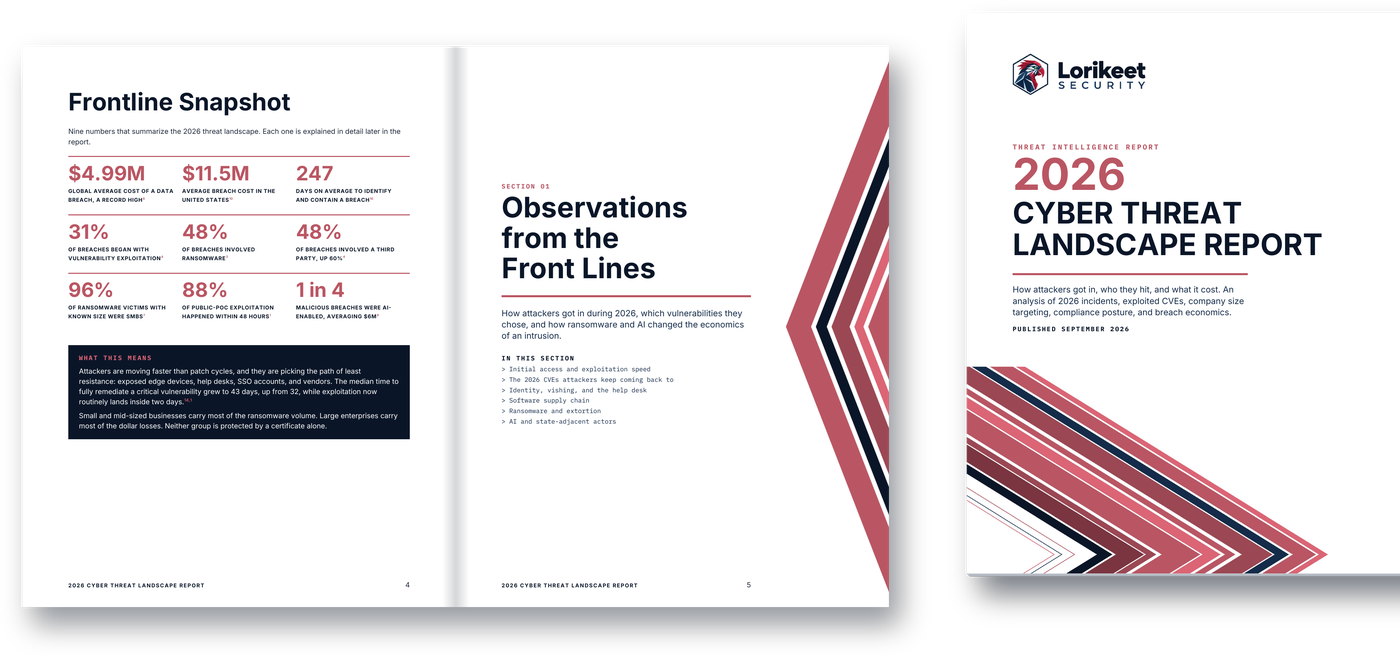
How attackers got in, who they hit, and what it cost.
Built entirely on public, verifiable research from 39 industry sources, regulatory enforcement actions, and real-world case studies.
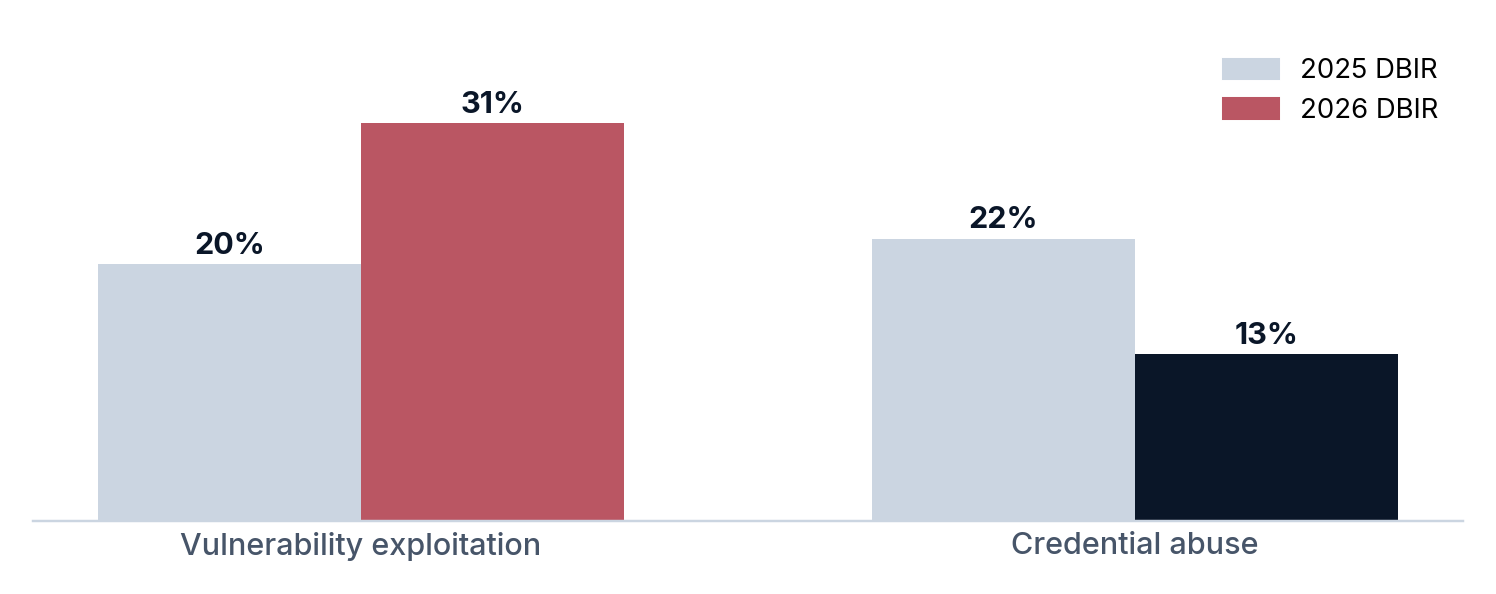
Exploiting known vulnerabilities became the single most frequent path into corporate environments, surpassing stolen credentials and credential stuffing.
Ransomware actors scaled volume attacks on resource-constrained organizations while escalating extortion demands against multi-billion dollar targets.
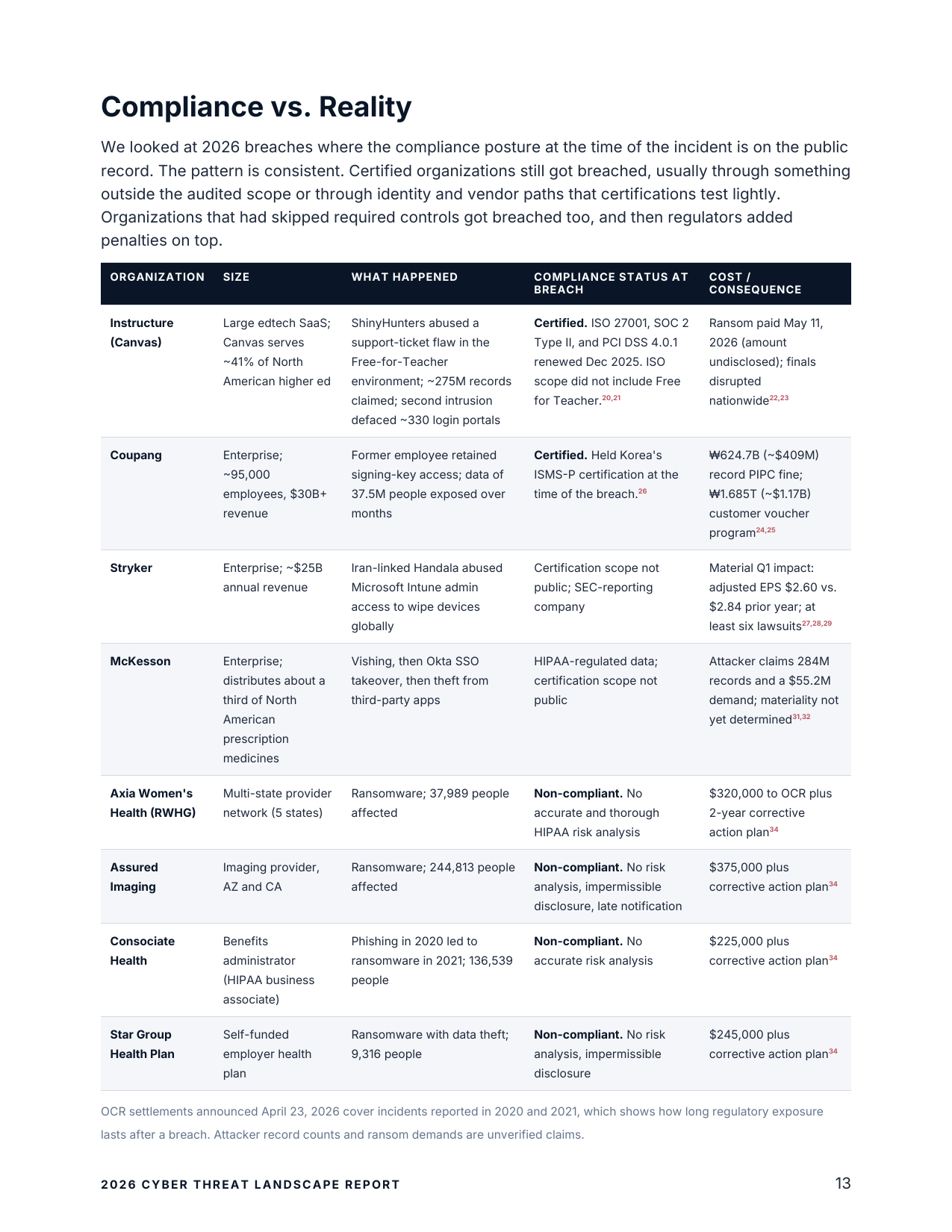
Passing an audit checks boxes for historical controls, but regulatory bodies and adversary intrusions demonstrated that paper certification cannot replace adversarial testing.
Excerpt from Page 13: Analysis of certified entities breached in 2026 and subsequent regulatory penalties.
Adversaries accelerated social engineering scripts and automated reconnaissance, while uncontrolled employee adoption created unmonitored shadow attack vectors.
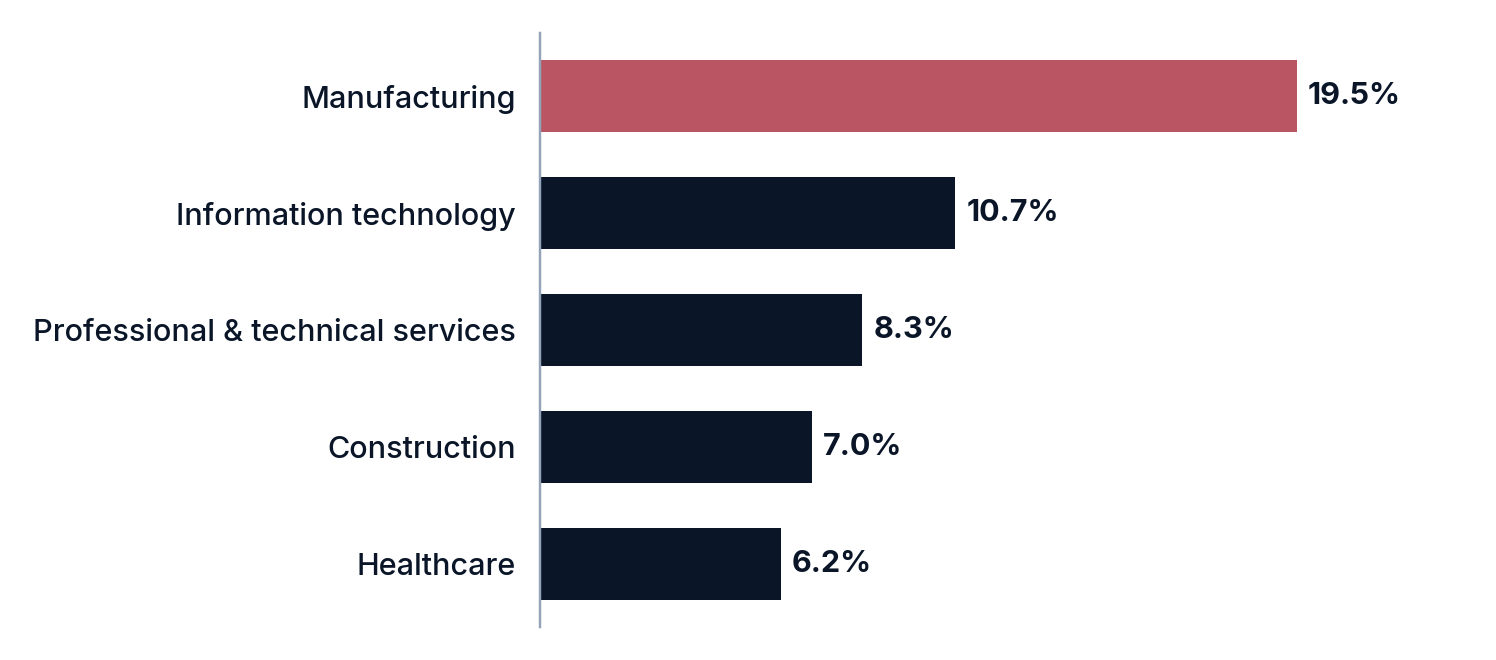
These groups demonstrated the tactics dominating intrusion data: identity-first extortion, weaponized device management, high-volume ransomware, and upstream dependency poisoning.
Download the complete 24-page research report for root-cause analyses, targeted CVE inventories, and seven prioritized engineering recommendations.
Public industry research (Verizon, IBM, CrowdStrike, Sophos, Check Point, NordStellar, VulnCheck, NetDiligence), regulatory filings and enforcement actions (SEC, HHS OCR, Korea PIPC), and news reporting, all cited. It contains no Lorikeet Security client data.
Small and mid-sized businesses. They made up 96% of ransomware victims where size was known in the Verizon 2026 DBIR, while large enterprises accounted for most of the dollar losses.
No. Instructure and Coupang were both certified when they were breached. Certification proves a scoped set of controls was tested. Organizations that skipped required controls were also breached, then fined.
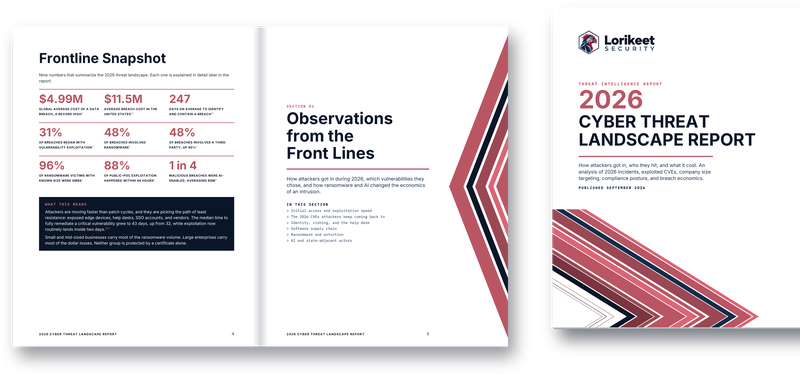
IBM puts the global average at a record $4.99M and the US average at $11.5M.
Lorikeet Security combines continuous penetration testing with agentic AI to find and fix exploitable vulnerabilities before adversaries can weaponize them.
Agentic AI pentesting that autonomously maps attack surfaces, discovers zero-day and logic flaws, and validates exploitable vectors across web apps and APIs 24/7 with zero false positives.
Continuous penetration testing combining human offensive security engineers with automated validation to unblock enterprise sales and guarantee compliance readiness.
Hi, I'm Lory! Need help finding the right service? Click to chat!