Defending Dynamic APIs and Cloud Assets: Why Static Scanners Miss Modern Vulnerabilities
In 2026, enterprise software architecture has decoupled entirely from monolithic servers. Engineering teams deploy microservices twenty times a day, spin up ephemeral serverless containers on AWS Fargate or Google Cloud Run, and stitch distributed architectures together with hundreds of RESTful and GraphQL endpoints.
Yet despite eight-figure cybersecurity budgets, enterprises continue to suffer catastrophic data breaches originating from what security executives thought was their most secure perimeter: authenticated APIs and cloud management layers. In fact, over 78% of modern API security breaches involve zero software syntax flaws or outdated package versions. Instead, they stem from flaws in business logic, authorization mismatches across multi-tenant contexts, and over-privileged cloud IAM identities.
Traditional security scanners—including legacy DAST tools, point-in-time network scanners, and static code analyzers—were architected in an era of predictable, static HTML applications. When pointed at dynamic cloud APIs, they operate essentially blind. This article breaks down why legacy static scanners fail against modern cloud architecture, how autonomous security agents uncover complex business logic vulnerabilities, and how Lory and Talon deliver continuous offensive assurance across shifting microservices.
The Architectural Blind Spots of Legacy Scanners
To understand why production APIs leak data despite "clean" weekly scanner reports, we must examine the technical mechanics of how legacy vulnerability assessment tools operate compared to how modern cloud applications execute.
1. The Loss of Application Context and State
Legacy Dynamic Application Security Testing (DAST) tools were designed around the HTTP request/response model of Web 2.0. They crawl an HTML page, locate <form> tags or URL query parameters, and inject generic fuzzing payloads (e.g., ' OR '1'='1 or <script>alert(1)</script>).
Modern APIs do not expose forms. They communicate through JSON and protobuf payloads, require strict header-based authentication (Bearer JWTs, HMAC request signing, mTLS), and depend on precise execution state. If an endpoint requires:
- Creating a cart with a validated UUID:
POST /api/v2/carts - Adding an inventory item with an active reservation token:
PUT /api/v2/carts/{id}/items - Executing an authorization hold via a payment intent:
POST /api/v2/payments/intent
A static scanner firing isolated fuzzing inputs at step 3 receives an immediate 400 Bad Request or 401 Unauthorized. The scanner logs the endpoint as "tested and secure," completely missing the fact that manipulating the cart currency parameter during step 2 allows arbitrary price modification.
2. Inability to Detect BOLA and BFLA
According to the OWASP API Security Top 10, Broken Object Level Authorization (BOLA) and Broken Function Level Authorization (BFLA) remain the #1 and #2 most exploited API vulnerabilities.
A BOLA vulnerability occurs when User A requests GET /api/v1/workspaces/8841/billing and successfully retrieves the proprietary billing details of Tenant B simply by modifying the integer or GUID identifier. From a syntax and protocol standpoint, the HTTP transaction is completely valid: HTTP 200 OK, valid JSON format, pristine response headers. A static scanner looks at the 200 OK response and sees zero SQL injection syntax, zero XSS reflections, and zero memory leaks. It passes without alert.
Uncovering BOLA requires an offensive tester to possess dual-context awareness: holding authenticated credentials for Tenant A and Tenant B simultaneously, systematically attempting cross-tenant record retrieval, and comparing semantic response structures.
Scanners inspect signatures; BOLA is an absence of access control logic within valid business code. Without an autonomous engine maintaining two separate authorization contexts in parallel, BOLA is completely invisible to automated scanners.
3. The GraphQL Introspection Trap
When enterprises migrate from REST to GraphQL, engineering teams frequently disable introspection queries in production to prevent schema enumeration. Static scanners rely on introspection to discover fields. When introspection yields a 400 error, the scanner halts testing.
In contrast, real adversaries and advanced autonomous testers use heuristic mutation fuzzing, field suggestion mining, and alias batching. By batching 500 mutation calls within a single HTTP POST request, attackers bypass API gateway rate limiters that only count HTTP request counts, brute-forcing 2FA tokens or exfiltrating data with zero gateway alarms triggered.
How Lory Autonomously Maps Modern API Attack Surfaces
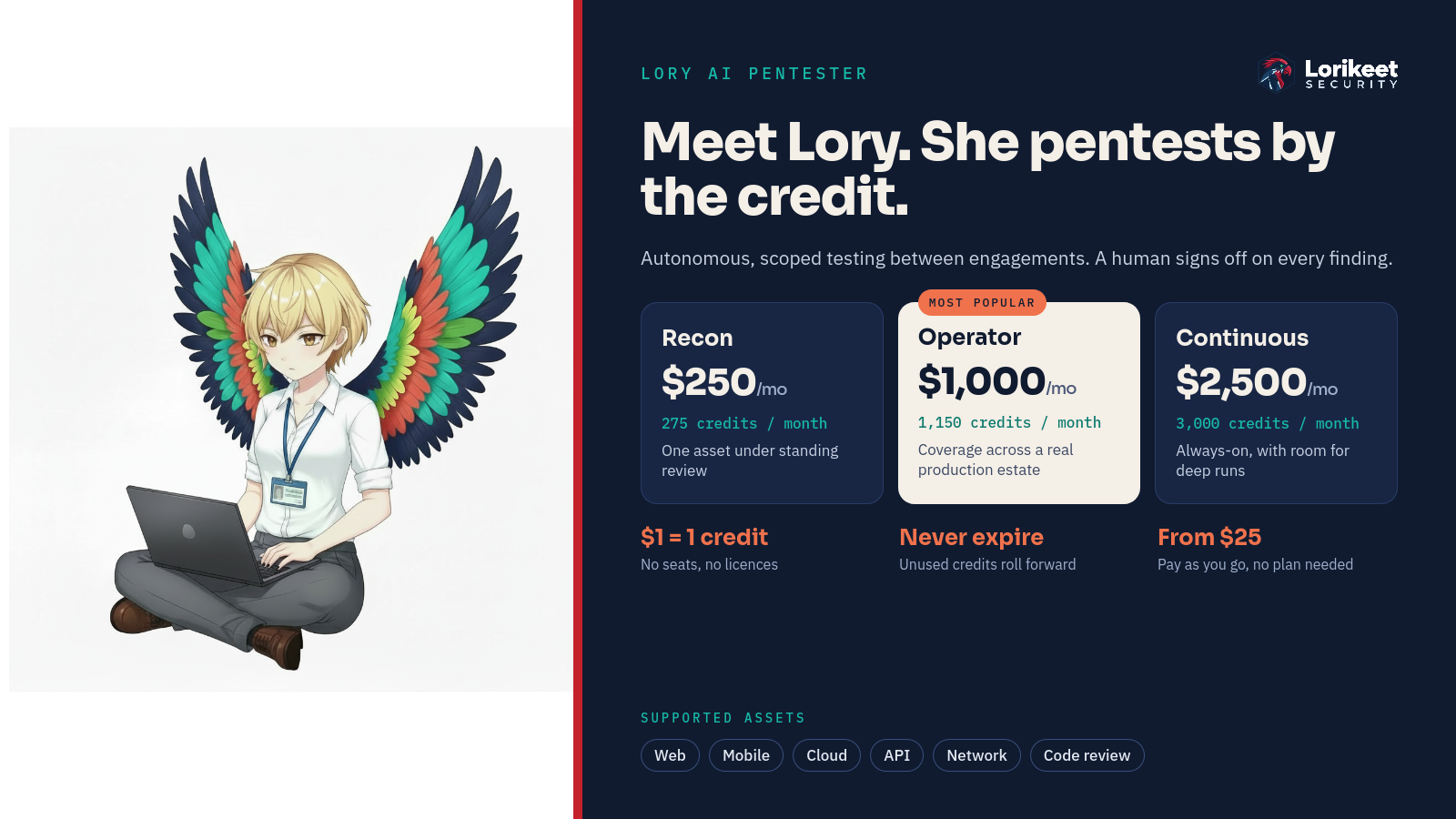
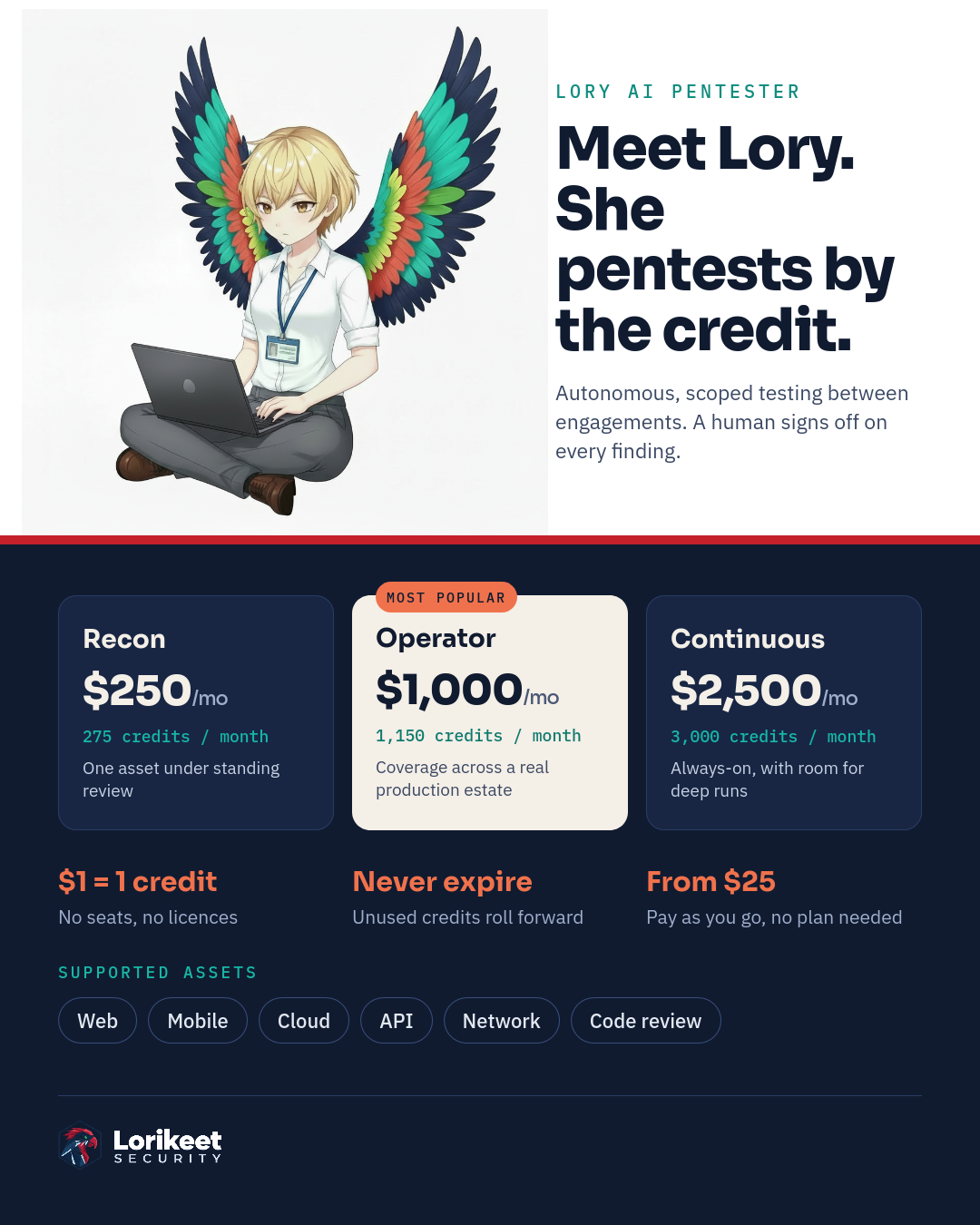
Lorikeet Security's autonomous testing agent, Lory, was engineered specifically to solve the semantic and stateful gaps that render scanners useless. Integrated into the Talon PTaaS platform, Lory approaches an API not as a collection of static URLs, but as an interactive state machine.
Autonomous Surface Reconstruction Beyond OpenAPI Specs
Most AppSec teams rely on developers to supply Swagger or OpenAPI 3.0 documentation. In practice, Swagger definitions are notoriously incomplete: internal debugging routes, deprecated v1 endpoints, and staging webhooks are routinely omitted.
Lory utilizes headless Chromium crawlers and dynamic traffic inspection to reconstruct the true attack surface:
- Client-Side Bundle Analysis: Lory deminifies single-page application (SPA) JavaScript bundles, extracting hidden route definitions, environment variables, and unpublished API paths.
- Traffic Flow Inference: Lory observes active API transactions, deducing parameter dependencies, mandatory UUID formats, and prerequisite HTTP headers.
- Zombie & Shadow API Discovery: By testing version permutation algorithms (e.g., testing
/api/v1/endpoints against schemas discovered in/api/v3/), Lory automatically locates unmaintained legacy backends that remain connected to production databases.
Validating Cloud IAM Boundaries and Metadata Traversal
In a cloud-native environment, an API vulnerability is rarely the final goal of an adversary; it is the entry point. Once an attacker achieves Server-Side Request Forgery (SSRF) or remote command execution on an API container, the true battleground shifts to Cloud IAM boundaries.
Static scanners report an SSRF vulnerability as a localized flaw. Lory and the Talon platform, however, assess the vulnerability in the context of the underlying cloud environment:
1. IMDSv2 and Container Credential Validation
Lory tests whether cloud metadata services (such as AWS Instance Metadata Service IMDSv1 vs IMDSv2 or GCP metadata endpoints) can be queried. If an SSRF vector cannot retrieve metadata headers due to IMDSv2 token protection, Lory dynamically pivots to inspect local container environment variables, task roles (ECS / EKS IAM Roles for Service Accounts - IRSA), and mounted secret volumes.
2. IAM Role Privilege Escalation Chains
Once an offensive agent identifies a cloud identity, the critical question is: What can this identity actually do? Lory evaluates cloud permissions to determine if the compromised container role can:
- Assume broader cross-account IAM roles (
sts:AssumeRole). - Access non-public S3 buckets containing database snapshots or encryption keys.
- Query internal cloud management endpoints (AWS KMS, DynamoDB, Secrets Manager) across VPC peering connections.
Comprehensive Comparison: Static Scanners vs. Talon Continuous PTaaS
Security teams are under intense pressure from CFOs and audit committees to consolidate redundant tooling while expanding risk coverage. The table below illustrates the operational differences between traditional scanning approaches and continuous autonomous testing on Talon:
| Capability & Dimension | Legacy DAST / Static Scanners | Traditional Annual Pentest | Talon + Lory Autonomous PTaaS |
|---|---|---|---|
| Testing Frequency | Scheduled weekly/monthly | Once every 365 days | Continuous 24/7 on code push |
| Business Logic & BOLA | 0% (Blind to auth state) | Manual spot check | Autonomous dual-context testing |
| GraphQL Batching & Logic | Fails on disabled introspection | Limited by tester hours | Deep mutation & alias fuzzing |
| Cloud IAM Boundary Validation | None (Web perimeter only) | Often scoped out of web test | End-to-end IAM escape validation |
| False Positive Verification | Extremely high (no verification) | Human verified | Zero false positives (Exploit-proven) |
| Retest Verification | Manual rescan with noise | Weeks delay + $2,500 retest fee | Instant 1-click retest included |
| Auditor-Ready Attestation | Unaccepted by auditors | Static PDF report (weeks late) | Certified attestation letter |
Pros and Cons: Static Scanners vs. Autonomous Continuous Pentesting
Continuous Autonomous Testing (Lory)
- True Business Logic Coverage: Validates multi-step workflows, shopping cart manipulation, and data segregation.
- Dual-Context BOLA Testing: Proves whether Tenant A can read or overwrite Tenant B's data with zero guesswork.
- Exploit-Backed Evidence: Every finding includes an exact curl command and request/response proof.
- Zero Friction Remediation: Findings stream instantly into Jira, GitHub, or Linear as code is deployed.
Legacy Static Scanners
- Massive Alert Fatigue: Security engineers waste 40% of their week triaging benign syntax warnings.
- Completely Blind to Cloud IAM: Cannot tell if an SSRF leads to harmless data or full root AWS takeover.
- Stops at Login Pages: Inability to manage modern OAuth2 PKCE or session rotations leaves 90% of code uninspected.
- No Auditor Credibility: SOC 2, ISO 27001, and enterprise vendor risk teams do not accept scanner dumps.
Enterprise Decision Checklist: Evaluating API & Cloud Security Solutions
When evaluating modern penetration testing solutions for dynamic microservices and cloud architectures, CISOs and AppSec leads should use the following ten-point verification checklist:
Modern API & Cloud Pentesting Checklist
The Bottom Line: Real Security Is Continuous and Contextual
Relying on static scanners to protect dynamic microservices is like locking your front door while leaving your garage wide open and your blueprints on the lawn. In a world where cloud infrastructure changes with every git push, offensive testing must be just as agile, autonomous, and context-aware as your engineering team.
By deploying Lory inside the Talon PTaaS platform, high-velocity technology companies replace static reports and blind scanners with an active offensive security partner. Discover vulnerabilities before adversaries do, eliminate false positives, and arm your developers with immediate, actionable remediation.
Secure Your APIs and Cloud Surface Continuously
Experience the difference between static scanning and autonomous offensive testing. Calculate your custom PTaaS plan in 60 seconds or book a live technical walkthrough of Talon.