Before an advanced persistent threat (APT) or financially motivated ransomware group sends a single malicious HTTP payload or fires a single exploit, they spend days—often weeks—conducting silent, passive reconnaissance. In the modern cloud era, organizations do not get breached through heavily hardened primary firewalls; they get breached through forgotten staging subdomains, abandoned developer APIs, exposed cloud object storage, and misconfigured SaaS integrations.
Understanding how adversaries construct their reconnaissance dossiers is the single most effective way to design an offensive defense. In this guide, we break down the exact tradecraft threat actors use to map your external attack surface, how they correlate intelligence across multiple data streams, and how continuous automated reconnaissance powered by Talon PTaaS and Lory AI allows security teams to neutralize exposures before attackers can exploit them.
The 5 Reconnaissance Vectors Threat Actors Weaponize
1. Real-Time Certificate Transparency (CT) Stream Ingestion
Whenever an engineer spins up a new host—such as internal-tools.company.com or staging-auth-v2.company.com—and issues an SSL/TLS certificate via Let's Encrypt or AWS Certificate Manager, that certificate is appended to public Certificate Transparency logs by law. Threat actors maintain streaming consumers (such as Certstream) that alert them within seconds of certificate issuance. Even if a host has no inbound links, attackers know its domain name immediately.
2. Passive DNS Mining and Autonomous Resolution
Active DNS brute-forcing can trigger threshold-based intrusion detection alerts. Instead, sophisticated actors query passive DNS aggregators (SecurityTrails, Farsight, VirusTotal) to uncover historical A, CNAME, and TXT records. This surfaces forgotten infrastructure that may still be routing traffic to obsolete cloud servers or orphaned Elastic IPs.
3. Cloud Asset and S3 Bucket Permutation
Attackers build targeted wordlists combining your brand name, subsidiary names, employee handles, and common development tokens (e.g., [company]-backup, [company]-prod-db, [company]-assets-cdn). Automated scanners systematically probe AWS S3, Google Cloud Storage, and Azure Blob endpoints for public read access or unauthenticated listing permissions.
4. Shadow APIs and Zombie Microservice Endpoints
As engineering organizations adopt microservice architectures, API endpoints evolve rapidly. Often, legacy API versions (e.g., /api/v1/users) remain active after /api/v2/ launches because mobile clients or legacy integrations require backward compatibility. These unmonitored "zombie" endpoints frequently lack modern security controls, rate limiting, and multi-factor authentication checks.
5. Breach Credential Correlation and Dark Web Ingestion
Reconnaissance is not purely architectural; it is identity-focused. Threat actors ingest freshly circulated dark web combo lists and infostealer malware logs to identify corporate email addresses associated with leaked plaintext credentials, testing them against single sign-on (SSO) portals and customer-facing interfaces.
| Adversary Recon Tactic | Attacker Objective | Defensive Countermeasure (Talon / Lory) |
|---|---|---|
| Certificate Transparency Ingestion | Detect newly stood-up staging/dev hosts instantly | Standing CT log monitoring & zero-token perimeter discovery |
| Historical Passive DNS Analysis | Find dangling CNAMEs vulnerable to subdomain takeover | Automated DNS hygiene checks & dangling alias alerting |
| Cloud Storage Bucket Permutation | Extract sensitive backups, source code, and customer PII | Deterministic S3/GCS bucket enumeration & IAM audit |
| Shadow API Endpoint Scraping | Bypass modern authentication by finding unmaintained v1 routes | Headless Chromium crawler & OpenAPI/GraphQL reconstruction |
| Infostealer Log Matching | Execute credential stuffing against administrative portals | Continuous authentication surface monitoring & MFA validation |
Offensive Defense: How Lory Recon Flips the Advantage
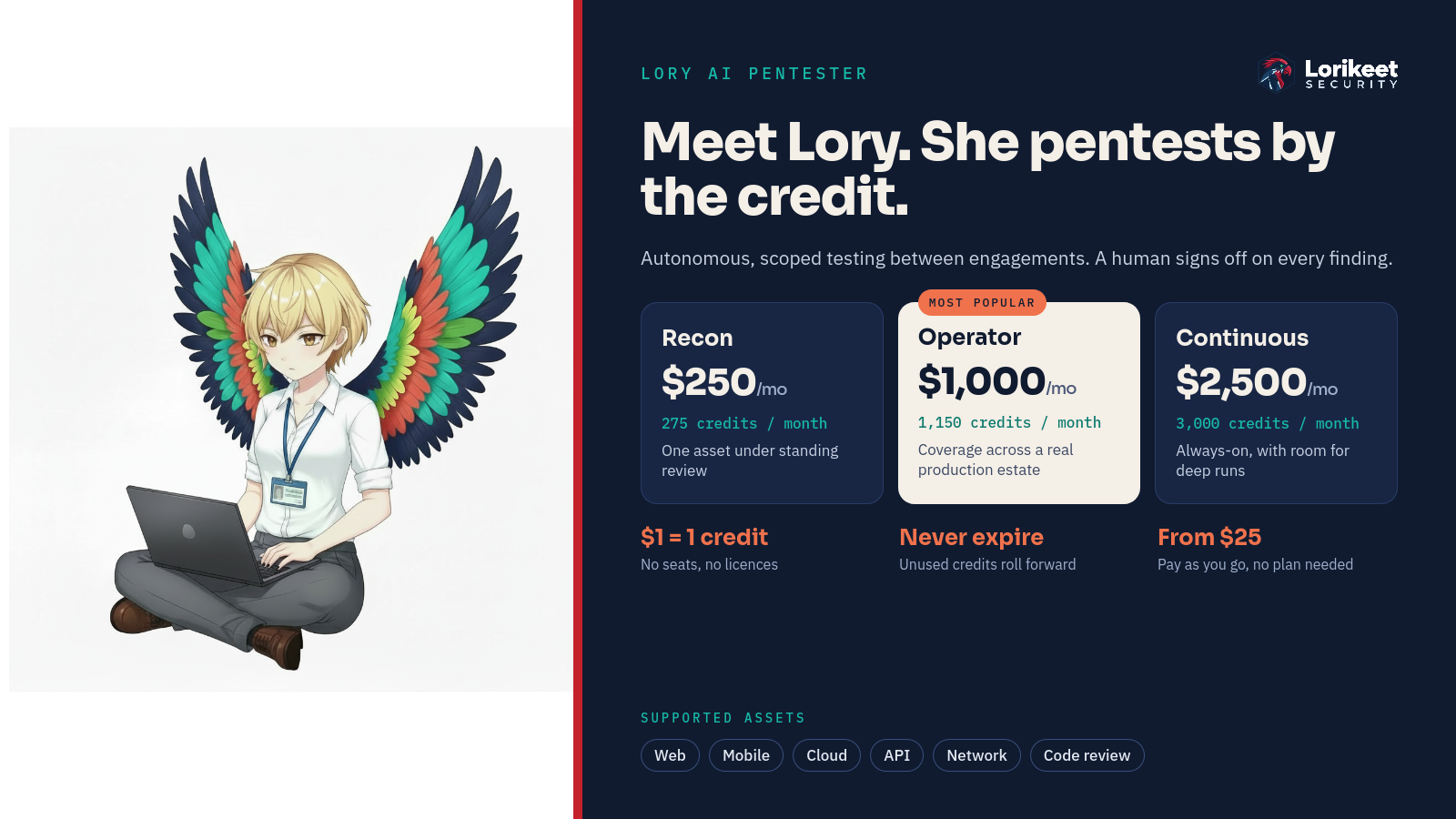
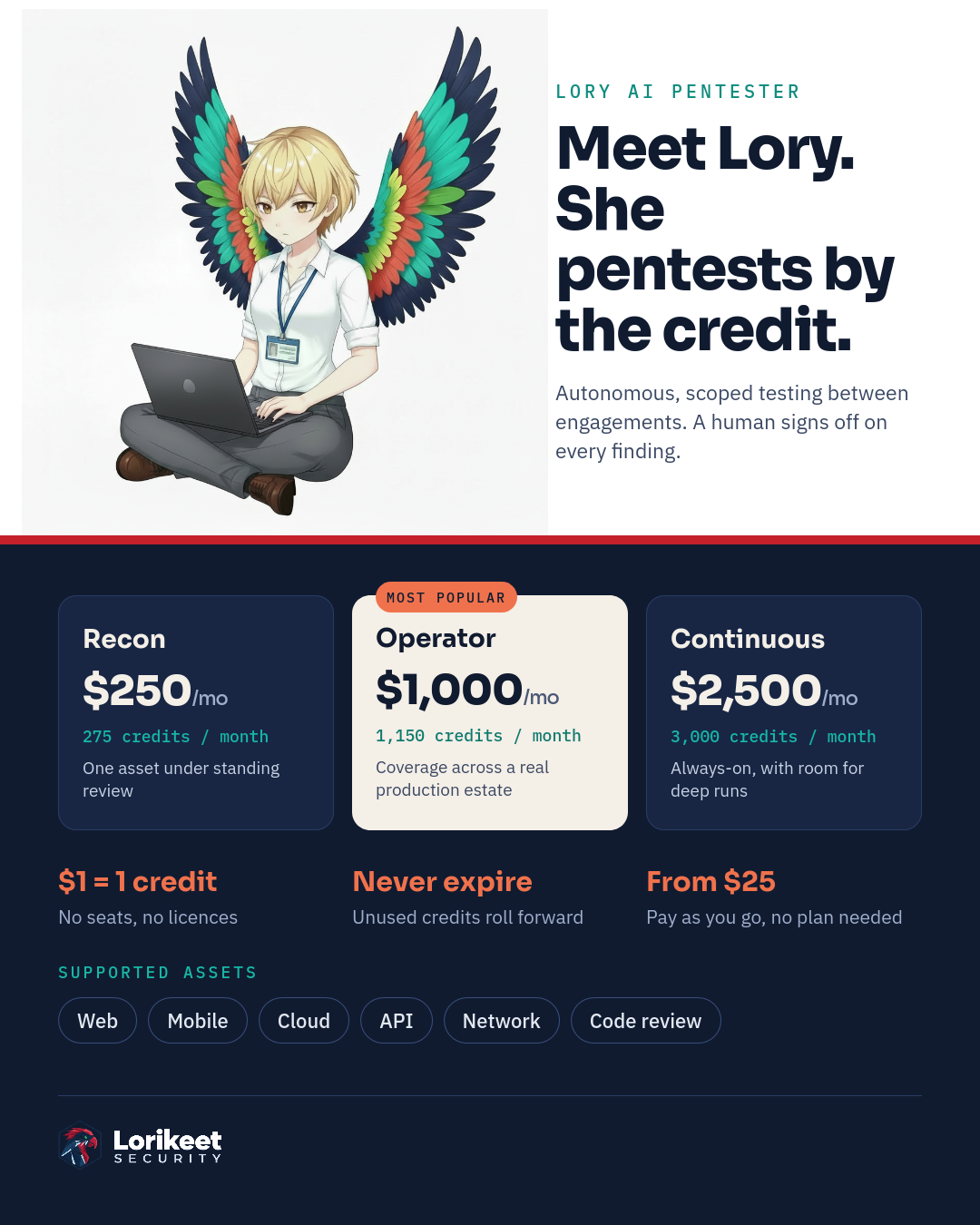
Rather than waiting for threat actors to discover your exposed assets, modern security leaders deploy automated offensive reconnaissance. Inside the Talon PTaaS platform, the Lory AI Reconnaissance Engine runs continuously across your declared surface:
- Deterministic Zero-Token Reconnaissance: Lory performs Layer 3 mapping—including DNS graph expansion, TLS analysis, and headless single-page application (SPA) crawling—without wasting LLM prompt tokens on raw network data.
- The Recon Digest: Telemetry is synthesized into a high-density, structured digest that feeds Lory's reasoning engine. Lory identifies exploitable architectural anomalies—such as an internal GraphQL schema accessible without authorization—and alerts engineers instantly.
- Human-in-the-Loop Validation: Before an alert is pushed to your dashboard, Lorikeet OSCP/CISSP engineers confirm reproduction steps to guarantee zero false-positive fatigue for your team.
The Attacker's Asymmetry: Threat actors only need to find one forgotten endpoint to achieve initial access. By turning reconnaissance into a continuous, automated defensive process, you eliminate the blind spots that attackers rely on.
Know Your Attack Surface Before Adversaries Do
Get continuous attack surface monitoring and autonomous penetration testing starting at $165/month with Talon PTaaS.