OWASP Top 10 Web Application Pentest Checklist: What Auditors & Adversaries Look For
Every major cybersecurity compliance framework—from SOC 2 Type II and ISO 27001:2022 to PCI DSS 4.0, HIPAA, and FedRAMP—mandates regular penetration testing against the application layer. Without exception, compliance auditors use the OWASP Top 10 as the universal benchmark to verify that an organization's systems have been subjected to rigorous offensive scrutiny.
However, there is a fundamental philosophical divide between how a compliance auditor inspects an application and how a hostile adversary exploits it:
- The Auditor's Lens: "Do you possess an independent, third-party penetration test conducted within the last 12 months? Did the methodology systematically test against all OWASP Top 10 vulnerability categories? Have critical findings been resolved within policy SLAs?"
- The Adversary's Lens: "Which tiny configuration gap or overlooked authorization check allows me to pivot from an unauthenticated visitor to full administrative control of your underlying cloud infrastructure?"
To achieve true security that satisfies rigorous audits while repelling actual criminal threat actors, engineering organizations must conduct penetration testing that satisfies both perspectives simultaneously.
Below is the comprehensive, category-by-category offensive testing checklist and auditor expectation guide for the OWASP Top 10.
The Auditor's Trap: Running an automated Nessus or Qualys vulnerability scan does not fulfill your SOC 2 or PCI DSS penetration testing requirement. AICPA and PCI SSC guidelines explicitly state that penetration testing requires manual, contextual exploitation to uncover authorization flaws and business logic bypasses.
Master Checklist: OWASP Top 10 Testing Matrix
| Category | Offensive Exploitation Focus | Auditor Expectation (SOC 2 / PCI DSS 4.0) | Remediation Priority |
|---|---|---|---|
| A01: Broken Access Control | BOLA, IDOR, vertical/horizontal privilege escalation, CORS bypass, missing function authorization. | Mandatory multi-role tenant testing; proof that tenant data isolation is enforced at data access layers. | Critical (P0) |
| A02: Cryptographic Failures | Cleartext transmission of tokens/PII, weak cipher suites, hardcoded secrets, flawed JWT signing. | TLS 1.2+ minimum, HSTS enabled, AES-256/GCM for data at rest, KMS envelope encryption evidence. | High (P1) |
| A03: Injection | SQLi, NoSQL injection, OS command injection, DOM/Stored XSS, GraphQL injection. | Zero unparameterized queries; parameterized ORM enforcement, CSP policy headers, output encoding. | Critical (P0) |
| A04: Insecure Design | Flawed password reset logic, lack of business rate limits, transaction manipulation, race conditions. | Documented threat models, secure architecture reviews, defense-in-depth design patterns. | Medium-High |
| A05: Security Misconfiguration | Default credentials, exposed debug consoles, open S3 buckets, missing security headers, verbose error traces. | CIS benchmark baselines, hardened cloud configurations, sanitized error pages in production. | Medium (P2) |
| A06: Vulnerable Components | Exploitable CVEs in npm, PyPI, Go packages, container base image flaws, unpatched frameworks. | Active SCA (Software Composition Analysis), automated dependency patching, complete SBOM availability. | Medium-High |
| A07: Identification & Auth | Credential stuffing, session fixation, MFA bypasses, weak lockout mechanisms, predictable tokens. | Enforced MFA across all administrative users, secure session destruction on logout, brute-force mitigation. | High (P1) |
| A08: Software & Data Integrity | Insecure deserialization, untrusted CDN scripts without SRI, unverified CI/CD deployment artifacts. | Signed deployment pipelines, Subresource Integrity (SRI) hashes on external assets, safe object serialization. | Medium (P2) |
| A09: Logging & Monitoring | Missing audit trails on privilege changes, untracked failed logins, logs susceptible to tampering. | Immutable centralized log storage (WORM), real-time SIEM alerting on brute-force, no cleartext PII in logs. | Medium (P2) |
| A10: Server-Side Request Forgery | Cloud IMDS credential extraction (AWS/GCP), internal network port scanning, webhook abuse. | Strict egress firewall rules, IMDSv2 enforcement, URL validation with DNS pinning against internal subnets. | Critical (P0) |
Comprehensive Category Breakdown & Testing Methodology
A01: Broken Access Control (BAC)
Rank #1 SeverityBroken Access Control remains the single most prevalent vulnerability in modern web applications. Because access controls are deeply intertwined with unique business requirements, automated scanners cannot detect whether User A should be allowed to view User B's tax documents.
How Testers Exploit It:
- Insecure Direct Object References (IDOR/BOLA): Replacing sequential integers or predictable UUIDs in API paths (e.g., `GET /api/v1/invoices/99281` → `GET /api/v1/invoices/99282`).
- Vertical Privilege Escalation: Modifying client-side roles or navigating directly to administrative endpoints (`/admin/dashboard`, `/api/v1/system/users`) with standard credentials.
- CORS Misconfiguration: Exploiting overly permissive `Access-Control-Allow-Origin: *` with `Access-Control-Allow-Credentials: true` to hijack authenticated session data via malicious third-party origins.
Auditor Expectation:
Auditors look for automated access control middleware in the codebase, tenant segregation verification at the database query level, and testing documentation showing cross-tenant user role permutation testing.
A02: Cryptographic Failures
High Compliance ScrutinyFormerly known as "Sensitive Data Exposure," this category focuses on failures related to cryptography which frequently lead to exposure of sensitive personal information (PII), credentials, or payment cards.
How Testers Exploit It:
- In-Transit Interception: Inspecting TLS cipher suites for weak algorithms (e.g., CBC mode, RC4, 3DES) or verifying absence of HTTP Strict Transport Security (`HSTS`).
- Weak Password Hashing: Extracting database backups and cracking passwords hashed using outdated algorithms like MD5 or unsalted SHA-1.
- Hardcoded API Keys: Decompiling client-side JavaScript bundles or mobile application binaries to locate embedded AWS, SendGrid, or Stripe production keys.
Auditor Expectation:
PCI DSS 4.0 Requirement 3 and SOC 2 CC6.1 mandate that all sensitive data in transit must use TLS 1.2 or TLS 1.3, while sensitive data at rest must use industry-standard encryption (AES-256-GCM) with centralized key management (AWS KMS, HashiCorp Vault).
A03: Injection
Catastrophic ImpactInjection flaws occur when untrusted user input is directly concatenated into an interpreter (SQL query, OS shell, NoSQL filter, LDAP query) without context-aware sanitization or parameterization.
How Testers Exploit It:
- Blind & Error-Based SQLi: Injecting syntax delimiters (`' OR 1=1--`, time-delay sleep calls) into search parameters or HTTP headers.
- Stored & DOM Cross-Site Scripting (XSS): Bypassing HTML filters to inject malicious JavaScript into user profiles or comment fields, stealing session tokens.
- Server-Side Template Injection (SSTI): Injecting template syntax (`{{7*7}}`, `${T(java.lang.Runtime).getRuntime().exec('id')}`) into rendering engines like Jinja2, Thymeleaf, or Freemarker to achieve Remote Code Execution (RCE).
Auditor Expectation:
Evidence that developers utilize parameterized queries or ORM frameworks, enforce Content Security Policy (`CSP`) headers, and execute regular static and dynamic testing against all user input channels.
A04: Insecure Design
Architecture & LogicInsecure Design represents fundamental architectural flaws that cannot be fixed by a simple code patch. It requires baking security controls directly into the threat modeling and design phase of development.
How Testers Exploit It:
- Business Logic Exploitation: Manipulating discount code redemption limits, altering item quantities to negative numbers in checkout workflows, or executing concurrency race conditions.
- Unrestricted File Uploads: Uploading executable scripts (PHP, JSP) or polyglot files disguised as profile pictures to trigger server execution.
- Lack of Account Takeover Protections: Reset workflows that leak verification codes via client-side telemetry or allow unlimited recovery attempts.
Auditor Expectation:
Auditors evaluating SOC 2 Common Criteria 3.2 expect documented threat modeling workshops for major product features and formal architectural design review procedures.
A05: Security Misconfiguration
Cloud & PlatformMisconfigurations are the most frequently exploited entry points for automated threat actor bots. These flaws stem from failing to harden application frameworks, cloud environments, and web servers.
How Testers Exploit It:
- Verbose Stack Traces: Triggering 500 Internal Server Errors to expose backend database structures, framework versions, and file system paths.
- Unprotected Administrative Consoles: Locating exposed Spring Boot Actuator endpoints (`/actuator/env`), Swagger UI instances, or phpMyAdmin interfaces.
- Missing Security Headers: Checking for the absence of `X-Frame-Options`, `X-Content-Type-Options: nosniff`, and restrictive `Permissions-Policy`.
Auditor Expectation:
Verification of automated infrastructure-as-code (IaC) linting, CIS hardening benchmarks on server images, and zero default passwords across all staging and production assets.
A06: Vulnerable and Outdated Components
Supply ChainModern applications are composed of up to 80% open-source third-party dependencies. If an underlying library contains a known CVE, the parent application is vulnerable.
How Testers Exploit It:
- Known CVE Exploits: Fingerprinting outdated versions of Log4j, Apache Commons, OpenSSL, or jQuery to execute public exploit scripts.
- Transitive Dependency Blind Spots: Identifying vulnerabilities buried three or four layers deep in Node.js `package-lock.json` or Python `poetry.lock`.
Auditor Expectation:
SOC 2 CC6.8 and ISO 27001:2022 Control 8.19 require organizations to maintain an active vulnerability management program, generate a Software Bill of Materials (SBOM), and remediate critical CVEs within 14 to 30 days.
A07: Identification and Authentication Failures
Identity PerimeterConfirming user identity, authentication, and session state is critical to defending against account takeover (ATO) attacks.
How Testers Exploit It:
- Credential Stuffing & Password Spraying: Testing lists of compromised breach credentials without triggering account lockout or CAPTCHA challenges.
- Session Fixation & Token Reuse: Verifying whether session cookies or Bearer tokens remain valid after a user changes their password or clicks "Log Out."
- Weak Multi-Factor Authentication (MFA): Bypassing MFA through parameter manipulation, response manipulation (`{"mfa_verified": true}`), or missing enforcement on API endpoints.
Auditor Expectation:
Mandatory multi-factor authentication (MFA) across all administrative and user sessions, secure password complexity rules (NIST SP 800-63B guidelines), and session timeout thresholds (typically 15-30 minutes for sensitive applications).
A08: Software and Data Integrity Failures
Pipeline & ObjectsThis category focuses on code and infrastructure that does not protect against integrity violations, including insecure deserialization and unvalidated CI/CD pipelines.
How Testers Exploit It:
- Insecure Deserialization: Crafting serialized Java, Python pickle, or PHP objects that instantiate dangerous classes during deserialization to execute arbitrary code.
- Untrusted CDN Script Loading: Injecting malicious scripts via third-party analytics tags that lack Subresource Integrity (`integrity="sha384-..."`).
Auditor Expectation:
Verification that deployment pipelines require signed commits, peer reviews, automated branch protection rules, and safe serialization formats (such as standard JSON instead of native binary object formats).
A09: Security Logging and Monitoring Failures
Detection & ForensicsWithout adequate logging and continuous monitoring, breaches cannot be detected. The average time to identify a breach in 2026 remains over 200 days when logging controls fail.
How Testers Exploit It:
- Silent Infiltration: Executing aggressive brute-force attacks, directory enumerations, and BOLA queries without triggering alerts in the customer's SIEM or SOC.
- Log Injection: Injecting CRLF characters or malicious payloads into usernames to corrupt audit log formats or trigger blind code execution in log forwarders.
Auditor Expectation:
SOC 2 CC7.2 and PCI DSS Requirement 10 mandate that all privileged actions, authentication failures, and data access requests be recorded in immutable, timestamped logs with 1-year retention.
A10: Server-Side Request Forgery (SSRF)
Cloud Pivot RiskSSRF flaws occur when a web application fetches a remote resource without validating the user-supplied destination URL. In modern cloud environments, SSRF is the primary vector for extracting cloud instance metadata and IAM tokens.
How Testers Exploit It:
- Metadata Extraction: Supplying internal metadata addresses (`http://169.254.169.254/latest/meta-data/`) to extract AWS temporary session credentials.
- Internal Service Scanning: Forcing the server to issue HTTP requests to internal VPC IPs (`http://10.0.1.4:8080/admin`), bypassing external firewall perimeters.
- DNS Rebinding Bypasses: Registering domains that resolve to an external IP during the application's check, then switch to `127.0.0.1` upon execution.
Auditor Expectation:
Evidence of AWS IMDSv2 enforcement (requiring PUT tokens with hop limit 1), egress proxy filtering, and network-level firewalls blocking outgoing traffic to internal private CIDR blocks.
Meeting Auditor Expectations with Talon PTaaS
The traditional approach to meeting OWASP Top 10 compliance requirements—hiring an expensive consulting firm for a two-week annual test—is fundamentally broken:
- The 364-Day Vulnerability Window: If you pass an annual audit on January 1st and deploy a new microservice containing a critical BOLA flaw on January 15th, your company remains exposed to threat actors and compliance failure for 350 days.
- The Remediation Scramble: Annual reports deliver a 100-page PDF full of complex findings right as your audit window is closing, forcing engineering teams into panic mode.
- Retest Extortion: Traditional consultancies charge thousands of dollars just to verify whether your engineering team properly applied a two-line patch.
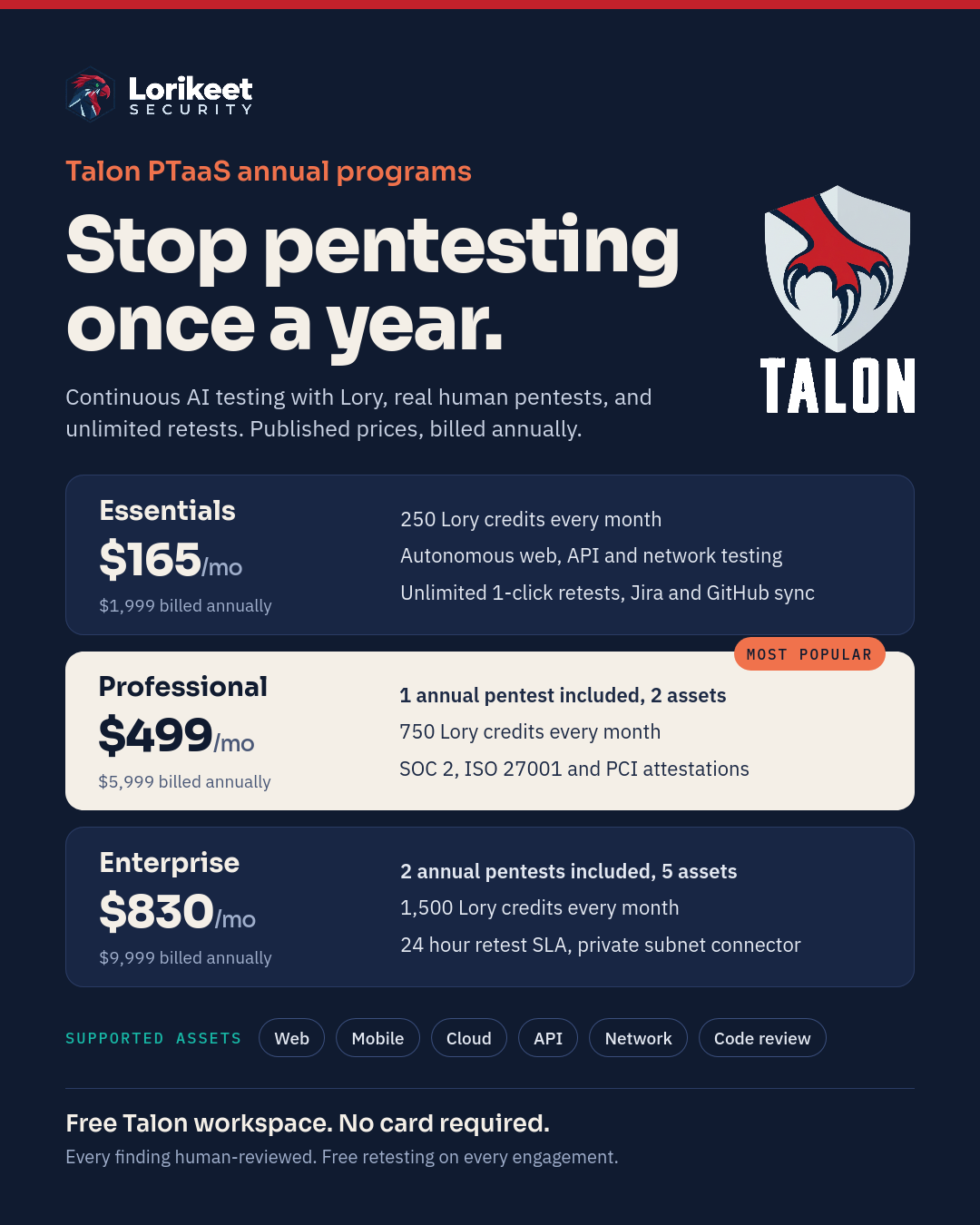
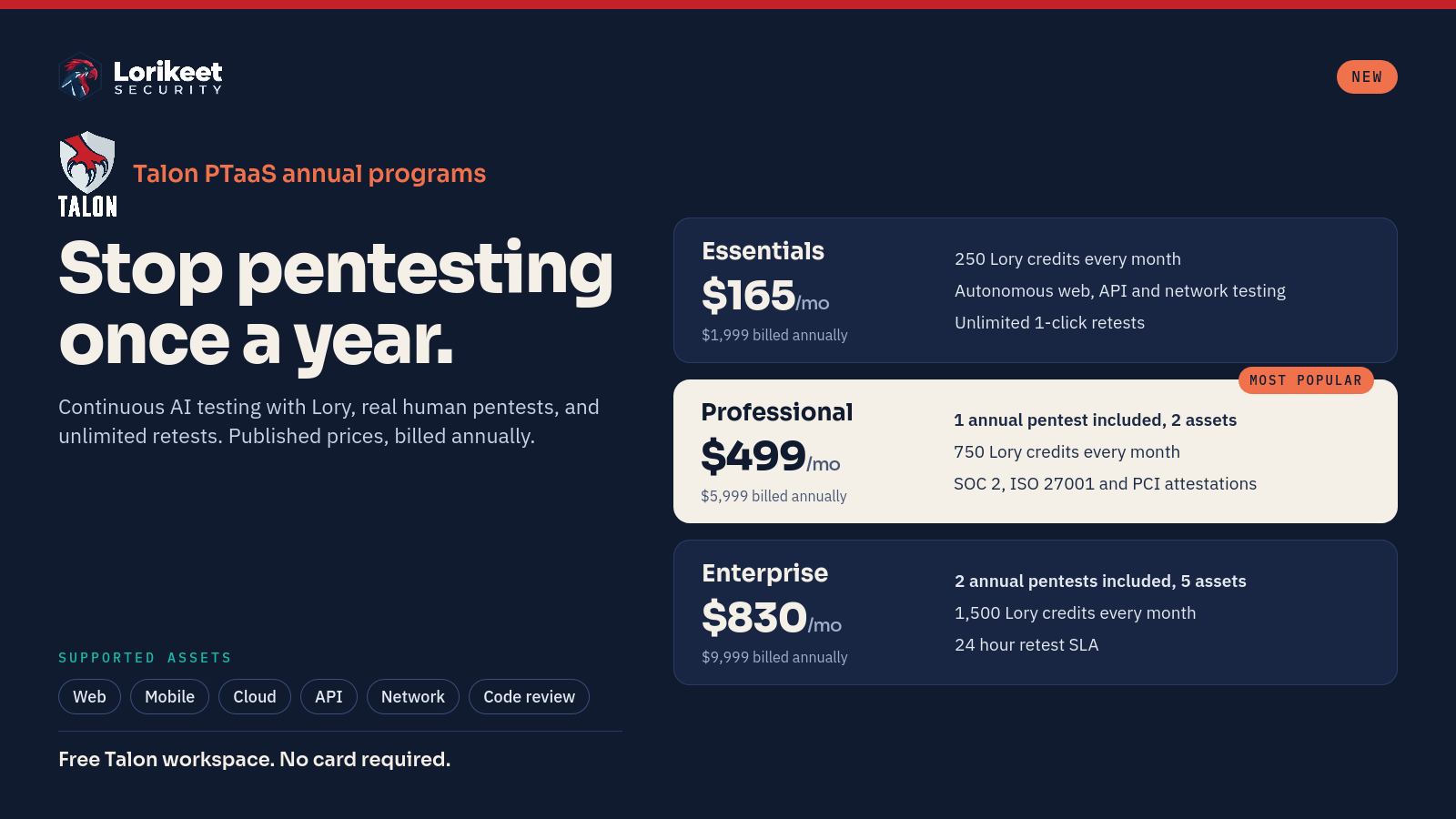
Talon PTaaS (Penetration Testing as a Service) solves this by replacing annual point-in-time snapshots with continuous, subscription-based offensive security:
| Feature | Traditional Pentest Consultancy | Talon Professional ($499/mo) | Talon Enterprise ($830/mo) |
|---|---|---|---|
| Annual Human Pentests | 1x Point-in-time assessment ($15,000+) | 1x Full Comprehensive Pentest (up to 2 assets) | 2x Full Comprehensive Pentests (up to 5 assets) |
| Continuous AI Testing | None (zero coverage between tests) | 750 Lory AI Credits / mo | 1,500 Lory AI Credits / mo |
| Retest Verification | $2,000 – $5,000 fee per retest | Unlimited 1-Click Retests | Unlimited 1-Click Retests (24h SLA) |
| Auditor Attestations | Delayed static PDF (weeks to deliver) | Instant Attestation Letter (SOC 2, ISO, PCI) | Multi-Framework Attestation Letter |
| Private Subnet Testing | Expensive on-site or VPN setup | Public perimeter & staging APIs | Lory Mesh Private Subnet Connector |
Frequently Asked Questions
What is the difference between how adversaries and compliance auditors evaluate the OWASP Top 10?
Adversaries look for chained vulnerabilities that yield administrative control or data exfiltration. Compliance auditors look for evidence that testing was executed by qualified external testers, that all OWASP categories were assessed, and that identified vulnerabilities were remediated and verified under documented SLAs.
Why does Broken Access Control remain the #1 vulnerability on the OWASP Top 10?
Broken Access Control is governed by application-specific business logic rather than universal syntax rules. Automated tools cannot intuit whether a specific user should have access to another user's invoice or document ID, making contextual human and intelligent AI testing essential.
How does PCI DSS 4.0 change penetration testing requirements regarding the OWASP Top 10?
PCI DSS 4.0 Requirement 11.4 strictly mandates that penetration testing must address all OWASP Top 10 risks across the cardholder data environment (CDE). Requirement 11.4.4 mandates that all identified vulnerabilities must be formally retested and verified by independent testers.
How does Talon PTaaS automate OWASP Top 10 verification?
Talon PTaaS pairs continuous Lory AI testing across your CI/CD pipelines with CREST-certified human offensive engineers. Findings populate real-time dashboards with Jira sync, and once patched, engineers trigger free 1-click retests to update auditor attestation letters automatically.
Can an automated vulnerability scanner satisfy an OWASP Top 10 pentest requirement?
No. Major compliance standards explicitly distinguish between automated scanning and penetration testing. An automated scan flags known missing patches, whereas penetration testing actively validates business logic, attempts multi-role privilege escalation, and delivers human-signed attestations.
Eliminate Pre-Audit Panic with Continuous PTaaS
Pass your SOC 2 Type II, ISO 27001, and PCI DSS 4.0 audits with zero stress. Get transparent monthly pricing, continuous OWASP Top 10 testing, and instant auditor attestations.