
Threat Intelligence-Led Penetration Testing (TLPT): Applying Real Adversary TTPs to Your Surface
In the modern threat landscape, the fundamental paradigm of cybersecurity testing has shifted. For two decades, organizations relied on compliance-oriented penetration tests: a scoped checklist of standard vulnerability checks, executed once every twelve months against an isolated staging environment to produce a clean PDF for an auditor.
Meanwhile, sophisticated threat actors—ranging from state-sponsored Advanced Persistent Threats (APTs) like Cozy Bear (APT29) and Volt Typhoon to ruthlessly organized ransomware operations like LockBit and BlackCat—do not execute generic checklists. They study target industries, weaponize bespoke zero-day exploits, compromise software supply chains, abuse legitimate cloud credentials, and navigate silently through corporate microservice fabrics.
This stark disconnect led financial regulators, defense agencies, and enterprise CISOs to pioneer Threat Intelligence-Led Penetration Testing (TLPT). Also known under regulatory frameworks such as TIBER-EU and DORA Article 26, TLPT replaces arbitrary vulnerability hunting with controlled, realistic attack simulations that directly mirror the actual Tactics, Techniques, and Procedures (TTPs) of motivated adversaries targeting your specific sector.
In this guide, we break down the end-to-end methodology of TLPT, explain why automated scanners fail against motivated humans, map realistic attack chains to the MITRE ATT&CK framework, and explore how organizations can operationalize continuous threat-led testing using Talon PTaaS and autonomous AI agents.
The TLPT Definition: Threat Intelligence-Led Penetration Testing (TLPT) is an advanced testing methodology that utilizes bespoke, curated Cyber Threat Intelligence (CTI) to design and execute realistic adversary simulations against an entity's critical live production infrastructure, testing people, processes, and technology without prior notification to defensive operational teams.
How TLPT Differs from Traditional Testing & Red Teaming
Security leaders frequently ask how TLPT compares to conventional security assessments. While related, they serve fundamentally different objectives:
| Attribute | Traditional Web Pentest | Standard Red Teaming | Threat Intelligence-Led Pentest (TLPT) |
|---|---|---|---|
| Primary Objective | Enumerate as many software bugs and misconfigurations as possible within scope. | Test organizational detection and response capabilities against a simulated breach. | Simulate specific, named threat actors targeting live critical functions using real CTI. |
| Intelligence Driven? | No (guided by OWASP/NIST checklists). | Partially (general adversary tradecraft). | Strictly mandatory (bespoke Targeted Threat Intelligence report). |
| Scope Boundary | Predefined IP blocks, URLs, or staging APIs. | Broad corporate network, often open-ended. | Core Critical or Important Functions (CIFs) and live payment/banking rails. |
| Defensive Awareness | White-box / Grey-box; defenders are aware of testing dates. | Black-box; defensive Blue Team is uninformed. | Blind execution against Blue Team, governed by a White Team crisis committee. |
| Regulatory Mandate | SOC 2, ISO 27001, PCI DSS annual requirement. | Voluntary maturity assessment. | Mandated by DORA (EU), TIBER-EU, Bank of England CBEST, MAS (Singapore). |
| Engagement Duration | 1 to 2 weeks. | 4 to 8 weeks. | 12 to 24 weeks (CTI Phase + Red Team Execution + Purple Replay). |
The Global Regulatory Landscape: DORA, TIBER-EU, and Beyond
TLPT is no longer merely a best practice for Tier-1 investment banks; it is becoming a legally binding requirement across global jurisdictions:
- DORA (Digital Operational Resilience Act — EU): Entering strict enforcement across the European Union, DORA Articles 26 and 27 mandate that significant financial entities (banks, investment firms, payment institutions) and critical ICT third-party providers (major cloud, SaaS, and infrastructure vendors) must carry out advanced TLPT at least once every three years. Testing must cover critical live production services and include external ICT providers in scope.
- TIBER-EU (Threat Intelligence-based Ethical Red Teaming): Established by the European Central Bank (ECB) and adopted across 14+ European national central banks (e.g., TIBER-DE, TIBER-NL, TIBER-FR). TIBER provides the standardized operational blueprint for threat intelligence provider accreditation and test manager oversight.
- CBEST (Bank of England & PRA): The UK framework assessing systemic financial market infrastructure against real-world nation-state cyber threats.
- MAS Guidelines on Technology Risk Management (Singapore): The Monetary Authority of Singapore mandates continuous threat-driven scenario testing for designated critical financial infrastructure.
The DORA Supply Chain Ripple Effect: Even if your SaaS company is headquartered in San Francisco, New York, or Austin, if you sell software or cloud infrastructure to European financial entities, you are classified as an ICT Third-Party Service Provider. Under DORA, your enterprise customers will legally require you to participate in pooled or independent TLPT exercises.
The 3 Phases of the TLPT Lifecycle
A rigorous TLPT engagement follows a formalized three-phase lifecycle designed to guarantee realism while maintaining safe operational boundaries:
Accredited CTI specialists analyze the organization's unique digital footprint, critical functions, and geopolitical threat profile. The result is a Threat Intelligence Report (TTIR) identifying specific adversary groups, active campaigns, and prioritized MITRE ATT&CK TTPs.
A certified Red Team executes covert, multi-stage attack scenarios against live production systems. Attack paths test initial access, defense evasion, lateral movement, and goal achievement (e.g., simulated wire transfer tampering or core database exfiltration).
The Red Team and internal Blue Team sit together in collaborative purple team workshops. Every action is replayed against SIEM, EDR, and cloud logs to identify detection gaps, tune alerting thresholds, and formalize operational resilience remediation plans.
Mapping TLPT Scenarios to MITRE ATT&CK: A Real-World Banking Attack Chain
To illustrate how a Threat Intelligence-Led Pentest unfolds, consider a real-world scenario simulating a sophisticated financial cybercrime syndicate targeting a digital banking core:
| Adversary Phase | MITRE ATT&CK ID | Threat Actor Technique (Simulated) | Defensive Telemetry Tested |
|---|---|---|---|
| Reconnaissance | T1596, T1589 | Passive scraping of certificate transparency logs, employee LinkedIn profiles, and leaked dev credentials on dark web breach forums. | External Attack Surface Monitoring & credential compromise alerts. |
| Initial Access | T1190, T1078 | Exploiting a zero-day BOLA vulnerability in a public staging API or replaying an unexpired OAuth bearer token stolen from an engineer's GitHub gist. | WAF inspection, API gateway token anomaly detection, rate-limit alarms. |
| Execution & Persistence | T1059, T1078.004 | Executing server-side template injection (SSTI) inside an internal microservice; establishing a persistent backdoor via Kubernetes mutating admission webhooks. | Container runtime detection (Falco), audit log tampering alerts, Kubernetes API audit logs. |
| Privilege Escalation | T1552.005, T1068 | Querying AWS IMDSv1 to harvest EC2 instance metadata IAM session keys; escalating to AdministratorAccess via over-permissioned trust policies. | CloudTrail anomaly detection (GuardDuty), unexpected IAM AssumeRole events. |
| Lateral Movement | T1021.002, T1210 | Pivoting through internal VPC peering connections using internal SSH keys discovered in unencrypted environment variables. | VPC Flow Logs, internal network segmentation firewalls, zero-trust network access (ZTNA). |
| Impact / Goal Achievement | T1565.001, T1499 | Simulating an unauthorized SWIFT transaction adjustment or writing dummy test records to core payment ledger tables without tripping audit triggers. | Database activity monitoring (DAM), integrity verification checks, real-time fraud monitoring engines. |
Why Vulnerability Scanners Fail Against Motivated Threat Actors
Many organizations invest tens of thousands of dollars into automated vulnerability management suites, only to be compromised by relatively simple attacks. Why does this occur?
1. Scanners Lack Context & Tenancy Intelligence
An automated scanner sends isolated HTTP requests. It can detect that an Apache web server is running version 2.4.49 with a known path traversal flaw, but it cannot understand that modifying the query parameter `account_id=1092` to `account_id=1093` accesses another enterprise client's financial transactions. Only an intelligent agent or human operator can comprehend multi-tenant business context.
2. Adversaries Exploit Living-off-the-Land (LotL) Techniques
Modern adversaries do not drop noisy malware executables that trigger basic antivirus signatures. Instead, they use legitimate administrative utilities already present on the system: PowerShell, `curl`, `kubectl`, `aws-cli`, and `certutil`. Vulnerability scanners look for vulnerable binaries; threat actors leverage legitimate permissions maliciously.
3. Vulnerabilities Are Chained, Never Isolated
In a typical compliance report, an auditor might see three findings labeled "Low" or "Informational":
- Finding 1: Verbose error messages revealing internal microservice hostnames (Low).
- Finding 2: Internal CORS policy permitting subdomains to read responses (Low).
- Finding 3: Staging API endpoint reachable without MFA (Low).
An automated vulnerability scanner marks all three as low-risk items to be remediated within 90 days. A human threat actor, however, chains them together: they compromise the staging subdomain, abuse the CORS policy to forge requests, use the internal hostnames to reach private databases, and exfiltrate customer records in under two hours.
Continuous TLPT: How Lorikeet Replaces Annual Red Teams with Always-On Testing
The traditional TLPT framework suffers from one massive flaw: it takes six to nine months to complete and costs between $100,000 and $250,000. By the time the final report is signed, the organization has deployed hundreds of code updates, changed infrastructure configurations, and onboarded dozens of new third-party vendors.
Lorikeet Security reimagines this paradigm by combining Talon PTaaS with Lory AI Pentester:
| Capability | Traditional Big 4 TLPT | Talon PTaaS + Lory AI |
|---|---|---|
| Cadence | Once every 3 years (as required by DORA). | Continuous 365-day threat emulation |
| Threat Intelligence Ingestion | Static CTI report compiled at project kickoff. | Dynamic ingestion of real-time CTI into Lory's vector plans |
| Execution Team | Manual red team consultants billing hourly. | Autonomous Lory AI agents guided by CREST-certified engineers |
| Retest Verification | Manual engagement add-on ($10k+). | 1-click retest verifications included |
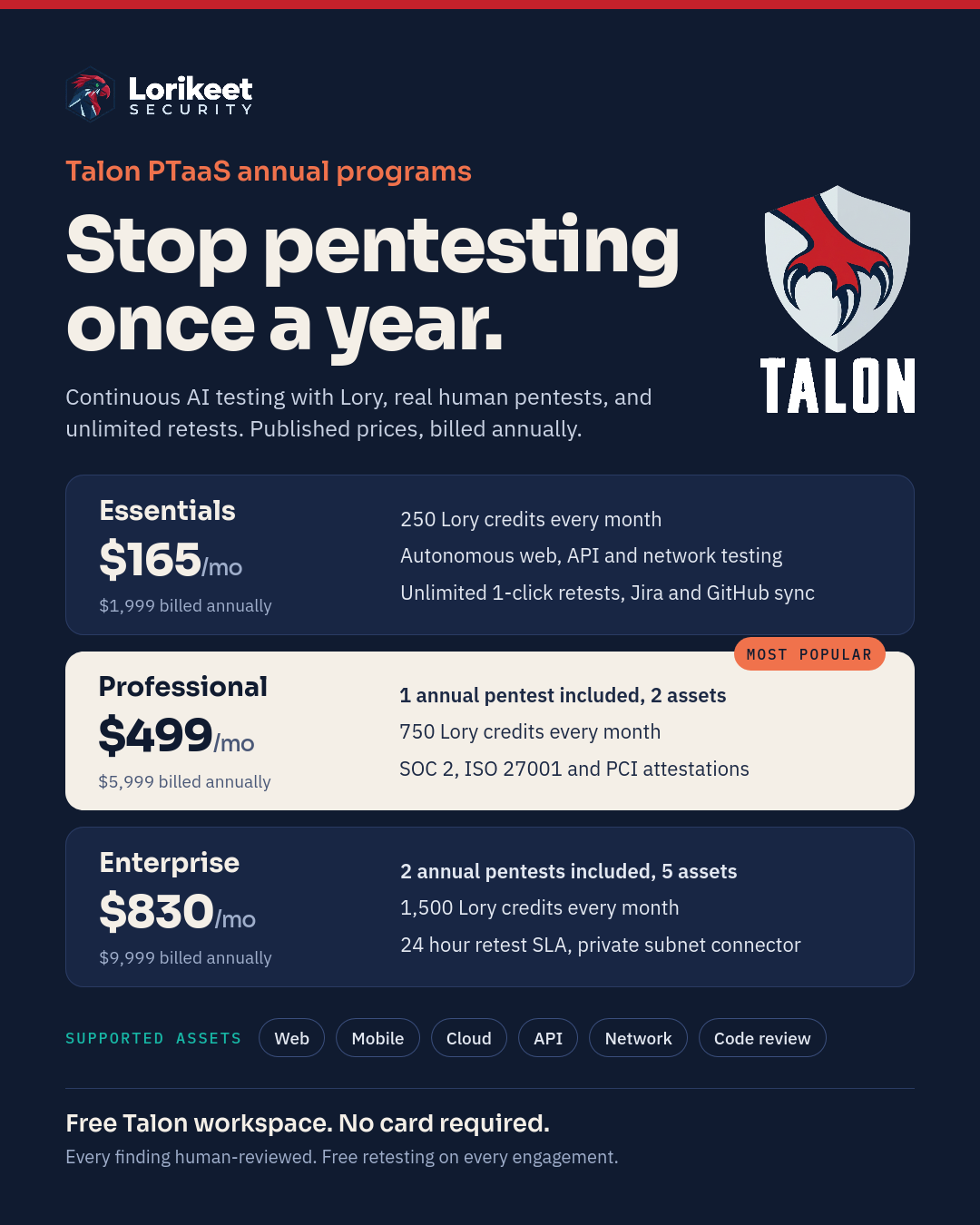
| Cost Structure | $120,000 – $300,000 per exercise. | Transparent subscription: Talon Enterprise ($830/mo) |
How Lory Operationalizes Threat Emulation
When integrated into your testing architecture, Lory does not act as a dumb crawler. Guided by real-time threat intelligence feeds, Lory:
- Ingests Current Threat Campaigns: When a new threat campaign (such as zero-day exploitation in an enterprise file transfer tool or a cloud identity provider) is identified by CTI analysts, Lory updates her offensive vector plans immediately.
- Simulates Multi-Stage TTPs: Lory tests multi-step attack paths: discovering unauthenticated endpoints, executing stateful mutations, extracting session identifiers, and attempting lateral pivots across microservices.
- Operates Behind Firewalls via Lory Mesh: Using our secure wireguard-based connector, Lory evaluates internal VPCs and staging environments without requiring open firewall ports.
- Certified Human Countersignature: Every critical scenario finding is verified and countersigned by Lorikeet's senior offensive engineers, ensuring that your executive team and regulatory examiners receive audit-proof evidence.
Buyer's Checklist: Scoping a Threat Intelligence-Led Pentest
When preparing for a regulatory or board-mandated TLPT exercise, use this checklist to ensure complete coverage:
- Mandate Independent Threat Intelligence: Verify that your testing partner includes an accredited CTI phase that evaluates threat actors targeting your specific industry, assets, and geographic presence.
- Define Critical or Important Functions (CIFs): In compliance with DORA Article 26, identify the business services that, if disrupted, would cause material financial harm or systemic market instability (e.g., payment routing, user authentication, customer ledger).
- Establish a Secret White Team: Appoint a confidential internal committee (typically the CISO, Head of Infrastructure, and Legal Counsel) who govern the test, establish rules of engagement (RoE), and ensure live production safety while keeping the operational SOC/Blue Team completely unaware.
- Require MITRE ATT&CK Mapping: Insist that all reported attack scenarios and findings are explicitly mapped to MITRE ATT&CK technique IDs, enabling direct integration into your detection engineering workflows.
- Ensure Continuous Retesting: A threat simulation is only as valuable as the resilience it builds. Ensure your vendor provides continuous retest verification as your engineers deploy defensive detections and architectural mitigations.
Frequently Asked Questions
What is Threat Intelligence-Led Penetration Testing (TLPT)?
TLPT is an advanced testing discipline where offensive security teams emulate real-world adversary TTPs identified through bespoke Cyber Threat Intelligence (CTI). Rather than running static checklists, testers replicate the actual behaviors of threat groups actively targeting that organization's industry and critical assets.
How does TLPT differ from standard penetration testing and red teaming?
Standard pentesting focuses on finding all vulnerabilities in a defined scope. Red teaming tests general defensive response without formal intelligence. TLPT formally integrates accredited threat intelligence to construct scenario-based attack chains against live critical functions, frequently under direct regulatory supervision.
Which regulations mandate Threat Intelligence-Led Penetration Testing?
Primary regulations include DORA (Articles 26 and 27) in the EU, the European Central Bank's TIBER-EU framework, Bank of England's CBEST, and Singapore's MAS guidelines. These regulations require systemic financial entities and their critical ICT third-party vendors to execute advanced TLPT at least every three years.
Why do automated vulnerability scanners fail against real-world threat actors?
Automated scanners search for known software version CVEs and basic syntax bugs. Adversaries, by contrast, utilize legitimate credentials, exploit business logic flaws, chain low-severity misconfigurations, and leverage Living-off-the-Land (LotL) utilities that trigger zero signature-based scanner alarms.
How do Lorikeet Security's Talon and Lory enable continuous threat testing?
Instead of an episodic exercise every few years, Talon PTaaS operationalizes adversary simulation 365 days a year. Talon combines CREST-certified human offensive operators with autonomous Lory AI agents that ingest real-time threat intelligence and test your surface continuously across CI/CD deployments.
Operationalize Threat-Led Testing on Your Attack Surface
Stop waiting for annual tests to discover if your defenses can withstand a motivated adversary. Experience continuous threat intelligence-led testing with Talon PTaaS and Lory AI.