Big 4 & Boutique Consultancies vs. PTaaS Platforms: 2026 Procurement Decision Matrix
Every year, thousands of Chief Information Security Officers (CISOs), Heads of Application Security, and procurement directors confront an increasingly fragmented offensive security market. When planning pentesting budgets for SOC 2 Type II, ISO/IEC 27001, PCI DSS v4.0, or enterprise customer due diligence, security leaders face a fundamental dilemma:
Should we hire a traditional Big Four accounting firm, an elite boutique security consultancy, a crowdsourced freelance platform, or a modern continuous Pentest as a Service (PTaaS) provider?
Historically, procurement departments defaulted to legacy consulting relationships. But in 2026, the economics and mechanics of software development have shifted radically. Cloud-native engineering teams ship features multiple times a day. Against this velocity, the legacy consulting model—characterized by \$40,000 one-off Statements of Work (SOWs), eight-week scheduling queues, 200-page static PDFs, and \$5,000 retesting fees—creates untenable financial waste and dangerous 351-day security blind spots.
This guide presents the definitive 2026 Procurement Decision Matrix. We objectively benchmark the four primary offensive security vendor archetypes across commercial structure, testing velocity, developer integration, retesting terms, and 3-year total cost of ownership (TCO).
The Four Vendor Archetypes in 2026
Before diving into the procurement matrix, it is crucial to clearly categorize the four vendor models active in the offensive security ecosystem today:
1. Big Four Accounting & Advisory
- Structure: Multi-disciplinary global audit and consulting giants.
- Pricing: Hourly billing or massive fixed SOWs (\$40k–\$100k+).
- Strengths: Brand prestige for risk committees, cross-practice audits.
- Drawbacks: High staff turnover, junior staffing, zero CI/CD tooling.
2. Elite Boutique Consultancies
- Structure: Pure-play offensive security and red team firms.
- Pricing: High-rate project SOWs (\$30k–\$70k per engagement).
- Strengths: Deep manual tradecraft, proprietary zero-day research.
- Drawbacks: Point-in-time snapshot, slow retests, billable change orders.
3. Crowdsourced PTaaS Platforms
- Structure: Tech platforms coordinating freelance contractors.
- Pricing: Annual prepaid credit blocks (\$20k–\$60k+ min commits).
- Strengths: Global crowd diversity, digital ticketing portals.
- Drawbacks: Expiring credit traps, variable tester quality, bounty noise.
4. Continuous AI-Driven PTaaS
- Structure: Autonomous AI engine (Lory) + Dedicated Senior Staff.
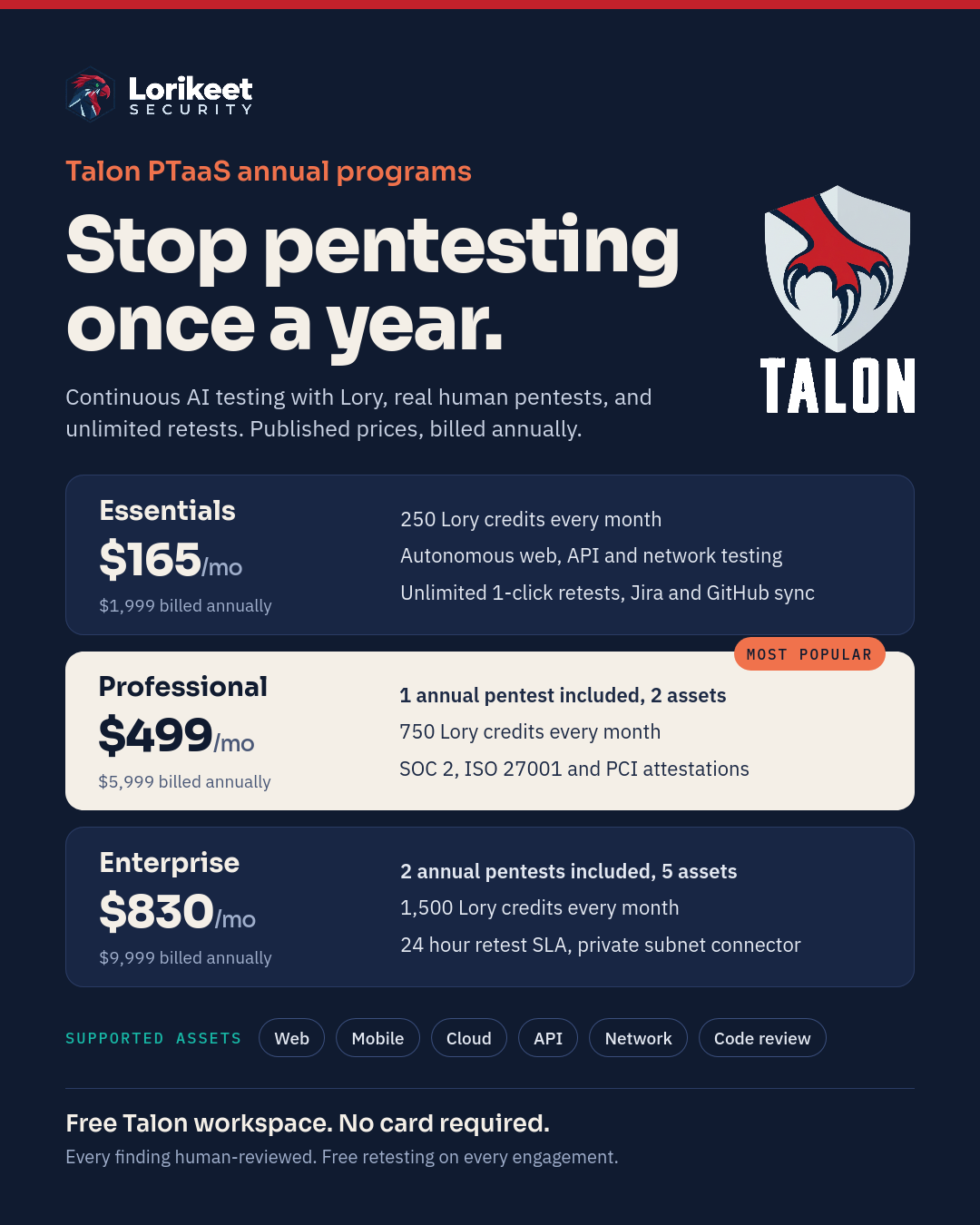
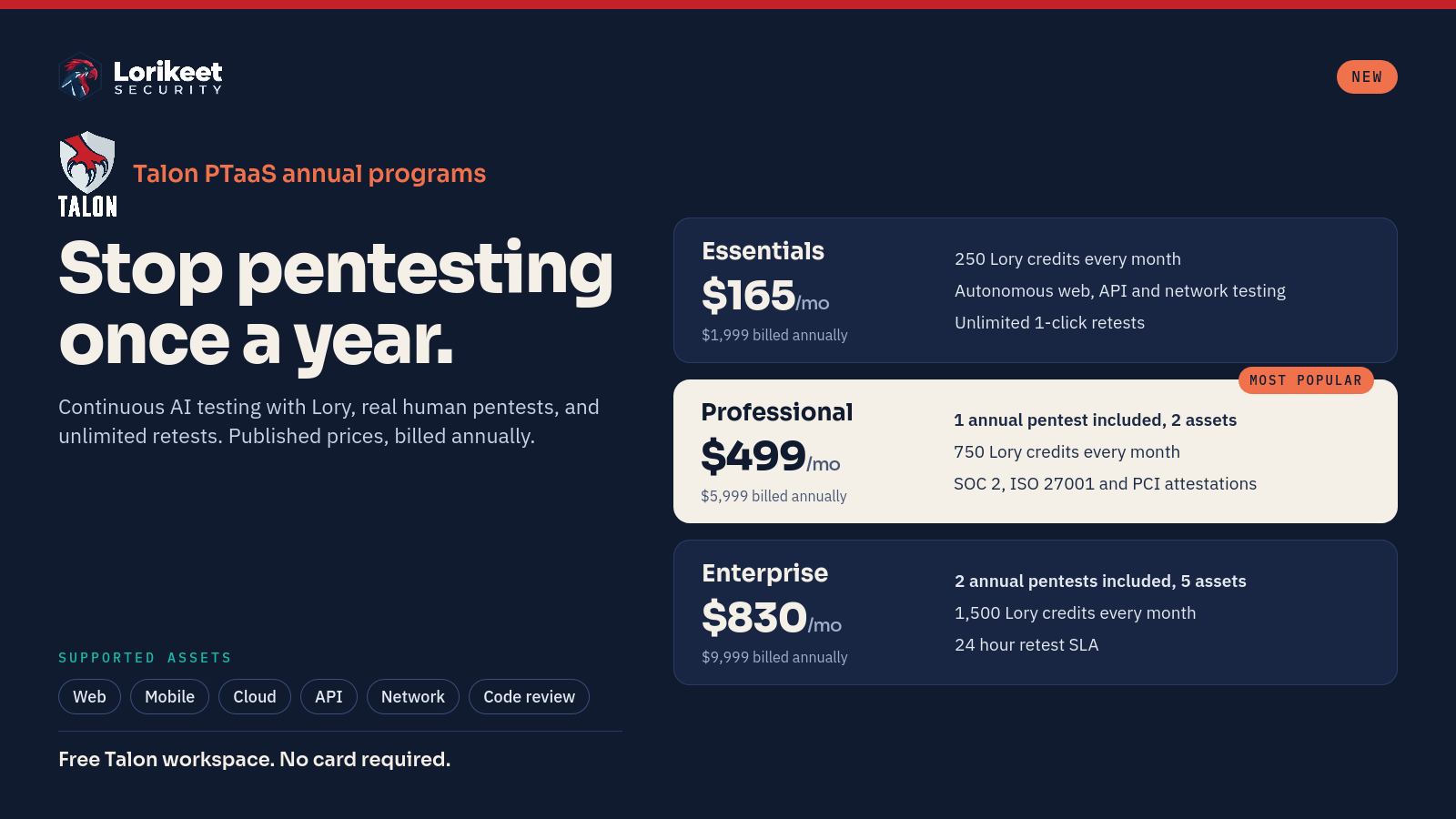
- Pricing: Transparent published subscriptions (\$165–\$830/month).
- Strengths: 365-day continuous sweeps, 72-hr SLA, MCP AI IDE integration.
- Drawbacks: Tailored for cloud/SaaS/APIs; not for physical bank vaults.
The 2026 Procurement Decision Matrix
The following comprehensive matrix evaluates the four vendor models across the nine essential criteria that security, engineering, and finance leaders evaluate during RFP reviews:
| Evaluation Dimension | Big Four Advisory | Elite Boutiques | Crowdsourced PTaaS | Continuous PTaaS (Talon) |
|---|---|---|---|---|
| Contract & Billing Model | Fixed SOW / Hourly billing (\$40k–\$100k+) | Project-based SOW (\$30k–\$70k) | Prepaid credit packages (\$20k–\$60k+) | Published subscriptions (\$165–\$830/mo) |
| Lead Time to Begin Testing | 6 to 10 weeks advance booking | 4 to 8 weeks advance booking | 7 to 14 days freelance matching | Instant sweeps; under 72h for certified audit |
| Retesting Policy & Fees | Billable change order (\$4k–\$8k) | Additional fees / 30-day cap | Strict 30–60 day window; burns credits | 100% Free: Unlimited 1-click retests included |
| Testing Coverage Model | Point-in-time (2-week test window) | Point-in-time (2-week test window) | Scheduled discrete testing bursts | Continuous 365-day sweeps + scheduled audits |
| Deliverables & Artifacts | 150+ page unformatted PDF report | Thorough technical PDF & executive deck | Web portal tickets + exported PDF | Auditor attestations + Live interactive portal |
| Developer Integration | Zero (Emailing password-protected PDFs) | Minimal (Manual CSV export to Jira) | Jira & GitHub issue push | Bi-directional Jira/GitHub + Native MCP AI IDEs |
| Private Subnet Testing | On-site physical appliance or static VPN | IPSec VPN or SSH bastion host | Proprietary proxy / custom cloud VPN | Zero-Trust WireGuard connector (Outbound-only) |
| Staffing Quality & Consistency | Junior analysts managed by partner | Senior offensive specialists | Variable freelance crowd pool | Lory AI Engine + Dedicated Senior Engineers |
| Average Annual TCO (1 App + API) | $45,000 – $75,000 | $35,000 – $60,000 | $25,000 – $45,000 | $5,999 – $9,999 (78% savings) |
Deep-Dive: When Does Each Vendor Model Make Sense?
An honest procurement evaluation recognizes that no single model fits every use case. Here is an objective analysis of where each archetype excels—and where each falls short.
1. Big Four Accounting & Advisory (Deloitte, PwC, EY, KPMG)
The Big Four dominate enterprise audit and risk governance. For organizations with massive non-technical compliance mandates, their recognizable brand names carry significant weight.
- Ideal Use Case: Global Fortune 100 banks, insurance conglomerates, or government defense agencies where the primary goal of the security assessment is mitigating board-level liability and satisfying multi-jurisdictional financial regulatory bodies.
- The Engineering Reality: Big Four pentesting practices routinely suffer from high junior-to-partner leverage ratios. Engagements are scoped by senior partners but executed by junior analysts following standardized checklists. Reports are delivered as static PDFs weeks after testing ends, offering zero integration into modern developer workflows.
2. Elite Boutique Security Consultancies (NCC Group, Bishop Fox, Mandiant)
Boutiques represent the pinnacle of deep-dive manual tradecraft. Their researchers regularly present novel exploits at DEF CON and Black Hat.
- Ideal Use Case: High-risk, novel technical architectures requiring bespoke research: novel cryptographic protocols, embedded IoT hardware, automotive firmware, or multi-week adversary emulation / physical red teaming.
- The Engineering Reality: Boutiques are economically optimized for high billable day-rates (\$2,500–\$3,500/day). While the depth of testing is extraordinary, treating routine web application, API, and cloud infrastructure pentesting as bespoke boutique consulting is financially inefficient. Retesting typically requires billable change orders, and the point-in-time model leaves your production systems unmonitored for the rest of the year.
3. Crowdsourced PTaaS Platforms (Cobalt, HackerOne, Synack)
Crowdsourced PTaaS modernized consulting by replacing static PDFs with web-based vulnerability tracking and coordinating global freelance talent.
- Ideal Use Case: Large enterprises with hundreds of disparate public-facing web properties that want broad, diverse crowd eyes probing their perimeter on an intermittent basis.
- The Engineering Reality: The reliance on prepaid "credit blocks" creates severe procurement friction. Unused credits frequently expire after 12 months, forcing security teams into year-end panic spending. Furthermore, because freelance contractors rotate continuously, engagements lack retained architectural context, and bounty hunters often generate low-severity finding noise.
4. Continuous AI-Driven PTaaS (Talon by Lorikeet Security)
Talon represents the modern paradigm: software-driven offensive security paired with dedicated senior human engineers.
- Ideal Use Case: Modern B2B SaaS, FinTech, HealthTech, and AI companies deploying software continuously and requiring compliance certifications (SOC 2, ISO 27001, PCI DSS) without administrative overhead or bloated consulting fees.
- The Engineering Reality: Talon replaces point-in-time snapshots with continuous 365-day autonomous sweeps powered by the Lory offensive AI engine. When human-certified testing is required, dedicated in-house engineers conduct comprehensive manual testing within 72 hours. All retesting is free and automated with 1-click verification, and findings synchronize natively into Jira, GitHub, and AI coding assistants via MCP.
The 2026 Procurement Shift: Leading security leaders are bifurcating their offensive budgets: allocating 80% to continuous, automated PTaaS (like Talon) for core applications, APIs, and cloud environments, while reserving 20% for specialized boutique consultancies for novel zero-day research or physical red teaming.
3-Year Total Cost of Ownership (TCO) Model
To demonstrate the financial impact of vendor selection, consider a standard mid-market SaaS company managing:
- One primary customer-facing web application (React/Next.js)
- A backend REST and GraphQL API layer (AWS ECS/Kubernetes)
- Bi-weekly software release cycles
- Annual SOC 2 Type II audit requirements and frequent enterprise sales vendor assessments
| Cost Component | Traditional Boutique | Crowdsourced Platform | Talon PTaaS (Professional) |
|---|---|---|---|
| Year 1 Base Assessment | $35,000 (1 SOW) | $28,000 (80 Credits) | $5,999 (Annual Subscription) |
| Year 1 Retesting & Patch Verification | $6,500 (2 change orders) | $3,500 (Additional credits) | $0 (Included Unlimited) |
| Year 2 Base + Retests | $43,000 | $31,500 | $5,999 |
| Year 3 Base + Retests | $45,000 | $33,000 | $5,999 |
| Internal Developer Overhead (Triage/Sync) | $18,000 (Manual PDF triage) | $10,000 (Portal copy-pasting) | $2,000 (Jira & MCP AI IDE Sync) |
| Total 3-Year Investment | $147,500 | $106,000 | $23,997 |
| Net 3-Year Savings with Talon | -$123,503 (84% Savings) | -$82,003 (77% Savings) | Baseline Modern TCO |
The 2026 Pentest RFP Scorecard: 7 Critical Questions to Ask Vendors
When drafting your next penetration testing RFP or evaluating vendor proposals, include these seven critical qualification questions:
- What happens between scheduled tests? If we push critical code to production next month, will your platform detect newly introduced authorization flaws, or are we unmonitored until our next annual engagement?
- What are your explicit retesting terms and fees? Is retesting included in perpetuity, or does it expire after 30 days? How much do you charge if our team requires a second round of verification 90 days post-assessment?
- Do your testing credits or allocations expire? If our engineering roadmap pushes back a major release, do our prepaid fees vanish under a "use-it-or-lose-it" policy?
- How do developers interact with findings? Can our engineers receive reproducible curl scripts and trigger retests directly from Jira, GitHub, or their AI development IDE (Cursor/Claude Code)?
- How quickly can you deliver an auditor-ready attestation letter? When an enterprise prospect demands a signed report to close a contract, what is your guaranteed SLA from retest request to final letter?
- Who actually executes the test? Are engagements staffed by dedicated, named certified engineers (OSCP, OSWE), or are scopes distributed to an anonymous freelance contractor marketplace?
- How do you access private staging subnets? Do you require opening public inbound firewall ports and static IP whitelisting, or do you provide a zero-trust, outbound-only connector?
Frequently Asked Questions (FAQ)
Can Talon completely replace our annual Big Four or boutique pentest for SOC 2?
Yes. For SOC 2 Type II, ISO/IEC 27001:2022, and PCI DSS v4.0 compliance, accredited external audit firms require a comprehensive third-party penetration test conducted by qualified offensive security professionals. Talon’s Professional ($499/mo) and Enterprise ($830/mo) tiers include full manual penetration tests executed by certified senior engineers, complete methodology documentation, CVSS v3.1 scoring, verified remediation proof, and formal signed executive attestations that fully satisfy auditor controls.
Why is continuous PTaaS so much more cost-effective than traditional consultancies?
Traditional consultancies bill high daily rates because highly paid senior human testers must spend days performing repetitive, mechanical tasks: port scanning, directory fuzzing, crawling JavaScript SPAs, and running baseline injection tests. Talon automates all repetitive baseline tasks using the autonomous Lory AI engine. Our certified senior engineers step in exclusively for deep-dive manual exploitation and business logic verification, radically reducing billable labor hours while delivering superior testing continuity.
What if an enterprise customer insists on a specific legacy consultancy name?
In our experience across hundreds of enterprise vendor risk reviews, enterprise procurement teams rarely require a specific brand name. What enterprise security questionnaires and vendor risk committees mandate is an independent, accredited third-party penetration test conducted within the last 12 months with verified remediation of all critical and high findings. Talon’s executive attestations and live auditor verification portals routinely satisfy Fortune 500 security reviews.
How long does it take to switch from a traditional consultancy to Talon PTaaS?
Switching to Talon requires virtually zero ramp-up time. During an initial 30-minute technical onboarding call, we configure your assets, deploy the Lory Mesh Zero-Trust Private Connector (if testing private VPCs), and synchronize your Jira/GitHub workspaces. Autonomous scanning begins immediately, and full human-led certification testing can be completed within 72 hours.
Upgrade to Continuous PTaaS and Eliminate Consulting Overhead
Stop paying \$40,000 for one-off PDF reports. Transition to continuous offensive security with transparent published pricing, unlimited retesting, and rapid 72-hour turnarounds.