Cobalt Core vs. Talon PTaaS: Transparent Comparison of Pricing, Speed, and Testing Models
When Pentest as a Service (PTaaS) first emerged a decade ago, platforms like Cobalt revolutionized how security leaders procured penetration testing. By wrapping crowdsourced freelance testers (the "Cobalt Core") in a web application and replacing emailed PDFs with digital vulnerability tracking, Cobalt solved the initial friction of legacy consulting engagements.
However, as engineering teams transitioned from bi-annual releases to continuous daily deployments in 2026, the crowdsourced freelance model began revealing severe structural friction. Security leaders routinely confront "use-it-or-lose-it" credit expiration traps, opaque 5-figure minimum contracts, rigid 30-day retesting limits, and two-week lead times required to schedule freelance testers across global time zones.
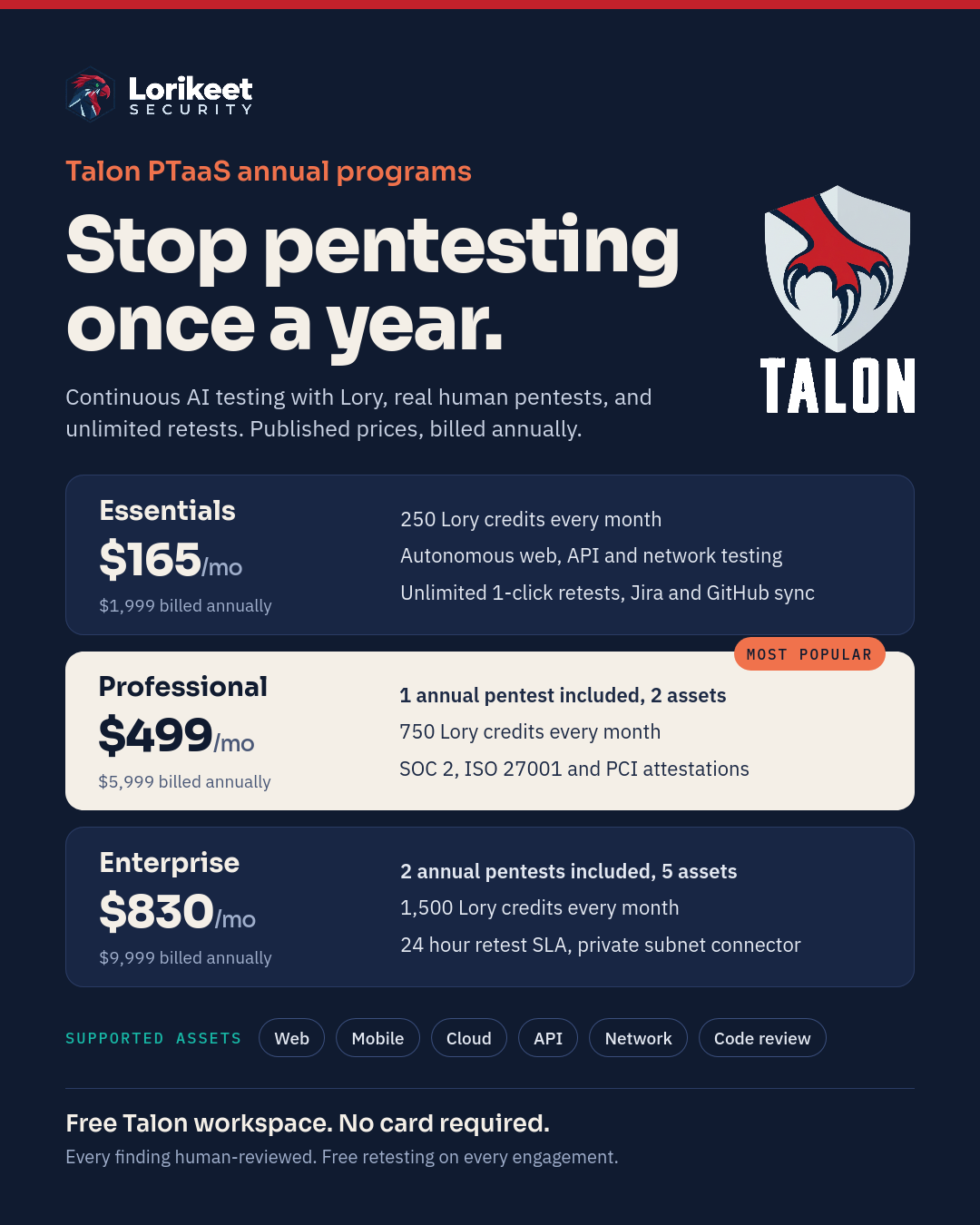
Modern security and engineering teams are migrating toward continuous, hybrid architectures. Talon PTaaS by Lorikeet Security pairs an autonomous offensive engine (Lory) with dedicated, full-time senior security engineers. Instead of forcing companies to buy \$30,000 credit packages that vanish after 12 months, Talon offers published subscriptions starting at \$165/month, credits that never expire, 72-hour test turnarounds, and native Model Context Protocol (MCP) integrations inside developer IDEs.
This guide provides an exhaustive, buyer-focused comparison between Cobalt Core and Talon PTaaS across commercial structures, testing execution, developer velocity, and compliance readiness.
At-a-Glance Head-to-Head Comparison Matrix
Before examining deep architectural distinctions, here is how Cobalt Core and Talon PTaaS compare across primary evaluation criteria for procurement and security engineering teams:
| Evaluation Dimension | Cobalt Core PTaaS | Talon PTaaS (Lorikeet) | Buyer Impact |
|---|---|---|---|
| Delivery Architecture | Crowdsourced freelance contractor community (Cobalt Core) | Hybrid: Autonomous Lory AI Engine + Dedicated Senior Engineers | Talon: Consistency & continuous depth |
| Pricing Model | Prepaid credit blocks (\$20k–\$60k+ min commitments) | Transparent published tiers: \$165, \$499, \$830/month | Talon: Zero sales friction, predictable budgets |
| Credit Expiration Policy | Credits expire annually (Use-it-or-lose-it) | Credits never expire; continuous coverage | Eliminates year-end forced pentest waste |
| Launch Speed & Lead Time | 7 to 14 days lead time for freelance matching | Under 72 hours for human test; instant for autonomous engine | Talon unblocks emergency enterprise deals |
| Retesting Terms | Strict 30–60 day window; additional retests burn credits | Unlimited 1-click automated retesting included | Talon: Verified fixes without nickel-and-diming |
| Developer Experience | Jira & GitHub ticket generation from web portal | Bi-directional Jira/GitHub + Native MCP AI IDE integration | Fix vulnerabilities directly in Claude Code & Cursor |
| Testing Continuity | Discrete point-in-time test windows (e.g., 2 weeks) | Continuous 365-day autonomous sweeps + scheduled deep audits | Eliminates 364-day security blind spots |
| Private Subnet Testing | SSH jump boxes or cloud VPN tunnels requiring open ports | Lory Mesh Zero-Trust Private Connector (WireGuard) | Zero inbound firewall holes into staging VPCs |
| Auditor Acceptance | Recognized PDF reports and attestation letters | Auditor-ready attestations + real-time shareable portals | Both widely accepted for SOC 2, ISO, PCI |
1. The Testing Model: Freelance Crowdsourcing vs. Autonomous AI + Dedicated Engineers
The fundamental divide between Cobalt and Talon lies in who or what is executing the penetration test.
Cobalt's Crowdsourced Freelance Model
Cobalt operates a marketplace of independent security contractors known as the Cobalt Core. When you initiate a pentest, Cobalt’s project coordinators assemble 2 to 3 freelance testers from their global pool based on time zones and stated proficiencies.
While this crowdsourced approach provided greater elasticity than legacy 1990s consultancy firms, it carries inherent operational drawbacks:
- Tester Variability: The quality of your assessment is heavily dependent on the individual freelancers randomly staffed on your engagement. One quarter you may receive an elite mobile researcher, while the next quarter your API test is staffed by junior contractors following standard checklist scripts.
- Context Loss Across Engagements: Because freelance pentesters cycle through hundreds of different client projects, they do not retain institutional knowledge of your system architecture, business logic quirks, or previous mitigation strategies. Every test begins essentially from zero.
- Coordination Overhead: Coordinating access, multi-factor authentication (MFA) tokens, and staging environment refreshes with multiple independent contractors in disparate regions introduces administrative drag.
Talon's Hybrid Model: Autonomous AI Engine + Dedicated Senior Engineers
Talon approaches application security through a modern hybrid methodology engineered specifically for fast-moving engineering organizations:
- Lory Autonomous Offensive Engine: Rather than relying solely on human manual clicks for initial mapping and routine attack vectors, Talon deploys Lory. Lory continuously maps attack surfaces, crawls dynamic single-page applications (SPAs), analyzes API schemas (Swagger/OpenAPI, GraphQL, gRPC), tests authentication boundaries, and chains multi-step business logic exploits without human latency.
- Named Certified Security Engineers: Lory is not a stand-alone black-box scanner. Every vulnerability detected by Lory is validated by Lorikeet’s full-time senior offensive engineers (holding OSCP, OSWE, and CREST credentials). Our dedicated engineers focus their manual efforts on complex, high-impact business logic flaws, permission boundaries (BOLA/IDOR), and architectural vulnerabilities that AI alone cannot fully contextualize.
- Continuous Retained Context: Because our core engineers work directly with your team over the duration of your subscription, they understand your code repository structure, CI/CD pipeline, and threat model intimately.
Key Architectural Difference: Cobalt brings human contractors to perform repetitive manual tasks. Talon automates exhaustive manual tasks with an autonomous offensive engine, freeing dedicated senior engineers to focus purely on critical business logic vulnerabilities.
2. The Pricing Trap: Cobalt's Expiring Credits vs. Talon's Published Subscriptions
Procurement friction is often the primary reason security directors and VPs of Engineering seek an alternative to Cobalt. Cobalt packages its services into abstract "pentest credits" (typically 1 credit corresponds to a fixed number of testing hours).
The Cobalt "Use-It-or-Lose-It" Trap
To obtain an account with Cobalt, enterprises typically must commit to a bulk purchase—often 80 to 200+ credits representing \$20,000 to \$60,000+ in annual spend upfront. These contracts routinely feature strict credit expiration clauses:
- Annual Expiration: Any credits not consumed within the 12-month contract window are forfeited without a refund or rollover.
- The Q4 Scramble: Security teams frequently discover in month 10 that they have 30 unused credits remaining. To avoid losing the budget, teams rush to schedule arbitrary tests against stable internal microservices or low-risk assets, overloading their engineering teams with uncoordinated reports at year-end.
- Opaque Sizing: Sizing a test in Cobalt requires negotiations with sales representatives over how many credits a given asset "costs," making budget estimation complex and unpredictable.
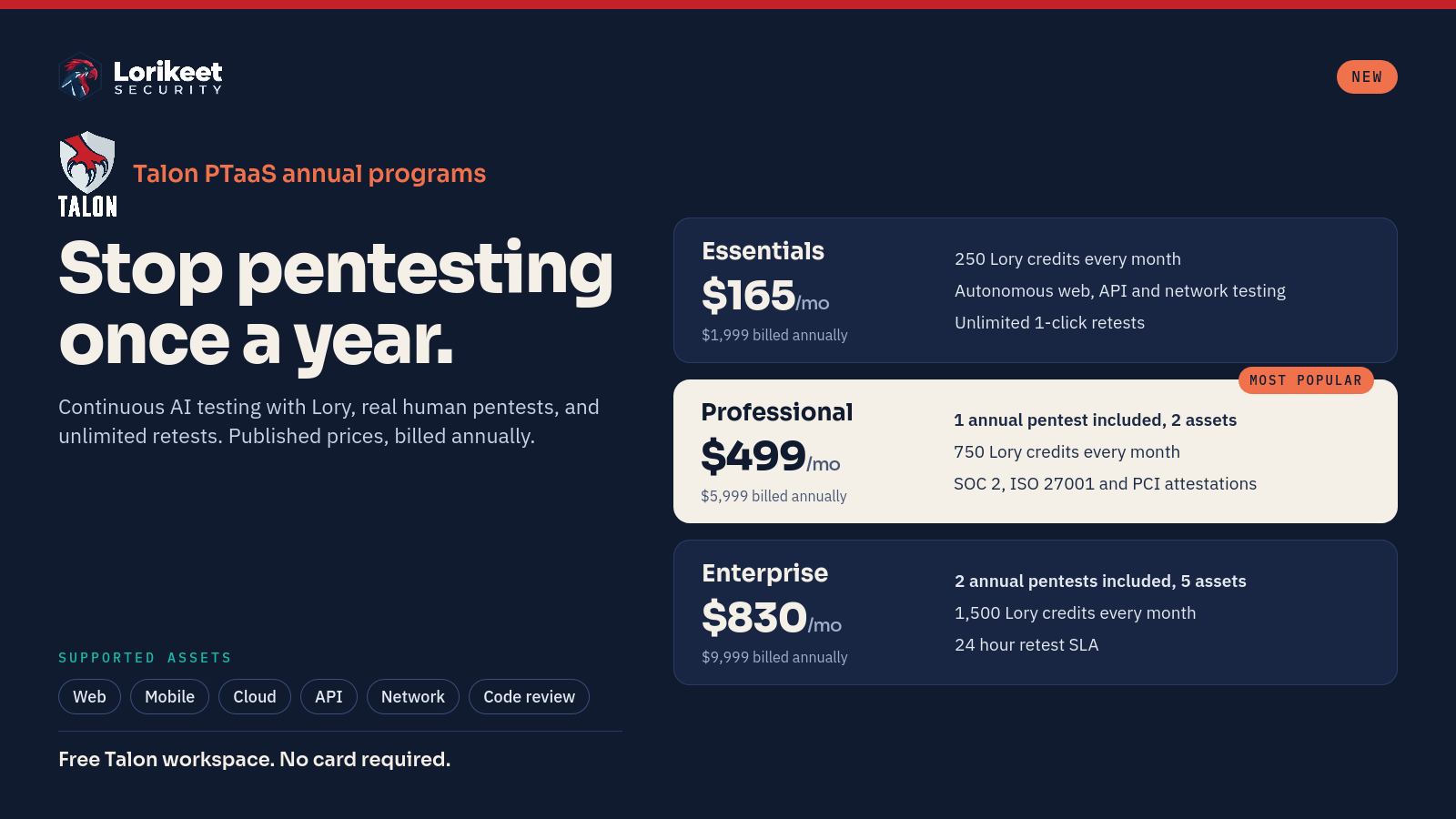
Talon PTaaS: Published, Transparent, Zero-Waste Subscriptions
Talon fundamentally rejects the credit-expiration model. All pricing is public, transparent, and structured around predictable SaaS subscriptions that align with modern engineering roadmaps:
Talon Essentials
For Seed & Early Startups
- Continuous Lory AI attack surface sweeps
- Web apps, cloud APIs & external assets
- Automated Jira & GitHub issue sync
- Native Claude Code & Cursor MCP
- Credits never expire
Talon Professional
For SOC 2 / ISO Compliance
- Includes Complete Certified Pentest
- Full manual testing by Senior Engineers
- SOC 2 & ISO 27001 Auditor Attestation
- Continuous 365-day autonomous sweeps
- Unlimited 1-click verified retests
- Direct Slack / Teams triage channel
Talon Enterprise
For Multi-Product SaaS & FinTech
- Multiple web apps, APIs & mobile apps
- Private VPC staging via WireGuard
- Certified Human Lead Pentester assigned
- 24-hour critical patch retest SLA
- Executive & Board-ready risk reporting
With Talon, any testing assessment credits or plan allocations never expire. If your product release schedule is delayed, your testing entitlements remain preserved in your account indefinitely. There is zero forced spending, zero waste, and full transparency.
3. Test Velocity & Lead Time: 72-Hour Turnaround vs. 2-Week Staffing
In an enterprise B2B sales cycle, security reviews are frequently the final barrier to closing an eight-figure contract. When an enterprise prospect’s procurement committee suddenly demands a certified third-party penetration test report before signature, waiting weeks for a vendor to begin testing can stall revenue.
Cobalt's Scheduling Lag
Because Cobalt relies on an external marketplace of freelance contractors who book their calendars weeks in advance, launching a test requires significant coordination:
- Scoping & Credit Alignment: 3 to 5 business days negotiating credits and scope definition with account managers.
- Tester Matching: 4 to 7 business days for the platform algorithm to identify and confirm available freelancers with appropriate availability.
- Total Lead Time: Typically 10 to 14 days before testing begins, followed by an additional 1 to 2 weeks of execution and report finalization.
Talon's 72-Hour Rapid Onboarding
Talon’s hybrid model enables radical acceleration:
- Instant Continuous Onboarding: Within 15 minutes of connecting your domains, APIs, or cloud environments, Lory begins reconnaissance, directory discovery, endpoint enumeration, and vulnerability probing.
- 72-Hour Full Assessment Initiation: When you require a formal, compliance-certified penetration test, our dedicated in-house engineers are deployed within 72 hours.
- No Staffing Lotteries: Our core team is in-house and dedicated. We do not place your request into an open gig marketplace hoping qualified contractors accept the assignment.
4. Retesting Policies: The Hidden Cost of Remediation
Penetration testing only delivers value when vulnerabilities are successfully remediated and re-verified. A test report highlighting critical SQL injections or broken object level authorization (BOLA) is an active liability until an engineer confirms the fix.
| Feature | Cobalt Core Policy | Talon PTaaS Policy |
|---|---|---|
| Retest Window | Limited: 30 to 60 days following report delivery | Unlimited: Active throughout your subscription |
| Retest Cost | Limited included retests; complex fixes consume credits | 100% Free: Unlimited 1-click retests included |
| Retest Automation | Manual scheduling through portal; waiting for tester availability | Instant autonomous verification via Lory engine |
| Lead Sign-Off SLA | 3 to 7 business days depending on contractor schedules | Verified attestation delivered within 24 to 72 hours |
Under Cobalt’s standard terms, if your engineering team takes 65 days to refactor an authentication microservice or rewrite a flawed authorization model, you may fall outside the complimentary retest window. To have those remediations certified, you must consume additional credits from your prepaid balance.
Under Talon, every active subscriber enjoys unlimited 1-click retesting. When your developer resolves a finding and clicks "Request Retest" in the Talon dashboard or marks the Jira ticket as resolved, Lory instantly re-executes the exact attack payload against the endpoint. Once Lory confirms the exploit fails, a Lorikeet senior engineer verifies the fix and re-issues an updated auditor-ready attestation.
5. Developer Workflow & AI IDE Integration: Jira, GitHub, and MCP
A core failure of traditional PTaaS platforms is the "portal silo." Pentest platforms built in 2018 assume developers want to log into another SaaS web portal to read vulnerability summaries. In reality, developers live inside Jira, GitHub, Linear, and modern AI development environments.
Cobalt's Webhook and Jira Integration
Cobalt provides standard integrations that push findings into Jira and GitHub as issues. However, the interaction is largely one-way and text-heavy. Developers receive a ticket with reproduction text and must manually craft curl commands or Python scripts to verify whether their local fix works before pushing code.
Talon's Native MCP (Model Context Protocol) Integration
Talon is engineered from the ground up for modern AI-assisted engineering teams. In addition to deep, bi-directional synchronization with Jira, GitHub Issues, and Linear, Talon offers a first-of-its-kind Model Context Protocol (MCP) server:
- Claude Code, Cursor & Windsurf Integration: Developers working inside Cursor or Claude Code can directly query Talon’s security engine via natural language prompts:
@talon inspect finding SEC-402 and generate the patch in auth_middleware.ts
- Local Exploit Simulation: The developer’s AI coding agent can inspect the exact payload Lory utilized, review the AST of the vulnerable code, generate the fix, run local test suites, and ping Talon’s API to verify the vulnerability is closed.
- Zero Context Switching: Security remediation transitions from a dreaded administrative hurdle into a seamless, automated extension of daily development.
6. Real-World Buyer Scenarios: Which Platform Fits Your Organization?
Choosing the right vendor depends heavily on your team's size, engineering velocity, and internal security capabilities. Here are three common procurement profiles:
Scenario A: The Seed to Series B SaaS Company Preparing for SOC 2
Challenge: You need an accredited, auditor-approved penetration test to pass your upcoming SOC 2 Type II audit or unblock a \$200,000 enterprise pilot. Your security budget is lean, and your engineers ship code three times a week.
The Verdict: Talon PTaaS (Professional Tier - \$499/mo). Cobalt’s \$25,000–\$35,000 minimum entry barrier is financially inefficient. With Talon Professional at \$5,999 billed annually, you receive a full, human-certified penetration test, an official auditor attestation letter, 365 days of continuous Lory autonomous monitoring, and unlimited retesting. You save nearly \$25,000 while maintaining superior security posture.
Scenario B: The Fast-Scaling Tech Company Fatigued by Cobalt's Expiring Credits
Challenge: You are an existing Cobalt customer. You committed to 100 credits last year. Due to a major infrastructure overhaul, your release cycles slowed in Q2 and Q3. You now have 35 credits expiring in 45 days, and your account representative is pushing you to sign an early renewal with an increased minimum commitment.
The Verdict: Migrate to Talon PTaaS (Enterprise Tier - \$830/mo). Migrating to Talon immediately eliminates the expiration threat. Unused capacity remains yours forever. You transition from sporadic, stressful point-in-time testing to continuous attack surface visibility, private staging subnet testing via WireGuard, and direct Slack access to certified lead engineers.
Scenario C: The Highly Regulated Enterprise Needing 100+ Global Freelancers
Challenge: You are a multinational conglomerate requiring 80 distinct point-in-time penetration tests across 40 disparate international subsidiaries simultaneously, prioritizing large rosters of independent freelance contractors over continuous automated monitoring.
The Verdict: Cobalt Core or Synack. If your primary procurement mandate is mass freelance crowd elasticity across dozens of disparate business units without central CI/CD integration, Cobalt’s global crowdsourced marketplace is designed for that specific enterprise procurement structure.
Frequently Asked Questions (FAQ)
Will auditors like Schellman, A-LIGN, or Coalfire accept Talon's PTaaS reports?
Yes. Major compliance auditing firms—including Schellman, A-LIGN, Coalfire, Sensiba, and Prescient Assurance—fully accept Talon’s certified penetration test reports for SOC 2 Type II, ISO/IEC 27001:2022, PCI DSS v4.0, and HIPAA compliance. Every report includes tester credentials, detailed methodologies, CVSS v3.1 scoring, verified remediation evidence, and executive attestations signed by senior offensive security engineers.
How difficult is it to migrate from Cobalt to Talon?
Migration takes less than 24 hours. You can import existing Cobalt CSV or JSON vulnerability exports directly into Talon to preserve historical remediation timelines. Our team configures your bi-directional Jira/GitHub webhooks and provisions your Lory Mesh Private Connector during an initial 30-minute technical onboarding call.
How does Talon prevent false positives from autonomous testing?
Unlike raw vulnerability scanners that generate hundreds of unverified alerts based on software version headers, Talon’s Lory engine validates vulnerabilities through active proof-of-concept (PoC) exploit execution. Furthermore, every critical and high-severity finding is manually reviewed and signed off by a certified human offensive engineer before notification alerts are triggered.
Can Talon test non-public internal environments and staging VPCs?
Yes. Talon includes a lightweight Zero-Trust Private Subnet Connector built on high-performance WireGuard encryption. You deploy a single Docker container or Kubernetes pod inside your staging AWS VPC, GCP project, or on-premises subnet. This enables Talon to assess internal APIs and pre-production builds without opening any inbound firewall ports.
Eliminate Expiring Credits and Modernize Your Pentest Program
Experience the speed and efficiency of Talon PTaaS. Get transparent pricing for your exact environment in 60 seconds with our interactive calculator, or speak with our senior offensive team today.