The Greater Toronto Area (GTA) stands as North America's third-largest technology cluster and the undisputed financial nerve center of Canada. Spanning the high-density trading floors and global bank headquarters of Bay Street, through the life sciences incubators of the MaRS Discovery District, and westward across the Toronto-Waterloo Innovation Corridor, Ontario organizations build and deploy applications that manage hundreds of billions of dollars in daily transactions, process sensitive medical histories, and power multi-tenant enterprise software used worldwide.
However, this dense technological concentration has made Ontario web applications the premier target for global threat actors. Sophisticated adversaries recognize that modern web applications are no longer simple static brochures—they are deeply integrated, cloud-native microservice fabrics communicating via GraphQL, REST APIs, and event-driven architectures. For Toronto technology leaders, chief information security officers (CISOs), and VP of Engineering teams, ensuring web application resilience is not merely an engineering hygiene task. It is a strict legal, commercial, and regulatory mandate governed by PIPEDA, the pending Bill C-27 (Consumer Privacy Protection Act), and the Office of the Superintendent of Financial Institutions (OSFI) Guideline B-13.
This comprehensive guide details the technical requirements, legal parameters, architectural testing methodologies, and commercial evaluation criteria necessary to conduct rigorous web application penetration testing in Toronto and Ontario.
The Ontario Tech Ecosystem: Distinct Regional Attack Surfaces
Conducting an effective penetration test requires an offensive team that understands how the local market builds and operates software. A generic automated scan designed for legacy monolithic web servers fails completely when applied to the specialized architectures found throughout Toronto.
1. The Bay Street Financial District & Fintech Corridor
Toronto houses the corporate headquarters of Canada's "Big Five" banks (RBC, TD, Scotiabank, BMO, CIBC), alongside leading pension funds (CPPIB, OMERS, OTPP) and a flourishing ecosystem of high-growth fintechs (wealth management, cross-border payments, crypto asset custodians, and neo-banking platforms). These web applications interface directly with core banking rails, Interac e-Transfer APIs, SWIFT messaging systems, and Lynx high-value payment systems.
Testing in this domain requires specialized expertise in financial business logic, transaction concurrency race conditions, cryptographic message validation, and session fixation vulnerabilities that could allow an attacker to hijack authenticated financial sessions or manipulate ledger balances.
2. MaRS Discovery District & HealthTech Startups
Clustered around College Street and University Avenue, the MaRS Discovery District represents the world's largest urban innovation hub. Here, hundreds of digital health, biotech, and medical artificial intelligence startups build web platforms that connect directly into Ontario's public hospital networks, including the University Health Network (UHN), Mount Sinai, and The Hospital for Sick Children (SickKids).
Applications in this sector handle Protected Health Information (PHI) subject to Ontario's strict Personal Health Information Protection Act (PHIPA). Web penetration testing must focus intensely on tenant isolation, role-based access control (RBAC), and HL7/FHIR API security to prevent unauthorized record harvesting or diagnostic tampering.
3. The Toronto-Waterloo Technology Corridor
Stretching from downtown Toronto through Mississauga, Oakville, Kitchener, and Waterloo, this corridor boasts the highest concentration of SaaS developers in North America outside Silicon Valley. Companies here build hyper-scalable B2B multi-tenant SaaS platforms deployed across multi-cloud environments (predominantly AWS and Azure). The dominant attack vectors against these platforms include Broken Object Level Authorization (BOLA), Server-Side Request Forgery (SSRF) targeting cloud metadata services, and container breakout vectors within modern Kubernetes deployments.
Canadian Data Sovereignty & Ontario Regulatory Mandates
Unlike organizations operating solely within the United States, Ontario enterprises must satisfy rigorous Canadian data residency, cross-border privacy, and statutory compliance standards. Conducting a web app pentest without factoring in these frameworks leaves major regulatory blind spots.
PIPEDA and Bill C-27 (CPPA)
The Personal Information Protection and Electronic Documents Act (PIPEDA) establishes the federal baseline for handling personal data. Under Principle 4.7, organizations must safeguard personal information against loss or theft, as well as unauthorized access, disclosure, copying, use, or modification. The Office of the Privacy Commissioner of Canada (OPC) has repeatedly made clear in published breach investigation findings that organizations that fail to conduct regular, independent technical penetration testing violate this statutory duty.
With Canada's privacy reform under Bill C-27—introducing the Consumer Privacy Protection Act (CPPA)—non-compliant organizations face administrative monetary penalties reaching up to CAD $25,000,000 or 5% of global gross revenues for egregious violations. Rigorous web application penetration testing provides the definitive evidentiary proof that an organization has validated its technical safeguards.
OSFI Guideline B-13: Technology and Cyber Risk Management
For federally regulated financial institutions (FRFIs)—and critically, for the hundreds of Toronto B2B SaaS and fintech vendors selling software to them—OSFI Guideline B-13 mandates structured, repeatable offensive testing. Under the Cyber Security Domain (Section 2.2), OSFI requires entities to establish a comprehensive Threat and Vulnerability Management framework that includes:
- Adversarial penetration testing against all internet-facing and business-critical web applications.
- Verification of third-party SaaS integrations and software dependencies.
- Formal remediation tracking with strict risk-based closure timeframes.
Toronto software providers attempting to close enterprise contracts on Bay Street will face immediate procurement disqualification if they cannot provide an independent third-party penetration test report aligning with OSFI B-13 principles.
Canadian Data Sovereignty in Penetration Testing: When engaging a penetration testing firm, ensure that all test payloads, proof-of-concept exfiltration artifacts, and customer staging data remain resident within Canadian sovereign territory. Lorikeet Security operates dedicated Canadian testing infrastructure located within AWS ca-central-1 (Montreal) and Azure Canada Central (Toronto), ensuring full compliance with public sector and provincial data residency mandates.
OWASP Top 10: How Vulnerabilities Manifest in Ontario Applications
Every authoritative web application penetration test must map its methodology and findings against the OWASP Top 10. However, abstract definitions mean little without understanding how these vulnerabilities actually manifest inside Ontario enterprise codebases.
| OWASP Category | Technical Attack Vector | Real-World Ontario Scenario |
|---|---|---|
| A01: Broken Access Control (BOLA / IDOR) | Manipulation of object IDs, UUIDs, or tenant IDs in API endpoints to access unauthorized records across account boundaries. | A Waterloo B2B SaaS platform allows a standard tenant in Toronto to query /api/v2/tenants/{id}/invoices and download competitor financial statements simply by altering the tenant integer parameter. |
| A02: Cryptographic Failures | Weak cipher suites, unencrypted sensitive data at rest, hardcoded JWT signing keys, or improper token entropy. | A Bay Street fintech app signs user authentication tokens using symmetric HS256 with an easily brute-forced secret, allowing attackers to forge arbitrary administrative JWTs. |
| A03: Injection (SQL / NoSQL / GraphQL) | Unsanitized user inputs concatenated into database queries or backend interpreters, bypassing parameterization. | A custom healthcare research search engine in MaRS concatenates raw patient filter strings into a MongoDB query, exposing anonymized clinical trial datasets to unauthenticated users. |
| A04: Insecure Design | Architectural flaws in authentication logic, password resets, rate limiting, or financial reconciliation. | A Toronto real estate investment platform fails to implement database-level transaction locks, allowing concurrent API withdrawals to execute multiple payouts before balance deduction. |
| A05: Security Misconfiguration | Exposed AWS S3 buckets, default admin dashboards, verbose stack traces disclosing internal paths, missing security headers. | A public cloud staging environment deployed in ca-central-1 leaves debug mode enabled, exposing environment variables containing production Stripe and SendGrid API keys. |
| A06: Vulnerable & Outdated Components | Software supply chain risks; unpatched third-party NPM, PyPI, or Maven libraries harboring known remote code execution (RCE) CVEs. | An Ontario supply chain logistics platform runs an unpatched version of Apache Struts or Spring Framework with a critical CVSS 9.8 remote code execution flaw. |
| A07: Authentication Failures | Credential stuffing exposure, missing multi-factor authentication (MFA) enforcement on sensitive actions, session fixation. | An insurance broker portal does not enforce rate limiting on password reset endpoints, enabling automated enumeration and account takeover of thousands of policyholders. |
| A08: Software & Data Integrity Failures | Insecure CI/CD pipelines, untrusted deserialization of objects, unverified code updates or webhook callbacks. | A payment webhook listener fails to verify cryptographic HMAC signatures from third-party payment gateways, allowing an attacker to spoof successful payment notifications. |
| A09: Logging & Monitoring Failures | Absence of centralized audit trails for privilege escalation, failed logins, or bulk export events; no real-time alerting. | An attacker brute-forces administrative endpoints for 14 consecutive days without triggering a single SOC alert or IP ban, violating OSFI B-13 monitoring mandates. |
| A10: Server-Side Request Forgery (SSRF) | Abusing web features (URL previews, PDF generators, webhook testers) to force the backend server to send requests to internal resources. | An Ontario document generation app allows users to supply a custom logo URL. Attackers supply http://169.254.169.254/latest/meta-data/ to steal temporary AWS IAM instance credentials. |
While automated scanners can easily discover basic misconfigurations (A05) and outdated open-source libraries (A06), they cannot detect the complex logic flaws that constitute over 80% of critical severity findings in modern applications: Broken Object Level Authorization (A01), architectural race conditions (A04), and chained SSRF exploits (A10). Catching these flaws demands experienced human offensive security researchers augmented by state-of-the-art autonomous testing engines.
Modern API Testing: REST vs. GraphQL in Ontario Applications
In modern web applications, the traditional monolithic web frontend is merely a thin client communicating with a complex web API. Testing must drill into the specific communication protocols utilized by your engineering team.
REST API Penetration Testing
RESTful architectures remain the foundational backbone for most Ontario financial and SaaS platforms. Offensive assessment of REST APIs requires rigorous verification of the OWASP API Security Top 10, specifically targeting:
- Broken Object Level Authorization (BOLA): Verifying whether user A can manipulate API path parameters (e.g.,
/api/v1/customers/8921/profile) to read or modify user B's records. - Mass Assignment: Injecting unadvertised administrative attributes into HTTP POST/PUT payloads (e.g., passing
{"role": "admin", "is_verified": true}during standard profile updates) that are blindly bound to backend database models. - Lack of Resource & Rate Limiting: Sending volumetric requests designed to exhaust server memory, database connection pools, or downstream third-party API quotas.
GraphQL Penetration Testing
Toronto and Waterloo engineering teams increasingly prefer GraphQL for its query flexibility and mobile responsiveness. However, GraphQL introduces an entirely unique attack surface that conventional web scanners completely misunderstand:
- Introspection Query Leakage: Leaving GraphQL schema introspection enabled in production allows attackers to instantly download your entire data model, internal object types, and hidden mutations.
- Circular Query & Deep Nesting Denial of Service: Crafting deeply recursive queries (e.g., Author -> Posts -> Author -> Posts) that force the backend resolver to execute exponential database queries, crashing production containers.
- Batching Attacks: Bypassing application-layer rate limits by wrapping hundreds of sensitive authentication queries (e.g., password brute-force or MFA code guessing) within a single HTTP request batch.
The Lorikeet Methodology: Five Phases of Penetration Testing
Lorikeet Security conducts web application penetration testing using a proven, battle-tested methodology aligned with the OWASP Web Security Testing Guide (WSTG v4.2), the NIST SP 800-115 guidelines, and the PTES (Penetration Testing Execution Standard).
Phase 1: Scoping, Threat Modeling & OSINT Reconnaissance
Before launching active testing, our team coordinates with your engineering leadership to establish clear rules of engagement (RoE). We analyze the application's business purpose, threat model, data classifications, and underlying hosting infrastructure (AWS, Azure, GCP, or on-premise Toronto data centers). We perform external passive reconnaissance to discover undocumented staging subdomains, historical API versions, forgotten test portals, and leaked employee credentials across breach databases.
Phase 2: Automated Enumeration & Attack Surface Mapping
Using our proprietary Lory AI autonomous testing engine, we rapidly enumerate every URL path, REST route, GraphQL mutation, WebSocket channel, and input parameter across the application. Lory maps the entire application state machine, identifies technology stacks, and flags initial misconfigurations with zero performance degradation to your target systems.
Phase 3: Deep Manual Offensive Exploitation
This is where real penetration testing happens. Our certified security researchers (holding OSCP, BSCP, GXPN, and eWPT credentials) manually dive into complex application logic. We test authenticated workflows across multiple user roles (unauthenticated guest, low-privilege customer, elevated manager, and platform administrator) to uncover privilege escalation, multi-tenant data bleed, business logic bypasses, and chained exploit paths.
Phase 4: Risk Analysis & Developer-First Reporting
Every finding is vetted to eliminate false positives and scored using the standard CVSS v4.0 framework. We do not deliver 150-page generic automated scanner dumps filled with theoretical boilerplate. Lorikeet reports are built for engineers: complete with step-by-step reproduction curl commands, video proof-of-concept recordings, architectural root-cause analyses, and copy-paste remediation code snippets tailored to your exact framework (Node.js, Python/Django, Go, Ruby on Rails, or Java/Spring).
Phase 5: Collaborative Debrief & Complimentary Retesting
We hold an interactive debrief meeting with your development and security teams to review findings and discuss remediation strategies. Once your engineers deploy security patches, Lorikeet provides complimentary retesting within 60 days to formally verify that vulnerabilities have been eradicated, issuing an updated, clean attestation report suitable for your auditors, board members, and enterprise buyers.
Procurement Comparison: Legacy Canadian Consultancies vs. Talon PTaaS
For decades, Ontario organizations had only two choices when procuring a penetration test: hire an expensive Big 4 accounting consultancy (charging exorbitant fees for slow, outsourced labor) or engage an unvetted local boutique delivering static PDF reports weeks after testing concluded. Pentest as a Service (PTaaS) fundamentally transforms this dynamic.
| Feature / Capability | Traditional Legacy Consultancies | Talon PTaaS by Lorikeet Security |
|---|---|---|
| Testing Delivery Model | One-time, point-in-time snapshot. Vulnerabilities reappear the moment new code is pushed. | Continuous Offensive Security: On-demand testing alongside continuous autonomous AI scanning. |
| Time to First Finding | 2 to 4 weeks after testing finishes (delivered in a massive static PDF). | Real-Time (Day 1): Confirmed vulnerabilities appear in your interactive portal immediately. |
| Engineering Workflow Integration | Manual copy-pasting from PDFs into Jira; zero developer tooling integration. | Native Bi-Directional Sync: Instant 1-click export to Jira, GitHub Issues, and Linear. |
| Retest Verification | Slow, heavily billed change orders requiring new contracts and weeks of scheduling. | 1-Click Instant Retests: Included in subscription; verified by human testers and autonomous engines. |
| Compliance & Audit Readiness | Static PDF report that quickly expires and triggers auditor skepticism. | Auditor-Ready GRC Portal: Real-time attestations mapping directly to SOC 2, ISO 27001, and OSFI B-13. |
| Pricing & Transparency | Opaque, inflated hourly rates (CAD $25,000–$45,000+ per engagement). | Transparent Subscription Plans: Predictable monthly or annual pricing with zero hidden surcharges. |
Step-by-Step Scoping Guide for Toronto CTOs & CISOs
Accurate scoping is the single most critical factor in achieving an effective penetration test. Inaccurate scoping leads to either inflated pricing or critical application modules being omitted from testing.
1. Count and Classify User Roles
The complexity of testing authenticated access control scales with the number of discrete privilege levels. For each application, document:
- Unauthenticated Public Access: Login, registration, password recovery, landing pages.
- Standard Consumer / Tenant User: Primary user interface and day-to-day transaction workflows.
- Organization Administrator: User management, billing configuration, audit log viewers.
- Internal Superadmin / Support Operator: Cross-tenant management dashboards and system configuration tools.
2. Catalog APIs and Microservices
Provide the total number of dynamic endpoints (REST routes or GraphQL queries/mutations). If you have Swagger/OpenAPI documentation, Postman collections, or a GraphQL schema file, sharing these under NDA allows testers to bypass weeks of blind endpoint guessing and immediately focus their hours on deep vulnerability discovery.
3. Define Staging vs. Production Testing Windows
Whenever feasible, we recommend conducting intensive penetration testing against a dedicated staging environment that mirrors production architecture, complete with sanitized synthetic datasets. This allows our testers to execute aggressive payload fuzzing, race-condition testing, and business logic stress tests without risking denial-of-service, data corruption, or false alarms for your real production customers. If testing must occur in production, we coordinate tight off-peak testing windows and implement strict testing constraints.
Frequently Asked Questions
Canadian data sovereignty mandates that sensitive personal, financial, and healthcare data remain within Canadian borders and be governed exclusively by Canadian privacy statutes (such as PIPEDA, Bill C-27, and Ontario PHIPA). During penetration testing, providers must ensure that test accounts, staging environments, synthetic data, and any exfiltrated proof-of-concept data are hosted strictly within Canadian cloud regions (such as AWS ca-central-1 or Azure Canada Central) and that testing traffic does not route unencrypted through foreign jurisdictions subject to extraterritorial surveillance laws.
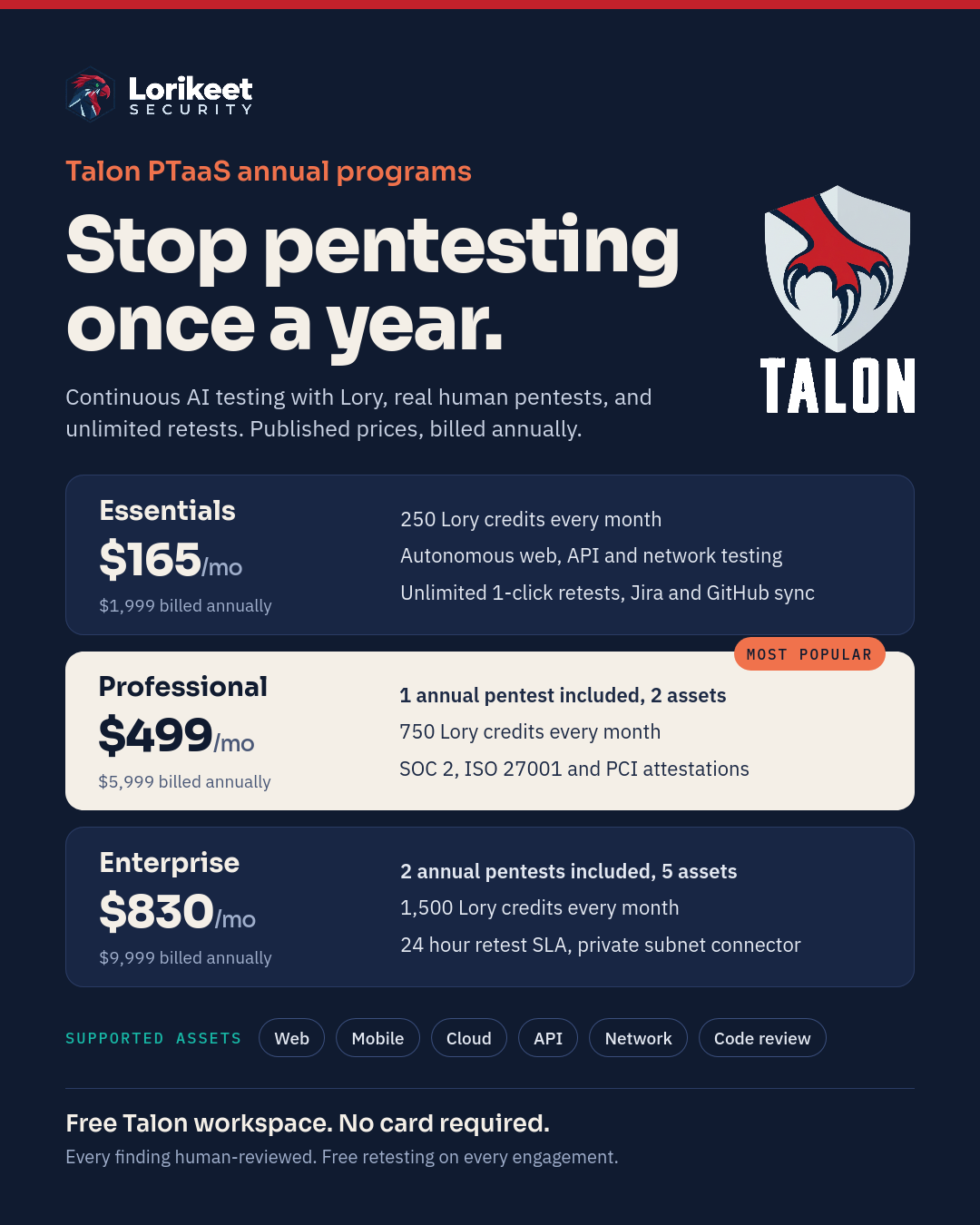
For a standard single-tenant or multi-tenant web application with authenticated role-based access control and REST/GraphQL APIs, traditional Canadian consultancies typically charge between CAD $18,000 and $35,000 for a one-time point-in-time assessment. Modern Pentest as a Service (PTaaS) platforms like Talon by Lorikeet Security deliver continuous, real-time testing with human verification and autonomous exploitation starting from predictable subscription tiers (CAD $1,500 to $4,500 monthly or bundled annually), cutting testing overhead while providing continuous retesting.
While PIPEDA does not explicitly prescribe the exact phrase 'penetration testing', Principle 4.7 requires organizations to maintain safeguards appropriate to the sensitivity of the information. The Office of the Privacy Commissioner of Canada (OPC) has repeatedly ruled that failure to conduct regular, independent technical security testing constitutes a violation of PIPEDA. For federally regulated financial institutions and fintechs partnering with them, OSFI Guideline B-13 explicitly mandates robust vulnerability management, penetration testing, and threat-led assessments.
An automated vulnerability scanner runs signature-based checks against known CVEs and server misconfigurations, generating superficial alerts with high false-positive rates and zero understanding of business logic. A comprehensive penetration test combines automated discovery with deep manual exploitation by certified security researchers (OSCP, BSCP, GXPN). Testers chain complex vulnerabilities, test authenticated multi-tenant boundaries (such as BOLA and IDOR), probe custom GraphQL/REST logic, and evaluate post-exploitation impact.
A standard scoped web application engagement typically spans five to ten business days of active offensive testing. With traditional legacy consultancies, report generation adds another two to three weeks of delay. With Talon PTaaS, findings are posted to your dashboard in real-time as they are validated, complete with reproduction curl scripts, video proof-of-concept, and native Jira/GitHub ticket synchronization, allowing your engineering team to begin remediation on Day 2 rather than waiting a month.
Secure Your Ontario Web Applications Today
Whether you are preparing for a SOC 2 audit, complying with OSFI B-13 mandates on Bay Street, or protecting sensitive patient data in the MaRS corridor, Lorikeet Security delivers elite offensive penetration testing tailored for Toronto's premier tech leaders.