In the global tech capital stretching from San Francisco's SoMa and Mission corridors down through Palo Alto, Mountain View, Sunnyvale, and San Jose, engineering velocity is the defining competitive advantage. Product teams in the Bay Area ship code to production multiple times per day. They deploy on modern, composable architectures powered by React 19, Next.js Server Components, GraphQL federation, Supabase, Neon, and serverless compute clusters hosted on AWS and Google Cloud Platform.
Yet this unprecedented development pace has broken traditional cybersecurity paradigms. For decades, legacy security consultancies in the Bay Area convinced founders and engineering executives that an annual penetration test—a two-week manual sprint culminating in a 70-page static PDF report—was sufficient to satisfy enterprise procurement and protect user data.
In 2026, that premise is dead. When your engineering team merges 80 pull requests a week, a penetration test conducted in March tells your board, your enterprise prospects, and your compliance auditor nothing about the security posture of an API endpoint pushed to production in July. This engineering guide examines why modern Bay Area web applications fail legacy security reviews, breaks down the OWASP Top 10 2026 attack vectors across next-gen stacks, compares traditional consultancies to continuous Penetration Testing as a Service (PTaaS), and outlines how continuous testing under Talon PTaaS provides real-time security assurance for high-growth tech firms.
The Bay Area Engineering Reality: Shipping Daily to the Cloud
To understand the fundamental breakdown in modern application security, one must first recognize the structural differences between how software is built in San Francisco today versus five years ago:
- Decentralized Architectural Decision-Making: Modern engineering teams favor micro-frontends, edge workers, and distributed microservices. A single product feature may involve a Next.js frontend route on Vercel, an edge middleware authentication check on Cloudflare Workers, a GraphQL resolver on AWS ECS, and a direct Supabase database subscription.
- Continuous Integration and Automated Continuous Deployment (CI/CD): Code moves from a local Cursor or Claude Code IDE session through GitHub Actions directly into production environments in minutes. Security gates that take two weeks to execute simply get bypassed or deferred until audit season.
- Composable Third-Party Dependency Chains: Applications pull in hundreds of npm, PyPI, and Go packages, alongside external APIs for LLM inference (OpenAI, Anthropic), authentication (Clerk, Auth0, Stytch), and payments (Stripe). The perimeter is no longer a corporate firewall; it is an interconnected lattice of APIs and access tokens.
The 11-Month Blind Spot: If a company undergoes an annual point-in-time penetration test, it enjoys approximately two to three weeks of verified security assurance. For the remaining 49 weeks of the calendar year, every single production push introduces untested code, new API endpoints, and potential authorization flaws directly to the public internet.
Modern Stack Vulnerabilities: What Legacy Scanners Miss in 2026
Traditional vulnerability scanners and legacy penetration testing firms rely on scanning templates developed for monolithic PHP, Java Spring, or Ruby on Rails architectures. When pointed at modern TypeScript, React, and GraphQL applications, these legacy tools return either massive walls of false positives or, worse, complete silence—giving engineering teams false confidence.
Below are the architectural vulnerabilities unique to the modern Bay Area technology stack that our offensive security team regularly exploits during real-world engagements:
1. Next.js 15/16 App Router & Server Actions Authorization Bypasses
The shift toward React Server Components (RSC) and Next.js Server Actions has revolutionized frontend development, but it has dramatically blurred the line between client and server execution contexts. Server Actions create automated POST endpoints that developers often assume are private or protected simply because they are declared in a backend file.
In practice, an attacker can directly invoke these generated endpoints using standard HTTP clients without going through client-side validation routines. If the Server Action does not explicitly re-verify user session credentials, organization tenancy, and RBAC permissions on every execution, unauthorized state mutations occur:
2. React Server Component (RSC) Serialization Boundary Leaks
React Server Components pass serialized JSON payloads across the wire to client components through the RSC protocol. When developers pass entire database ORM objects (such as Prisma or Drizzle models) from a server component to a client component, internal attributes—such as password hashes, internal billing flags, stripe customer IDs, and encryption keys—are serialized into the client bundle HTML, completely visible in the browser's network inspect tab even if not rendered on the DOM.
3. GraphQL Federation & Depth Abuse
Bay Area SaaS companies rely heavily on Apollo Federation, Hasura, or custom GraphQL gateways to unify multiple backend services. Without rigorous schema hardening, malicious actors exploit recursive graph relationships to execute denial of service or bypass rate limiting:
- Circular Query Exhaustion: Requesting deeply nested relationships (`user { posts { author { posts { author { ... } } } } }`) consumes server memory and database connections, crashing backend microservices.
- Batching Attack Exploitation: Attackers send thousands of operations in a single HTTP POST request to bypass Cloudflare and WAF rate-limiting rules, executing high-speed credential stuffing or IDOR enumeration.
- GraphQL Schema Introspection in Production: Leaked introspection schemas allow attackers to map private mutation endpoints, administrative flags, and undocumented staging resolvers.
4. Supabase & PostgreSQL Row-Level Security (RLS) Misconfigurations
Supabase and direct-to-database platforms have become the default choice for early-stage and growth-stage Bay Area startups. Because the Supabase client library interacts with PostgreSQL directly from the browser using a public `anon` API key, security relies entirely on PostgreSQL Row-Level Security (RLS) policies.
A single missing `ENABLE ROW LEVEL SECURITY;` command or a poorly scoped `USING (true)` policy allows any anonymous visitor with the public `anon` key to execute arbitrary SQL `SELECT`, `UPDATE`, or `DELETE` operations across the entire table via the PostgREST interface.
The OWASP Top 10 2026: Threat Landscape for Cloud-Native SaaS
In 2026, web application security is evaluated against updated threat models that reflect modern cloud-native architectures, API proliferation, and identity-centric attacks. Below is how the OWASP Top 10 2026 maps to real-world vulnerabilities identified across San Francisco and Silicon Valley applications:
| OWASP 2026 Category | Modern Stack Vulnerability Vector | Real-World Impact in Bay Area SaaS |
|---|---|---|
| A01: Broken Access Control (BOLA/BFLA) | Insecure direct object references in REST/GraphQL APIs and Server Actions | Multi-tenant cross-account data exfiltration; customer data leaks destroying enterprise trust |
| A02: Cryptographic Failures | Hardcoded Supabase service role keys, leaked client secrets in Vercel env configs | Full database takeover; unrestricted read/write access bypassing all frontend authentication |
| A03: Injection & Query Manipulation | NoSQL injection, GraphQL syntax manipulation, ORM raw query escapes | Database dumping, administrative account creation, backend service persistence |
| A04: Insecure Architectural Design | Unauthenticated tenant onboarding flows, business logic discount abuse | Resource exhaustion, subscription tier bypasses, automated spam generation |
| A05: Security Misconfiguration | Public AWS S3 buckets, exposed debug endpoints, missing CSP and HSTS headers | Customer PII harvesting, session hijacking over public Wi-Fi, reverse proxy pivoting |
| A06: Vulnerable Third-Party Components | Outdated npm/PyPI dependencies with known remote code execution (RCE) CVEs | Supply chain compromise, container escapes, credential exfiltration via malicious packages |
| A07: Identification & Auth Failures | OAuth token reuse, missing MFA on internal staging environments, session fixation | Corporate account takeover, lateral movement across staging and production VPCs |
| A08: Software & Data Integrity Failures | Insecure GitHub Action workflows, unsigned container images pushed to ECR/GCR | CI/CD pipeline poisoning, production image backdooring, secret exfiltration |
| A09: Logging & Monitoring Failures | Failure to log API authorization failures, lack of real-time SIEM alerts | Attackers operating undetected for weeks during automated credential stuffing campaigns |
| A10: Server-Side Request Forgery (SSRF) | Unsanitized webhook endpoints, image fetching services querying AWS IMDSv2 | Cloud instance role exfiltration, internal VPC port scanning, metadata exploitation |
Continuous PTaaS vs. Legacy Annual Penetration Testing
When Bay Area founders and VPs of Engineering evaluate offensive security options, they face a stark contrast between two fundamentally opposing operational models:
| Capability & Metric | Legacy Bay Area Pentest Firm | Talon Continuous PTaaS (Lorikeet) |
|---|---|---|
| Testing Frequency | Once per year (2-week window) | Continuous 365-day testing + annual deep human test |
| Delivery Format | Static 70-page unsearchable PDF report | Live platform, GitHub/Jira/Linear tickets, MCP integration |
| Retesting Policy | $2,500 - $7,500 additional fee per retest cycle | 100% Free, Unlimited 1-Click Retesting |
| Turnaround Time | 4 to 6 weeks to schedule + 2 weeks to report | Instant kickoff, continuous real-time findings |
| Auditor Verification | Emailing unencrypted PDFs to compliance reviewers | Live auditor attestation links & compliance exports |
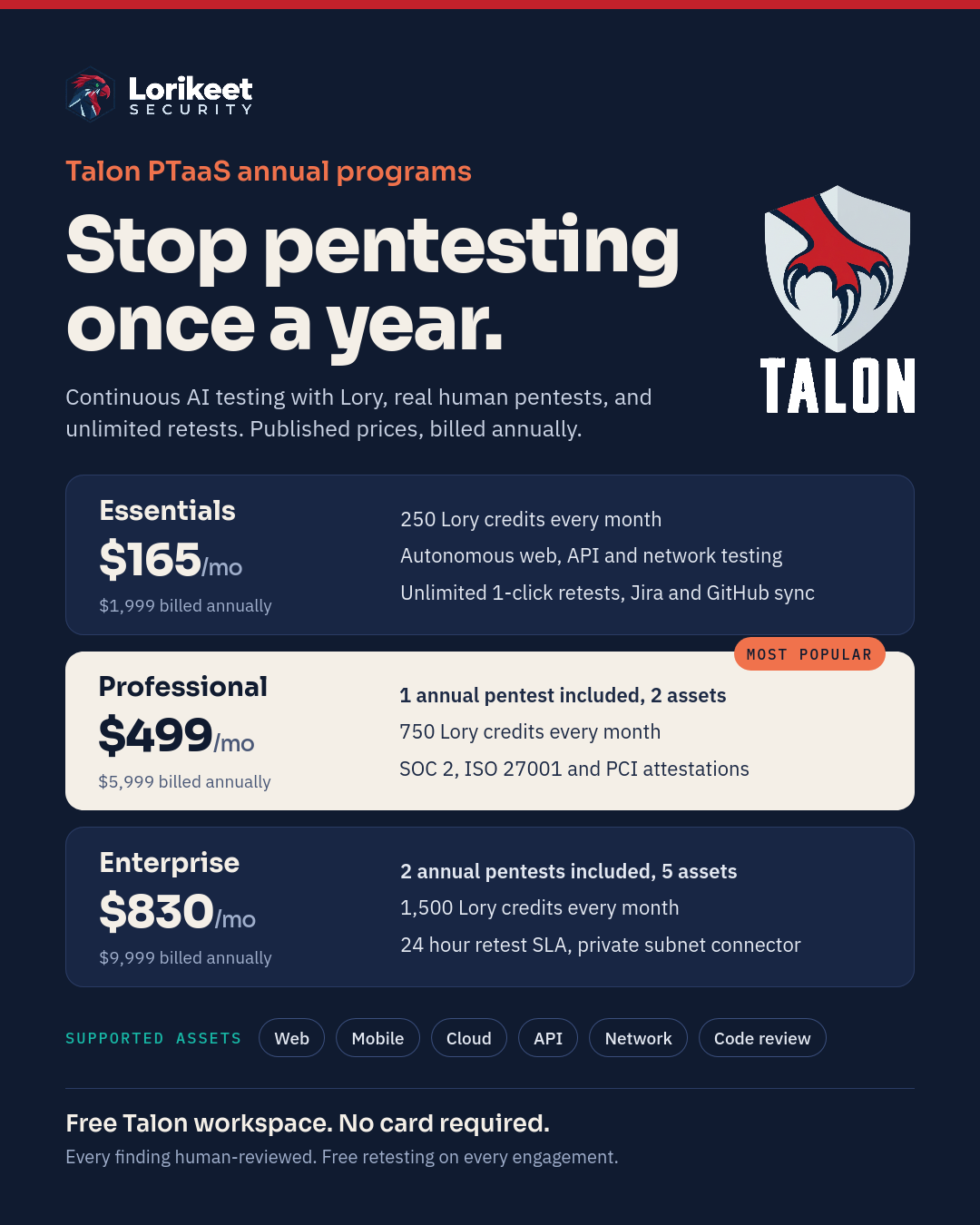
| Typical Annual Cost | $25,000 – $65,000+ per engagement | $1,980 – $9,960 billed annually ($165 – $830/mo) |
The Economics of Bay Area Pentesting: Pricing & Plans Breakdown
Traditional cybersecurity firms located in downtown San Francisco, Palo Alto, and San Jose carry massive overhead costs: high commercial office leases on Montgomery or Sand Hill Road, bloated partner structures, and billable hour incentives. As a result, standard web application assessments are billed at exorbitant rates—often running $250 to $450 per hour, translating into invoices of $30,000 or more for a single test.
Lorikeet Security was built from the ground up to eliminate this inefficiency. By combining Lory AI—our autonomous offensive security agent—with veteran CREST and OSCP-certified penetration testers, we deliver continuous offensive security at transparent annual subscription rates:
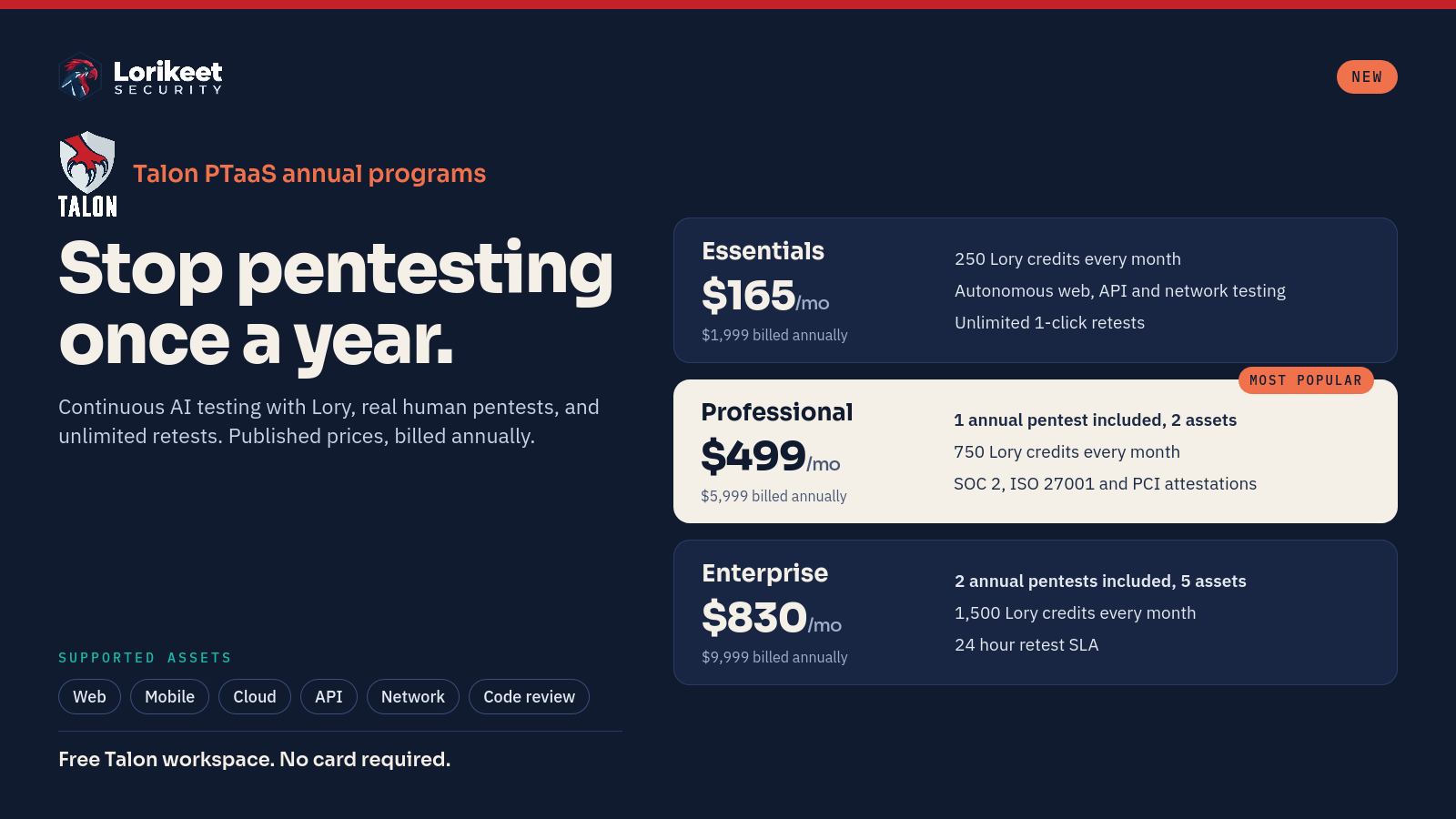
Talon Essentials
Billed annually at $1,980/year. Perfect for pre-seed and seed startups establishing continuous offensive hygiene.
- Continuous attack surface monitoring
- Lory AI autonomous vulnerability sweeps
- Cursor & Claude Code MCP server
- GitHub & Jira issue synchronization
- Unlimited automated retesting
Talon Professional
Billed annually at $5,988/year. The definitive choice for Series A/B SaaS companies closing enterprise deals.
- Full Annual Human Pentest Included
- Continuous autonomous Lory AI testing
- Up to 2 primary web/API assets
- Unlimited human verification on retests
- Certified SOC 2 & ISO 27001 Attestation
- Dedicated Slack channel with Lead Pentester
Talon Enterprise
Billed annually at $9,960/year. Tailored for multi-product organizations with complex cloud infrastructure.
- Multiple web apps, mobile apps & APIs
- Private VPC testing via WireGuard tunnels
- 24-hour SLA on critical vulnerability retests
- Quarterly executive threat briefings
- Custom vendor questionnaire assistance
Developer-First Remediation: Turning Findings into Closed PRs
The ultimate metric of a penetration test is not how many vulnerabilities were found—it is how quickly those vulnerabilities are remediated. Traditional consultancies deliver dense academic descriptions that frustrate software engineers. An engineer receives a ticket stating: "Application is vulnerable to Cross-Site Scripting under CWE-79" with zero context on which file or resolver caused the issue.
Talon PTaaS treats remediation as a software engineering problem. When our offensive team confirms a vulnerability, the Talon platform automatically:
- Generates an exact cURL or HTTP request payload that developers can copy and paste into their terminal or Postman to reproduce the exploit in their local development environment immediately.
- Provides targeted code remediation snippets tailored to TypeScript, Next.js, Python, or Go, detailing the exact architectural fix required rather than generic theoretical advice.
- Pushes tickets directly into GitHub Issues, Jira, or Linear with tags, severity levels, and assigned teams.
- Enables 1-Click Retesting: Once the engineer commits the fix and merges the pull request, they click "Retest" inside Talon. Our platform immediately runs the reproduction exploit. If resolved, the status updates to Verified Patched, and your auditor attestation report updates automatically.
Buyer Decision Checklist: How to Choose an AppSec Partner in San Francisco
When selecting a penetration testing partner for your Bay Area technology firm, use this checklist during discovery calls to separate modern AppSec platforms from antiquated consulting shops:
- Does the vendor provide continuous testing between annual audits? If their engagement ends the day the PDF is delivered, your application will be exposed for the rest of the year.
- Are retests included at zero additional cost? Never sign a contract that penalizes your engineering team with a $3,000 fee every time they ask a tester to verify a security patch.
- Does the team understand modern frontends and cloud primitives? Ask the tester how they evaluate Next.js Server Actions, RSC serialization data boundaries, GraphQL federation, and PostgreSQL RLS policies. If they only mention SQL injection and Apache misconfigurations, look elsewhere.
- Is there a direct integration with developer workflows? Ensure the platform syncs bidirectionally with Jira, GitHub, or Linear and provides programmatic access via an MCP server or API.
- Will enterprise buyers accept the deliverable? Verify that the testing firm provides a verified Letter of Attestation, CVSS v4 scoring, and a secure live auditor link suitable for passing SOC 2 Type II, ISO 27001, and Fortune 500 vendor risk assessments.
Modernize Your Application Security Program Today
Eliminate the anxiety of annual compliance scrambles and protect your production deployments with continuous offensive coverage. Explore Talon PTaaS pricing or schedule a 15-minute engineering walkthrough.