The 2026 Buyer's Guide to Pentest as a Service (PTaaS): Features, Scoping & Vendor Comparison
In 2026, the annual penetration testing ritual is formally obsolete. Software engineering teams ship production code multiple times a day across complex multi-cloud topologies, serverless microservices, and AI-assisted architectures. Against this operational tempo, waiting six weeks for a traditional security consultancy to schedule an assessment—only to receive a password-protected 80-page PDF report four weeks later—is not just inefficient. It introduces existential compliance and commercial risk.
As a result, security leaders, CTOs, and Heads of Engineering have pivoted aggressively toward Pentest as a Service (PTaaS). Gartner and offensive security analysts report that over 65% of mid-market technology vendors and SaaS startups now procure offensive testing through continuous, platform-delivered models rather than legacy point-in-time consulting engagements.
However, "PTaaS" has become one of the most crowded and loosely defined terms in cybersecurity marketing. Some vendors treat PTaaS as nothing more than a static client portal where they upload their traditional PDF deliverables. Others sell crowdsourced bug bounty programs disguised as rigorous compliance assessments. A select few offer true continuous offensive platforms combining certified human penetration testers, autonomous agentic exploitation, and bi-directional engineering integrations.
This buyer's guide breaks down the essential criteria for evaluating PTaaS vendors in 2026, compares the leading platforms side-by-side (including Talon by Lorikeet Security, Cobalt, HackerOne, and Synack), details how to scope your assets accurately, and provides a field-tested procurement rubric.
What Exactly Is Pentest as a Service (PTaaS)?
Penetration Testing as a Service (PTaaS) is a delivery model that replaces bespoke, transactional consulting engagements with a continuous cloud software platform. Instead of hiring a team to perform an annual security assessment in isolation, PTaaS provides an ongoing offensive operations hub where you can:
- Manage Scopes & Targets: Maintain a real-time inventory of web applications, REST/GraphQL APIs, mobile binaries, and cloud environments authorized for testing.
- Consume Real-Time Findings: Vulnerabilities are triaged, validated, and pushed directly to your dashboard as they are discovered—eliminating the lag of end-of-engagement reports.
- Integrate with Developer Workflows: Findings sync natively with Jira, GitHub, GitLab, and developer IDEs via the Model Context Protocol (MCP).
- Request 1-Click Retesting: Developers can verify remediation on fixed vulnerabilities within 24 to 48 hours without renegotiating change orders or incurring auxiliary fees.
- Generate Auditor Deliverables On Demand: Instantly export compliance-ready Executive Summaries, detailed vulnerability registers, and formal Attestation Letters mapped directly to SOC 2 Type II, ISO 27001:2022, PCI DSS 4.0, and HIPAA.
The 6 Critical Evaluation Criteria for 2026 PTaaS Platforms
When conducting market evaluations or issuing RFPs for offensive security platforms, buyers must look beyond glossy marketing brochures. Here are the six technical and commercial criteria that separate first-class PTaaS platforms from glorified consulting wrappers:
1. Continuous vs. Scheduled
Does the platform provide continuous autonomous testing between formal assessments, or is it merely a scheduling calendar for point-in-time tests that leave 360 days of blind spots?
2. Real-Time Finding Dossiers
Are findings delivered with exact HTTP requests, curl reproduction commands, and stack-specific remediation guidance, or are they generic copy-paste scanner descriptions?
3. Bi-Directional Issue Sync
Can findings automatically populate Jira or GitHub Issues, and does closing a ticket in Jira automatically queue a retest inside the platform?
4. Private Subnet Connectivity
Can the platform securely test private staging environments, internal VPCs, or Kubernetes clusters behind your firewall without forcing you to expose internal services to 0.0.0.0/0?
5. Credit Rollover Terms
Do unused testing credits or hours expire quarterly on a punitive "use-it-or-lose-it" contract, or do they roll forward indefinitely to protect your capital?
6. Pricing Transparency
Does the vendor publish upfront, transparent pricing on their website, or do they require three enterprise discovery calls before quoting an inflated figure?
1. Continuous vs. Scheduled: The Dual-Engine Advantage
Legacy consultancies argue that human creativity cannot be automated. Scanner vendors argue that humans are too expensive and slow. The reality of 2026 is that neither extreme works in isolation.
A high-grade PTaaS platform utilizes a dual-engine model. Certified human ethical hackers (OSCP, GXPN, CREST) execute deep architectural probing, complex business logic abuse, and multi-step lateral exploitation. Simultaneously, continuous autonomous agents—such as Lorikeet's Lory AI pentesting engine—continuously map your evolving perimeter, monitor for newly disclosed zero-days (such as perimeter VPN or framework exploits), and test new API routes between scheduled assessments.
Key Buyer Question: "What happens between our scheduled penetration testing windows? Does your platform continuously probe our staging and production perimeter for regressions, or is our dashboard dormant until next year's contract?"
2. Real-Time Portals with Verified Reproduction Proofs
Receiving a 50-page PDF report two weeks after testing completes is useless when developers have already moved on to other sprints. When a critical authentication bypass or IDOR is discovered on Day 1 of testing, engineering needs notification within hours, not weeks.
In premier PTaaS portals, findings appear with:
- CVSS 3.1 environmental scores and documented business impact.
- Exact curl commands or raw HTTP request/response payloads to reproduce the issue locally.
- Targeted code-level remediation snippets tailored to your framework (e.g., Prisma ORM parameterization, Rails strong parameters, or AWS IAM least-privilege policies).
- Direct in-platform researcher messaging to clarify nuances directly with the tester who discovered the flaw.
3. Bi-Directional Issue Tracker & MCP IDE Integrations
The friction between security and engineering usually boils down to data transfer. If your security team has to manually copy findings from a portal into Jira, velocity drops.
Furthermore, in 2026, leading engineering teams use AI coding environments like Cursor, Claude Code, and GitHub Copilot Workspace. Platforms like Talon have introduced dedicated Model Context Protocol (MCP) servers. An engineer can directly prompt Claude Code: "Query Talon finding #SEC-209 and apply the recommended input validation patch to our Express route handler." The AI inspects the live finding dossier, generates the code fix, and runs unit tests.
4. Private Subnet Support: The "Behind-the-Firewall" Challenge
A frequent failure mode for early PTaaS adopters is finding that their vendor can only test publicly accessible endpoints. Staging environments containing customer data or pre-release features are almost universally locked inside AWS VPCs, Google Cloud private clusters, or behind corporate firewalls.
Forcing engineering to create insecure firewall rules (whitelisting arbitrary vendor IP ranges) creates compliance headaches and risk. Modern PTaaS platforms provide lightweight outbound connectors—such as the Lory Mesh Private Subnet Connector on Talon Enterprise—which establish an encrypted WireGuard tunnel from inside your cluster to the testing engine, eliminating inbound firewall holes entirely.
5. Credit Rollover vs. Use-It-or-Lose-It Contracts
Many crowdsourced PTaaS platforms operate on a "credits" or "testing units" model. Beware of contract clauses stating that credits expire 90 or 365 days after contract execution. If your engineering release calendar is delayed by two months, you should never forfeit thousands of dollars in prepaid security testing.
Demand vendors who guarantee that purchased testing credits or allowances never expire and roll over seamlessly into subsequent quarters.
6. Transparent Published Pricing vs. Opaque Sales Traps
In the traditional security consulting industry, pricing is notoriously opaque. Vendors ask for your annual revenue, venture funding amount, and employee headcount before giving a quote—charging a well-funded Series B startup $35,000 for the identical scope they would sell to a bootstrapped team for $12,000.
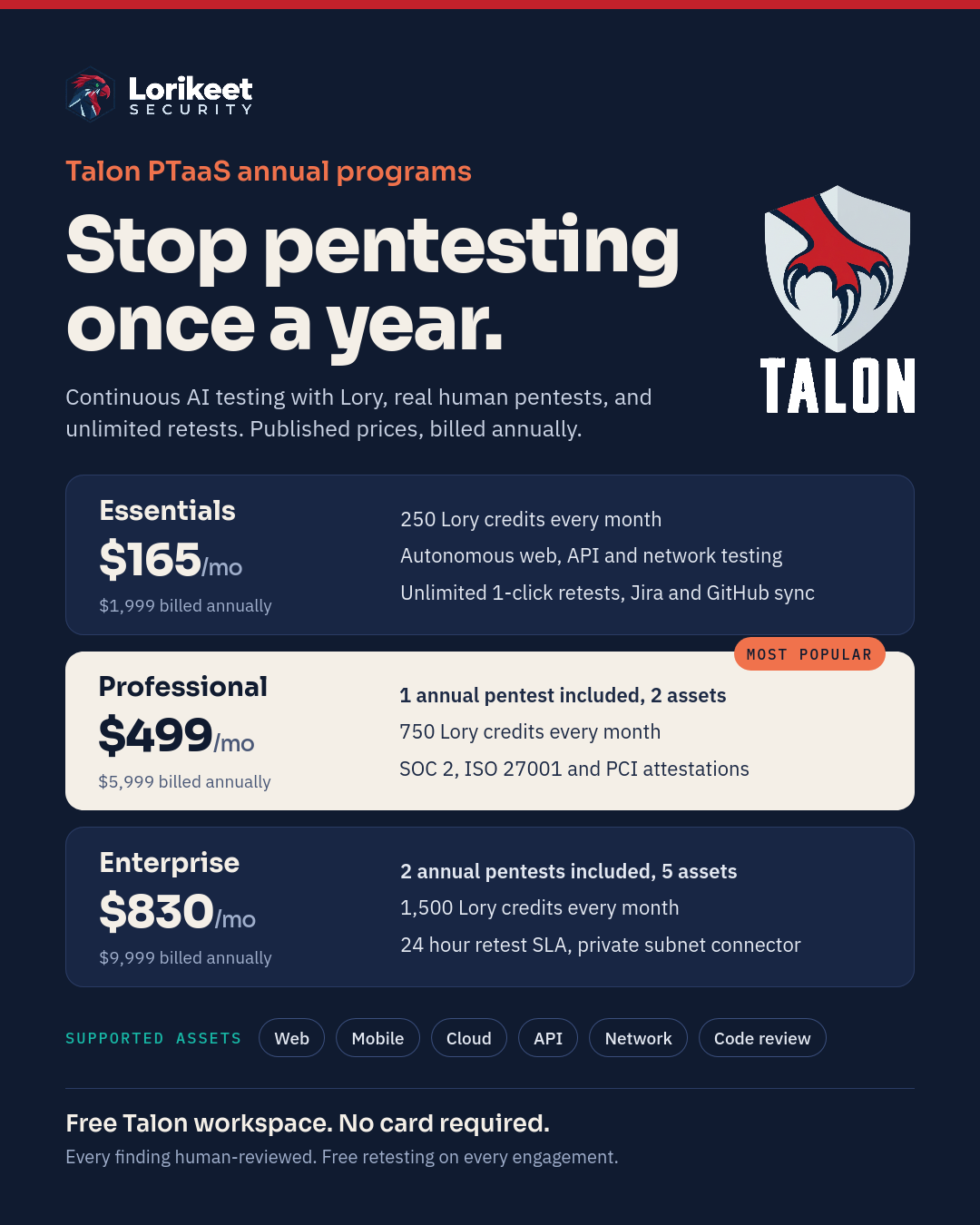
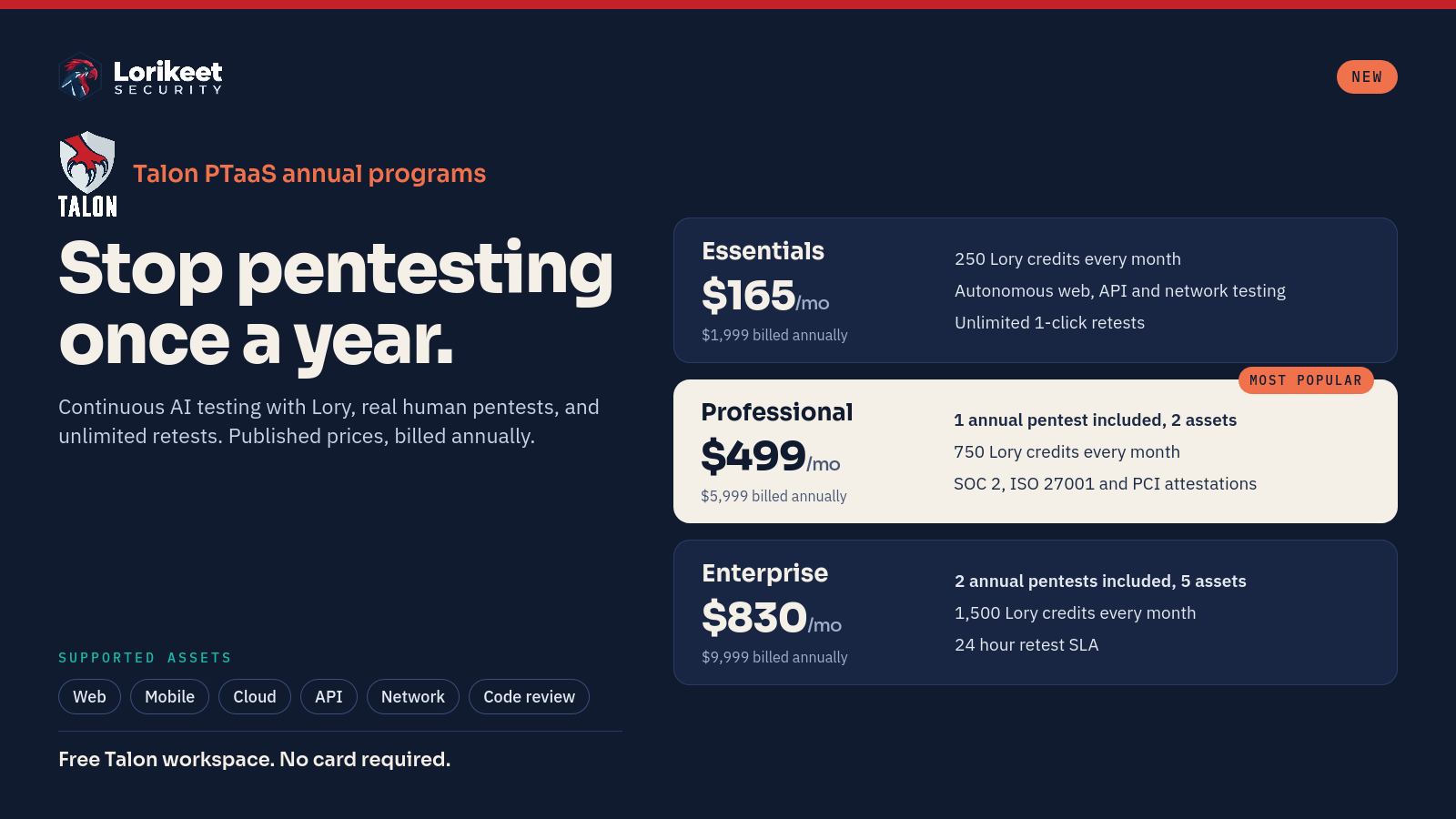
Look for vendors who maintain publicly accessible, transparent rate cards. For example, Talon PTaaS publishes its exact subscription tiers openly:
- Essentials ($165/mo · $1,999/yr): Continuous autonomous AI testing for fast-shipping teams, unlimited 1-click retests, 250 Lory credits/mo, and Jira/GitHub sync.
- Professional ($499/mo · $5,999/yr): 1x annual human pentest (2 assets: Web App, API, Cloud), 750 Lory credits/mo, SOC 2 / ISO 27001 attestations, and dedicated engineer support.
- Enterprise ($830/mo · $9,999/yr): 2x annual human pentests (5 assets: Web, API, Mobile, Cloud, Code), 1,500 Lory credits/mo, Lory Mesh private connector, and priority 24h SLA.
Comprehensive Vendor Comparison: Talon vs. The Market
To help you make an objective, defensible procurement decision, the table below compares Talon by Lorikeet Security against legacy crowdsourced platforms (Cobalt, HackerOne, Synack) and traditional boutique or Big 4 consultancies (NCC Group, Mandiant, Bishop Fox, PwC).
| Evaluation Vector | Talon PTaaS (Lorikeet) | Legacy Crowdsourced (Cobalt / HackerOne) | Enterprise Bug Bounty (Synack) | Traditional Consultancies (Big 4 / Boutiques) |
|---|---|---|---|---|
| Core Testing Engine | Certified Human Experts + Continuous Autonomous Lory AI | Freelance crowdsourced community | Vetted freelance "Red Team" community | Manual junior/senior consultants |
| Annual Starting Price | $1,999 to $9,999/yr (Transparent rate card) | $18,000 to $45,000/yr (Credit bundles) | $40,000 to $100,000+/yr (Enterprise minimums) | $25,000 to $60,000+ per engagement |
| Continuous Coverage | Continuous 24/7 AI testing included between tests | Dormant between credit burns | Continuous reconnaissance (higher tier only) | Zero coverage (Strict point-in-time) |
| Remediation Retesting | Unlimited 1-click retests included | Deducts credits from annual allotment | Limited verification cycles | 1 round included or $2,500+ retest add-on |
| Turnaround to Final Report | 72 hours average signoff | 5 to 10 business days | 7 to 14 business days | 2 to 4 weeks after testing window |
| Developer & AI Integration | Bi-directional Jira/GitHub + Native MCP Server | Standard Jira/GitHub push only | API and webhook connectors | Static PDF / Excel spreadsheet |
| Private Subnet Support | Lory Mesh zero-trust connector (Outbound only) | Manual SSH jumpbox or IP whitelisting | Proprietary LaunchPoint gateway hardware/VM | Client-configured VPN credentials |
| Auditor Direct Access | Read-only auditor links & instant attestations | PDF export & shared portal user seats | Compliance report generator | Redacted PDF document exchange |
How to Scope a Modern PTaaS Engagement Without Overpaying
One of the greatest sources of friction during pentest procurement is scoping. Over-scoping leads to bloated quotes; under-scoping leads to critical vulnerabilities slipping into production or auditor rejections during your SOC 2 Type II examination.
1. Web Applications & Single-Page Applications (SPAs)
Do not simply provide a base URL. Define your application by its operational complexity:
- Dynamic Endpoint Count: How many unique HTTP routes/actions exist behind authentication? A 10-page marketing site with a login portal requires vastly different effort than a multi-tenant ERP platform with 180 dynamic endpoints.
- Role-Based Access Control (RBAC) Matrix: Scoping must account for the number of user tiers (e.g., Tenant Admin, Standard User, Read-Only Auditor, Super Admin). Testing for Broken Object Level Authorization (BOLA) and Privilege Escalation requires testing matrix permutations across all roles.
- Third-Party Integrations: State explicitly whether payment gateways (Stripe), webhooks, and identity providers (Okta, Auth0) are in-scope for authorization validation.
2. APIs & Microservices (REST, GraphQL, gRPC)
In 2026, over 70% of web attacks target APIs directly rather than user interfaces. When scoping APIs:
- Provide OpenAPI/Swagger specs or Postman collections upfront. Platforms with automated ingestion can reduce setup time from days to minutes.
- For GraphQL, specify whether introspection is enabled in staging and provide the full schema definition to test for nested query resource exhaustion and field-level authorization flaws.
3. Cloud Infrastructure & Kubernetes
Clarify whether your PTaaS engagement covers cloud control plane configurations (AWS IAM policies, S3 bucket ACLs, KMS key rotations) or internal container breakout scenarios (testing if an attacker who compromises a container can reach host metadata or escalate to cluster admin).
Why Technology Leaders Choose Talon PTaaS
Traditional consultancies deliver an expensive static snapshot. Legacy crowdsourced vendors pass testing to unvetted freelancers and charge enterprise markups.
Talon by Lorikeet Security was purpose-built to solve both problems:
- Transparent Economics: Starting at just $165/month ($1,999 billed annually) for Essentials, scaling to $499/month ($5,999/year) for Professional (which includes 1x full annual human pentest + continuous AI testing), and $830/month ($9,999/year) for Enterprise (2x annual human pentests + 5 assets + private subnet connector).
- Fastest Time-to-Attestation: An industry-leading 72-hour average turnaround from testing completion to final signed auditor attestation letter.
- The Developer Experience You Deserve: Live findings dossiers, 1-click retesting, bi-directional Jira/GitHub synchronization, and native MCP support for Cursor and Claude Code.
Ready to Modernize Your Pentest Program?
Eliminate the 360-day blind spot, delight your compliance auditor, and empower your developers with continuous offensive security. Get instant pricing or schedule a live platform walkthrough today.