Cybersecurity Budgeting in 2026: How to Allocate for Pentesting, Continuous Testing, and Tooling
In 2026, technology companies face a brutal capital reality: macroeconomic discipline has tightened startup runways, yet enterprise enterprise customers demand stricter compliance controls than ever before. To close a six-figure contract with a Fortune 500 enterprise or healthcare network, even early-stage companies must present a clean SOC 2 Type II attestation, third-party penetration test reports, and answers to 150-question Vendor Security Questionnaires (VSQs).
Founders, fractional CISOs, and Heads of Engineering are caught in a financial squeeze. Traditional cybersecurity consultancies and Big 4 advisory firms still operate on legacy economic models, demanding minimum retainer floors of $15,000 to $35,000 for a single point-in-time web application assessment. For a Seed or early Series A company with a total annual security budget of $10,000 to $25,000, burning 80% of that budget on a single one-week snapshot is financial suicide.
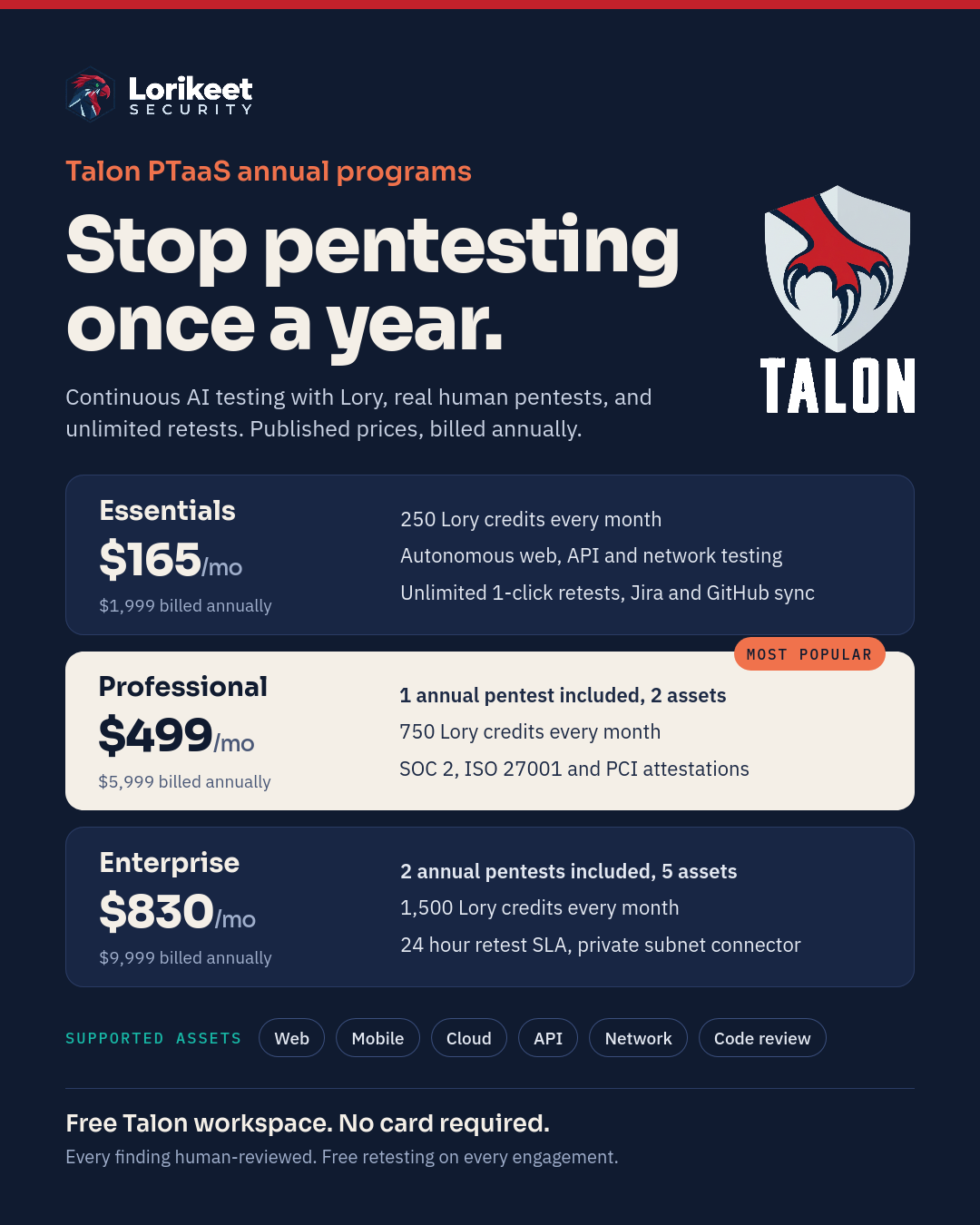
Fortunately, the offensive security market in 2026 has transformed. The rise of modern Pentest as a Service (PTaaS) and autonomous AI security engines—led by platforms like Talon and Lory AI from Lorikeet Security—enables startups to procure continuous offensive coverage and compliance-ready attestations starting at just $165/month ($1,999/year).
This guide provides an actionable blueprint for allocating cybersecurity spend across company growth stages (Seed, Series A, Series B, and Mid-Market), reveals the hidden costs of legacy consulting minimums, and demonstrates how to build an audit-ready offensive security program on a realistic budget.
The Hidden Costs of Legacy Pentesting Engagements
When evaluating an estimate from a traditional pentesting firm, the headline quote on the proposal is rarely the true total cost of ownership (TCO). Startups frequently encounter three unbudgeted expenses that balloon their offensive spend:
- The Retest Penalty Tax ($2,000 to $5,000): Traditional firms include a static report with findings. Once your engineering team develops patches, verifying those fixes requires scheduling a re-testing window. If that retest falls outside a narrow 30-day window, or if secondary remediation is required, consultancies bill change orders of $2,500+ or hourly rates upwards of $350/hr.
- Developer Remediation Friction: When an 80-page PDF arrives with vague findings and generic scanner advice, engineers spend days deciphering the issue, setting up test environments, and guessing how to patch it. In contrast, modern platforms with bi-directional Jira sync and IDE-native AI integration (Talon MCP) save 40+ engineering hours per engagement.
- Deal Stall Delay: If an enterprise prospect requires an updated pentest report within two weeks to close a Q4 deal, waiting four to six weeks for a traditional firm's calendar can push contract execution into the next fiscal quarter—delaying vital revenue.
The Capital Allocation Rule: Never spend more than 35% of your total security budget on static point-in-time penetration testing. The remaining 65% should fund continuous automated validation, developer security tooling, identity management, and compliance automation.
Stage-by-Stage Security Budget Allocation Framework
How much should your company actually spend on offensive security and tooling? Below is the 2026 industry benchmark based on analysis of over 300 venture-backed technology startups:
Pre-Revenue & Initial Launch
Focus: Passing enterprise pilot questionnaires, initial SOC 2 Type 1 readiness, securing the public web application and primary API with autonomous continuous testing.
Product-Market Fit & Scale
Focus: Unlocking enterprise deals, passing SOC 2 Type II and ISO 27001, annual certified human pentest paired with continuous AI probing between releases.
Multi-Product & Regulated Expansion
Focus: Multi-cloud infrastructure, mobile apps, private microservice networks, continuous external attack surface management (ASM), and priority 24h remediation SLAs.
Strategic Budget Allocation Breakdown by Growth Stage
The table below provides recommended percentage and dollar allocations for companies across Seed, Series A, and Series B stages:
| Security Category | Seed Stage ($8,000 Budget) | Series A ($25,000 Budget) | Series B ($60,000 Budget) |
|---|---|---|---|
| PTaaS & Pentesting | $1,999 (Talon Essentials) | $5,999 (Talon Professional) | $9,999 (Talon Enterprise) |
| Autonomous AI Probing (Lory) | Included (250 credits/mo) | Included (750 credits/mo) + $1,000 on-demand | Included (1,500 credits/mo) + $3,000 on-demand |
| Compliance Automation (Vanta/Drata) | $3,500 (Startup bundle) | $7,500 | $15,000 |
| Cloud Posture & Identity (SSO/IAM) | $1,500 (Native AWS/GCP tools + Google SSO) | $5,000 (Okta/JumpCloud + AWS GuardDuty) | $15,000 (Enterprise IDP, Wiz/Orca or CSPM) |
| Endpoint Protection & MDM | $1,000 (Apple Business / Kandji / Jamf) | $3,500 (CrowdStrike / SentinelOne) | $10,000 (Fleet-wide EDR & DLP) |
| Cyber Liability Insurance | $0 – $1,000 | $2,000 | $7,000 |
| Total Annual Spend | $7,999 – $8,999 | $24,999 | $59,999 |
How Talon & Lory AI Fit Startup Financial Models
In the old procurement world, CFOs were forced to sign $20,000 single-purchase order (PO) contracts that hit EBITDA as a lump-sum operational expenditure (OpEx). In modern financial modeling, technology businesses favor predictable, transparent recurring software subscriptions that bundle both the tool and the human service.
Talon Essentials — For Seed & Early-Stage SaaS
For pre-seed and seed startups preparing for their first commercial pilots, Essentials provides continuous autonomous penetration testing for web applications and APIs. It includes 250 Lory credits per month, unlimited 1-click retest verifications, bi-directional Jira/GitHub sync, and auditor-ready readiness summaries for SOC 2 and ISO 27001. At under $2,000 annually, it eliminates the need to delay testing until after your seed funding closes.
Talon Professional — The Series A Standard
The optimal solution for Series A companies undergoing their first formal SOC 2 Type II or ISO 27001 audit. Includes 1x comprehensive annual human penetration test covering up to 2 assets (e.g., your primary React/Node web application and AWS cloud infrastructure) performed by certified Lorikeet offensive engineers. Between assessments, your environment is continuously protected by 750 monthly Lory AI credits. It includes official auditor attestation letters accepted by all major compliance firms.
Talon Enterprise — For Series B & Mid-Market Teams
For multi-product companies, enterprise SaaS, and fintech/healthtech platforms requiring continuous assurance across diverse environments. Includes 2x annual human penetration tests covering up to 5 assets (Web, API, Mobile, Cloud, and Code Review), 1,500 Lory credits/month, the Lory Mesh Private Subnet Connector for behind-the-firewall staging testing, and a guaranteed 24-hour priority retesting SLA.
Autonomous Testing on Demand: Lory AI Credit Economics
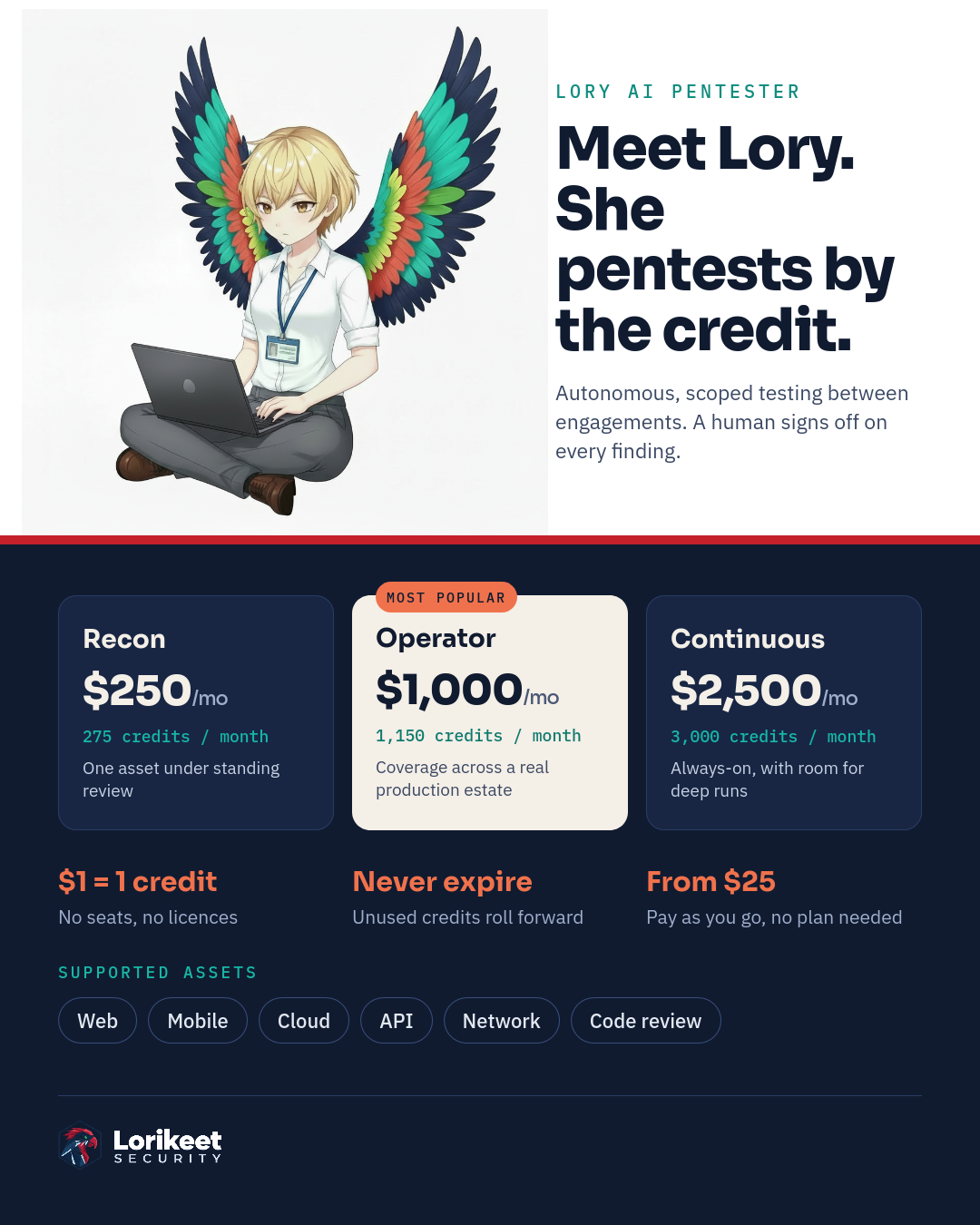
In addition to annual PTaaS subscriptions, Lorikeet Security offers Lory AI Pentester as an autonomous credit-based service. Lory operates on a simple, transparent commercial premise: $1 buys 1 credit, and credits never expire.
How do Lory credits translate into real-world testing costs?
- Surface Reconnaissance & Perimeter Mapping: ~35 to 50 credits ($35–$50). Perfect for pre-flight release checks and continuous attack surface monitoring.
- Standard Web & API Assessment: ~150 to 250 credits ($150–$250). In-depth testing across OWASP Top 10 vulnerabilities, auth bypasses, and IDORs. Every finding is reviewed and verified by a human analyst before publication to eliminate false positives.
- Deep Vector & Chained Exploitation: ~400 to 600 credits ($400–$600). Comprehensive multi-stage probing including business logic flaws and multi-role privilege escalation.
CFO Insight: Because Lory credits never expire, unused credits from lighter development cycles roll forward automatically. This prevents the wasteful end-of-quarter "use-it-or-lose-it" spending traps common with legacy security vendors.
Calculating Pentest ROI for Founders and the Board
Security leaders are frequently asked by the board: "What is the commercial ROI of our offensive security spending?" In 2026, security is no longer an insurance tax—it is an active revenue accelerator:
1. Shortened Enterprise Sales Cycles
The average mid-market B2B SaaS deal stalls in vendor security review for 28 days. When your sales team can provide an active Talon read-only auditor link and a signed Attestation of Remediation within two hours of a prospect's request, security review turnaround drops to under 4 business days. Accelerating deal velocity by three weeks across five enterprise opportunities delivers six-figure cash flow benefits.
2. Elimination of Emergency Retesting Surcharges
On traditional consultancies, a typical SOC 2 cycle requires two rounds of retests after initial findings are patched, generating an average of $5,000 in unexpected change orders. On Talon, unlimited 1-click retests are included across every tier, guaranteeing zero unbudgeted variance on your financial plan.
3. Developer Efficiency Multipliers
Engineering time is the most expensive line item on any tech company's income statement. A senior engineer making $180,000 costs approximately $90/hour. If that engineer spends 25 hours trying to reproduce and remediate poorly documented PDF findings, that single issue cost your business $2,250 in wasted engineering capacity. Talon's exact reproduction proofs and native AI IDE tools cut remediation time by over 70%.
Build an Audit-Ready Security Program That Fits Your Budget
Stop paying $25,000 for static PDF reports that leave your systems blind all year. See how Talon PTaaS delivers continuous protection, unlimited retests, and auditor attestations starting at $165/month.