California boasts the most stringent data privacy regime in the United States. Following the enactment of the California Consumer Privacy Act (CCPA) and its significant expansion under the California Privacy Rights Act (CPRA), businesses operating in or serving residents of California face rigorous obligations regarding how consumer personal information (PI) and sensitive personal information (SPI) are handled.
While much of the public conversation around CCPA/CPRA focuses on cookie banners and "Do Not Sell or Share My Personal Information" links, the law contains a lethal statutory enforcement mechanism that technical leaders often overlook: the private right of action for data security breaches under California Civil Code § 1798.150.
The Cost of Inadequate Security Under CCPA Section 1798.150
Under Section 1798.150, consumers whose non-encrypted and non-redacted personal information is subject to unauthorized access and exfiltration, theft, or disclosure as a result of a business’s failure to implement and maintain reasonable security procedures and practices may institute a civil action to recover:
- Statutory Damages: Between $100 and $750 per consumer per incident, or actual damages, whichever is greater.
- Injunctive or Declaratory Relief: Court orders mandating immediate architectural changes.
- Any Other Relief: Including attorney fees and class certification costs.
The Multiplication Effect: In a modern SaaS or consumer tech platform with 50,000 California users, a single data exfiltration incident resulting from an insecure API or SQL injection creates immediate statutory liability exposure between $5,000,000 and $37,500,000 without consumers having to prove actual financial loss.
Defining "Reasonable Security" in Application Development
The California Attorney General and the California Privacy Protection Agency (CPPA) have repeatedly pointed to the Center for Internet Security (CIS) Controls, NIST Special Publication 800-53, and the OWASP Top 10 as the benchmark for what constitutes "reasonable security."
To establish an affirmative legal defense that reasonable security was maintained, California organizations must demonstrate regular, independent technical testing across three primary exposure vectors:
| Vulnerability Category | CCPA / CPRA Risk Scenario | Talon PTaaS Validation Method |
|---|---|---|
| Broken Object Level Auth (BOLA) | Insecure direct object references in consumer APIs allow harvesting other users' profiles and PII. | Multi-role authenticated autonomous Lory AI sweeps + certified human business logic verification. |
| Exposed Cloud Storage & Buckets | Misconfigured AWS S3 buckets or Azure Blob containers leaking unencrypted user documents and KYC data. | Continuous perimeter recon and cloud IAM permission boundary auditing. |
| Third-Party Script Leakage | Analytics tags and client-side JavaScript scraping sensitive form inputs during account registration. | Deep client-side DOM analysis, CSP verification, and token exfiltration audits. |
| Unauthenticated GraphQL Introspection | Hidden backend mutations exposed to public queries, enabling batch extraction of personal records. | Automated schema reconstruction, batch query stress testing, and depth limit validation. |
How Talon PTaaS Proves Defensible Compliance
Proving reasonable security cannot be accomplished by running a static vulnerability scanner once a year. Modern web applications update continuously, and modern privacy regulations demand continuous hygiene.
Talon PTaaS delivers a complete compliance shield for California engineering teams:
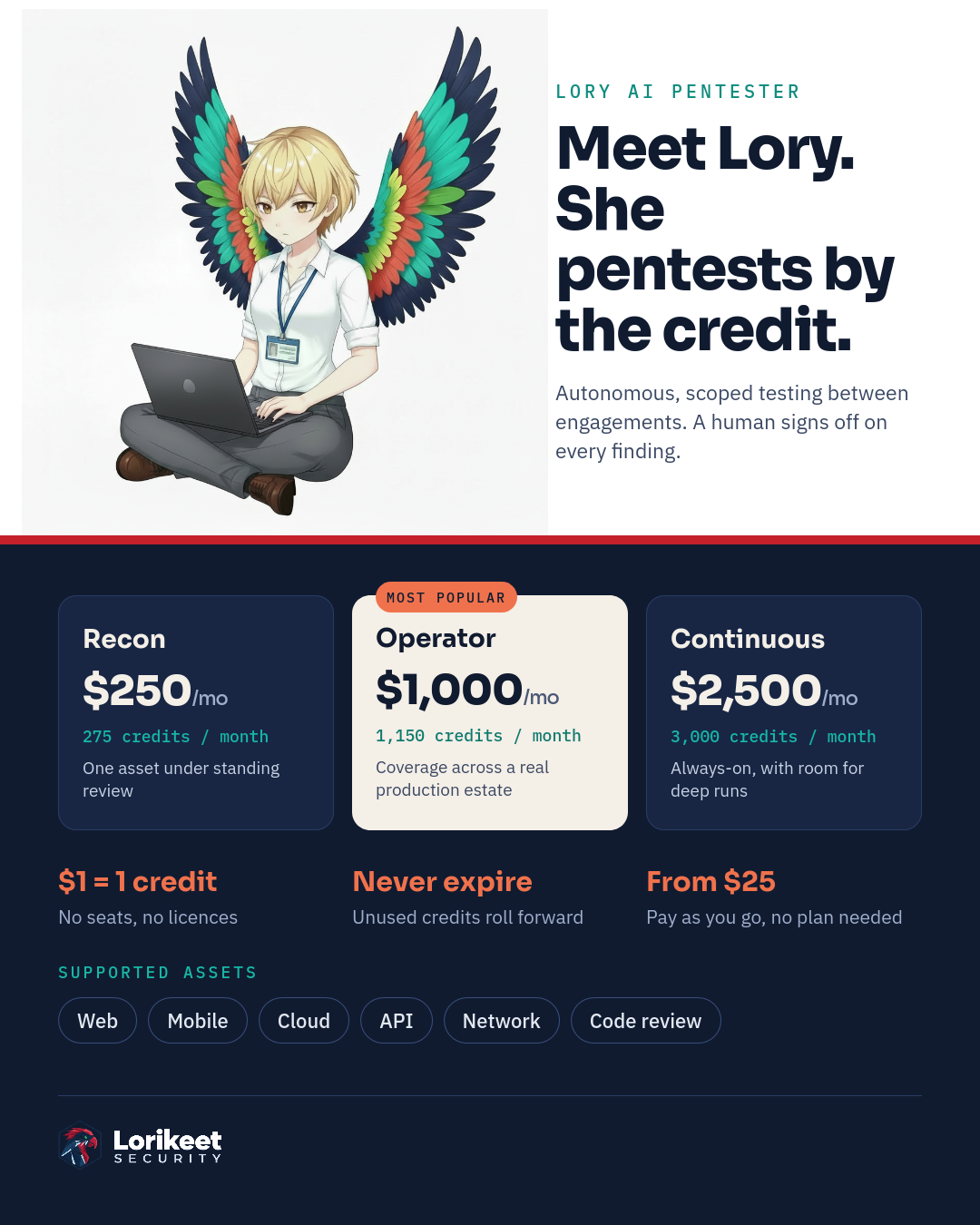
- Continuous Autonomous Probing: Lory AI tests every in-scope asset between major releases, identifying misconfigurations and auth bypasses the moment they are introduced.
- Certified OSCP/CISSP Human Verification: Pure AI scanners produce false alarms that distract engineering. Every vulnerability surfaced in Talon is countersigned by a senior human penetration tester.
- 1-Click Remediation & Retesting: When engineering fixes a vulnerability, they click "Request Retest" directly on the finding card. Talon validates the patch and issues a cryptographically signed Attestation Letter.
- Audit Trail for Regulatory Inquiries: In the event of an audit or inquiry from the California Privacy Protection Agency, Talon provides complete historical logs proving consistent, recurring adversarial testing.
Protect Your Business from CCPA Statutory Liability
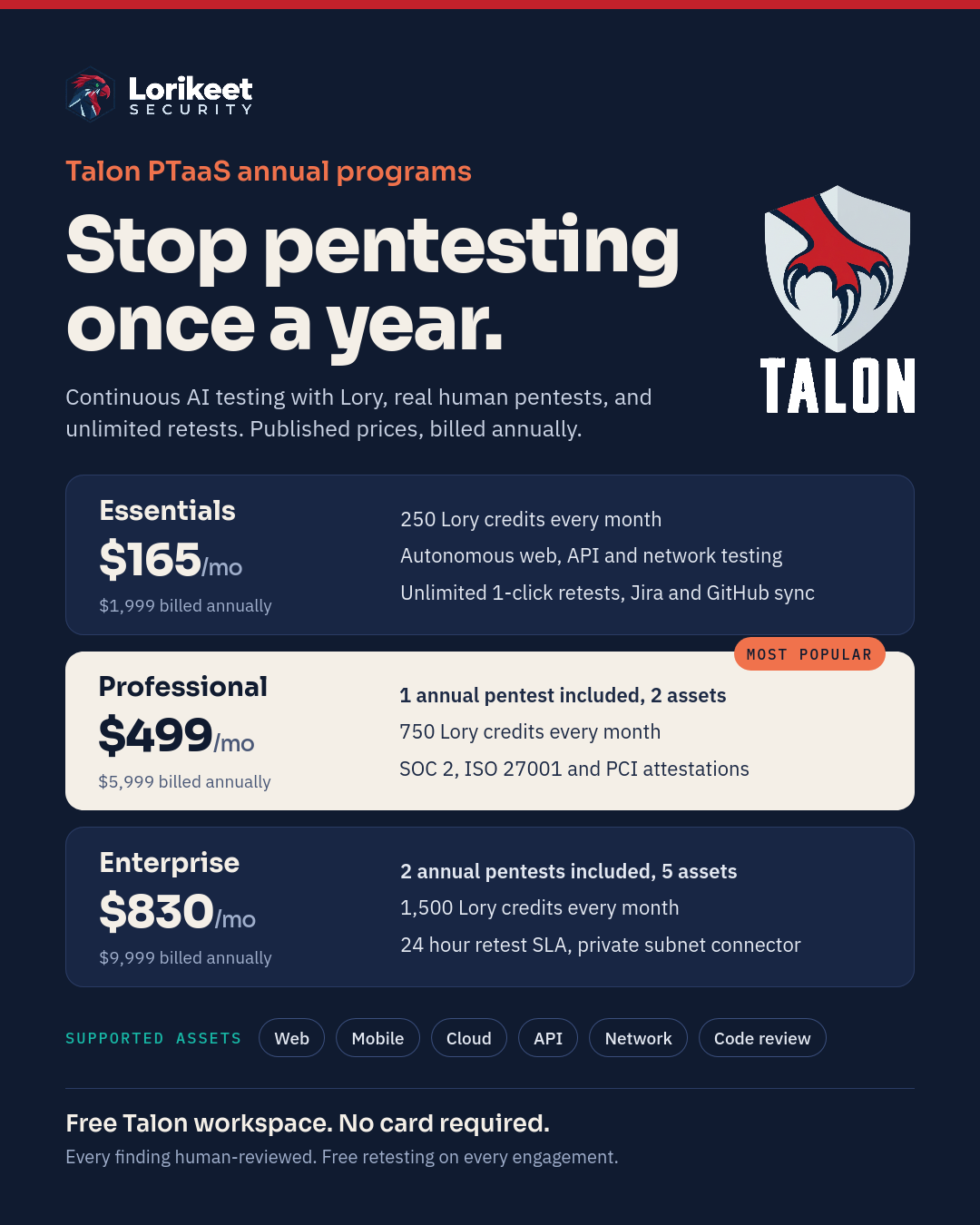
Deploy continuous penetration testing and demonstrate defensible "reasonable security" starting at $165/month with Talon PTaaS.