Why Pure AI Scanners Fail Compliance: The Power of Human-in-the-Loop Pentesting with Lory & Talon
In 2026, the cybersecurity market is inundated with venture-backed startups promising "Fully Autonomous 100% AI Penetration Testing." Marketing pitch decks claim that Large Language Models (LLMs) can replace human security engineers entirely, running fully unmonitored scripts against production networks with zero human intervention.
Yet when companies hand these "pure AI pentest" outputs to enterprise procurement officers, Fortune 500 vendor risk assessors, or SOC 2 Type II and ISO 27001 auditors, the deliverables are routinely and unceremoniously rejected.
Why? Because there is an immense regulatory, legal, and operational chasm between an automated vulnerability scan and a certified, defensible penetration test.
In this article, we examine why pure AI scanners consistently fail compliance standards, the devastating cost of scanner hallucinations on engineering productivity, and why the future of offensive security belongs to the Human-in-the-Loop (HITL) model pioneered by Talon and Lory AI.
The Auditor's Rule: AICPA SOC 2 Trust Services Criteria (CC7.1) and ISO 27001 (Annex A 8.8) mandate independent, qualified evaluation of vulnerabilities. An unvalidated machine output that has not been verified by a qualified human tester is classified as an automated vulnerability scan — not a penetration test.
The Three Fatal Flaws of Pure AI Security Scanners
1. The False Positive Avalanche (Hallucination Fatigue)
Generative AI models are probabilistic correlation engines. When an autonomous AI tool tests a web application, it generates dozens of speculative attack vectors. If an endpoint returns an unusual HTTP 500 error or echoes back a reflected quotation mark, an uncalibrated AI model frequently flags a "Critical SQL Injection" or "Remote Code Execution."
In reality, the endpoint was simply returning a generic database error from an ORM, and no data extraction was possible. When an engineering team connects a pure AI scanner to their issue tracker, developers quickly suffer from alert fatigue. After wasting 40 hours debugging three imaginary critical vulnerabilities, engineers lose all confidence in the security tool and begin ignoring its output.
2. Business Logic Blindness
The most severe real-world security breaches in modern SaaS platforms do not involve textbook SQL injections or missing HTTP headers. They involve broken business logic:
- An authenticated tenant in an e-commerce platform modifying a UUID parameter to access competitor invoice records (BOLA / IDOR).
- A user applying a 100% discount coupon three consecutive times in a checkout race condition.
- A tenant administrator elevating their role to system superuser through an undocumented API edge case.
A raw LLM lacks institutional business context. It cannot distinguish between an intentional application feature and a catastrophic authorization leak without guided context and human insight.
3. Destructive Production Hazards
Offensive security requires weaponized payloads. When an unconstrained AI agent is given free rein to generate HTTP payloads against a live production or staging environment, it can inadvertently trigger denial-of-service conditions, lock administrative accounts, drop database tables, or spam production webhook integrations with garbage data.
What Enterprise Procurement & SOC 2 Auditors Actually Demand
When a prospective enterprise customer’s Chief Information Security Officer (CISO) reviews your third-party security assessment, they look for specific criteria that pure AI tools cannot satisfy:
| Audit Requirement | Pure AI Scanner | Talon PTaaS + Lory HITL | Enterprise Compliance Impact |
|---|---|---|---|
| Attestation of Methodology | Generic algorithm prompt documentation | OWASP ASVS & PTES standard testing protocols | Passed by top CPA auditors (Drata/Vanta accepted) |
| Human Practitioner Sign-Off | None (Machine generated) | Certified OSCP/CREST offensive engineers | Satisfies enterprise vendor risk questionnaires |
| Exploitation Evidence (PoC) | Speculative screenshots or prompt traces | Verified curl commands & deterministic repro steps | Zero false positives for development teams |
| Remediation Verification | Rescan that re-flags false positives | Human-verified 1-click retest attestation | Unlocks signed Attestation Letter in 72 hours |
| Target Safety Guarantees | High risk of production data corruption | Strict scope boundaries & safe payload guardrails | Safe execution on live staging and production |
The Talon Solution: Human-in-the-Loop Architecture
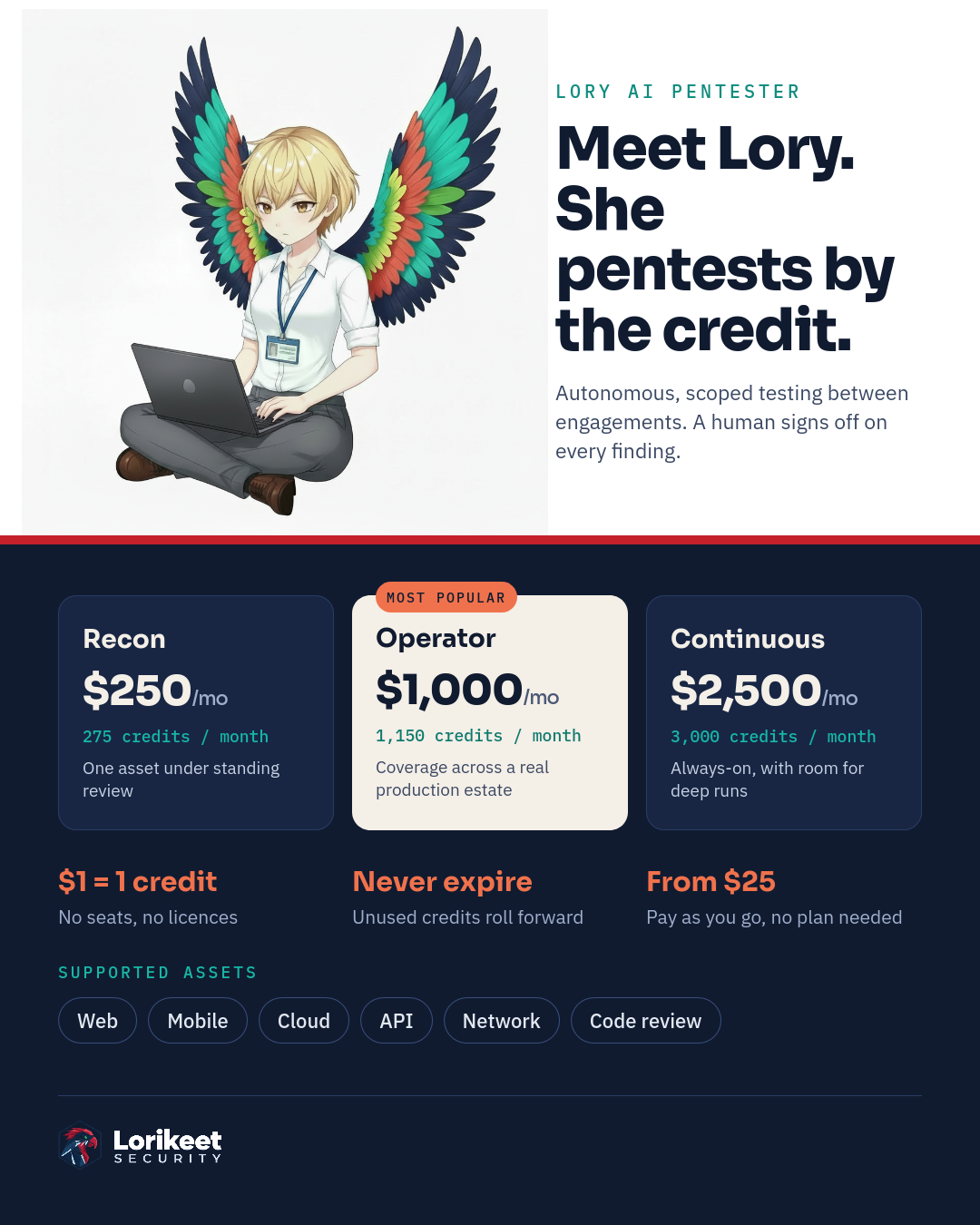
At Lorikeet Security, we reject the false binary between slow, expensive manual consulting and inaccurate, noisy automated scanning. The Talon Platform combines the superhuman speed and scale of Lory AI with the seasoned judgment of certified human offensive engineers.
1. Autonomous Speed & Scale
Lory acts as a tireless offensive force multiplier. She crawls complex SPAs, fingerprints technologies, maps API parameters, and runs 57+ targeted exploit playbooks in parallel. What takes a human pentester 3 days of manual parameter fuzzing, Lory executes in under 2 hours.
2. Certified Human Gatekeeper
Every prospective vulnerability discovered by Lory enters an internal Lorikeet triage queue. A senior offensive security engineer validates the proof-of-concept, eliminates false positives, adjusts CVSS scores to reflect your actual architecture, and writes tailored code-level remediation guidance.
3. Developer-Ready MCP Integration
Findings do not arrive as a cryptic PDF attachment. They stream directly into your Talon dashboard, sync with Jira/GitHub, and are accessible directly inside modern AI IDEs like Claude Code and Cursor via the Talon MCP Server for instant patch generation.
4. Defensible Attestation Letters
Once your team deploys a fix and clicks "Request Retest," our human analysts verify the remediation. When all high and critical issues are resolved, Talon issues an updated, countersigned Attestation of Penetration Testing accepted by all major compliance auditors and enterprise procurement teams.
Real-World Comparison: The Cost of Noise vs. The Power of Signal
A Series B logistics SaaS platform recently tested two approaches during their SOC 2 renewal:
- The Pure AI Tool: An automated AI security scanner was pointed at their staging environment. It ran for 6 hours and generated 142 findings. Over the next week, three senior engineers spent 45 collective hours investigating the report, only to discover that 138 of the findings were cosmetic header notices or false alarms. The auditor rejected the report because it lacked a certified pentester attestation letter.
- Talon PTaaS + Lory: The platform enrolled in Talon Professional ($499/mo). Lory executed a comprehensive autonomous assessment, identifying 6 authentic vulnerabilities, including an authorization flaw in a freight tracking webhook. Lorikeet's Lead Security Engineer reviewed, verified, and countersigned the 6 findings. The development team patched them within 48 hours, requested 1-click retests at zero extra cost, and received their countersigned SOC 2 attestation letter the following morning.
Evaluation Checklist: How to Vet an Offensive AI Vendor
Before purchasing any AI-driven security testing solution, ask the vendor these four essential compliance questions:
- "Is every finding reviewed and verified by a named human security engineer prior to delivery?" If the answer is no, prepare for alert fatigue and developer friction.
- "Does your final deliverable include a signed Attestation of Penetration Testing from a certified practitioner (OSCP, CREST, CEH)?" If the answer is no, your compliance auditor will reject the report as a mere vulnerability scan.
- "Are remediation retests included for free, or do they cost extra?" Talon includes unlimited 1-click retests on all subscription tiers.
- "Can our developers query the vulnerability context directly in Cursor or Claude Code?" Talon’s native MCP server allows developers to retrieve exact exploit payloads and remediation guidance directly in their development environment.
Achieve Zero False Positives with Talon & Lory
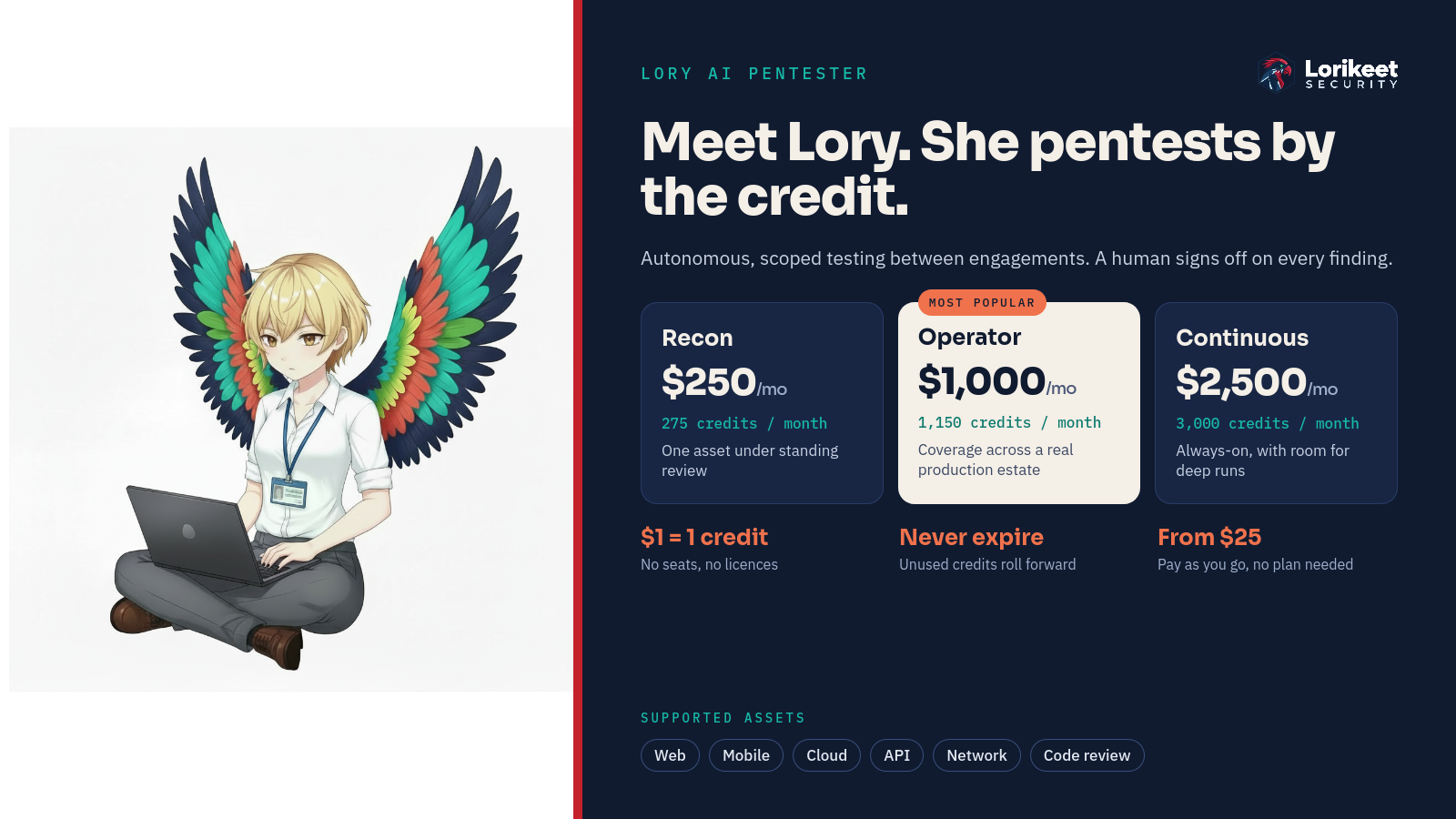
Experience the speed of autonomous AI pentesting backed by certified human security experts. Launch your free workspace, top up pay-as-you-go credits from $25, or book a live architecture demo.