Stop Pentesting Once a Year: Why Modern SaaS Teams Are Switching to Continuous PTaaS
Imagine a commercial airline that only inspects its jet engines once every twelve months, regardless of how many hundreds of transcontinental flights it flies each week. If maintenance engineers discovered a hairline crack in a turbine blade during that single annual inspection, they would congratulate themselves on passing the audit — while ignoring the fact that passengers were flying on compromised engines for months prior.
As absurd as that scenario sounds, it is the exact operational standard most software companies follow today for cybersecurity.
Modern engineering organizations deploy code to production twenty, fifty, or even one hundred times a week. Feature flags toggle new endpoints in real-time, Terraform scripts update cloud IAM boundaries hourly, and AI assistants write thousands of lines of new business logic every day.
Yet for penetration testing, companies still schedule an annual ritual: hiring a traditional consulting firm for two weeks every spring, collecting an encrypted 60-page PDF report, checking an internal compliance box, and doing nothing offensive for the remaining 364 days of the year.
The Temporal Disconnect: An annual penetration test is an obituary, not an ongoing defense. It documents what was broken during a single arbitrary week in the past, giving zero assurance about what you deploy to production this afternoon.
The Three Catastrophic Failure Modes of Annual Pentests
1. The Rapid Code Drift Problem
The minute a penetration testing firm finishes testing your application, your code begins to drift. Within two weeks of receiving the final report, your team has merged pull requests containing new database migrations, modified authentication token lifetimes, third-party webhook integrations, and updated npm dependencies.
If an engineer introduces a Broken Object Level Authorization (BOLA/IDOR) flaw in an account settings endpoint three weeks after the annual test, that vulnerability will sit wide open in production until the next annual audit window — providing malicious actors a massive 11-month exploitation window.
2. The Remediation Impasse & The Retest Tax
In a traditional pentest, fixing an issue is agonizingly slow. Developers receive a static PDF. They must manually recreate vulnerabilities without interactive tools or direct access to the tester.
Once a patch is deployed to staging, verifying that the fix works requires reopening contract discussions with the consulting firm or paying a $2,500+ retesting fee. Because of this friction, up to 40% of findings identified in annual pentests are never formally retested, leaving teams unsure if their remediation actually closed the vector.
3. The Compliance Panic Cycle
When SOC 2 Type II or ISO 27001 surveillance audit deadlines approach, engineering teams scramble. They realize their previous pentest report is 11 months old and will expire before the audit observation period concludes. They scramble to book an emergency engagement with boutique firms that have 6-week waiting lists, paying steep expedite fees simply to unblock an auditor’s checklist.
Side-by-Side: The Three Models of Penetration Testing
| Capability | 1. Annual Boutique Pentest | 2. Quarterly Scans / Bug Bounty | 3. Continuous PTaaS (Talon Platform) |
|---|---|---|---|
| Testing Frequency | Once per year (14-day window) | Periodic or unpredictable crowd submissions | Continuous autonomous testing + scheduled human audits |
| Finding Delivery | Static PDF after 2-3 weeks delay | Raw scanner alerts or unvetted bug reports | Real-time live dashboard with verified PoCs |
| False Positive Rate | Low (manual testing) | Very high (scanners flood inbox) | 0% (Every finding is human-countersigned) |
| Retesting & Verification | $2,500 – $5,000 extra fee; slow schedule | Manual re-review per submission | Unlimited 1-click retests included at $0 cost |
| Auditor Deliverables | Heavy PDF requiring manual redaction | Disjointed export files | Instant SOC 2 & ISO 27001 attestations & live links |
| Annual Cost | $25,000 – $60,000+ per year | $15,000 – $40,000 (plus bounty payouts) | From $1,999 to $5,999 / year all-inclusive |
The Four Pillars of Continuous PTaaS Architecture
Transitioning to Continuous Penetration Testing as a Service does not mean burdening your developers with 24/7 security noise. Instead, modern platforms like Talon combine human expertise with autonomous agent orchestration across four synchronized layers:
Layer 1: Standing Autonomous AI Sweeps (Lory AI)
Between formal human pentests, our autonomous security agent Lory continuously monitors your perimeter, verifies newly exposed endpoints, and executes deterministic playbooks against modern application logic. When your team adds a new GraphQL schema or changes CORS policies, Lory assesses the delta within hours.
Layer 2: Deep Human Offensive Engagements
Annual compliance frameworks (SOC 2, ISO 27001, PCI DSS) demand certified human offensive engineering. Talon plans include full-scope human penetration testing conducted by senior Lorikeet researchers (OSCP, CREST). Our engineers focus on high-order business logic flaws, multi-tenant isolation breaches, and complex privilege escalations that scanners cannot touch.
Layer 3: Instant 1-Click Retesting
When an issue is surfaced, developers get exact curl commands, HTTP requests, and stack-specific remediation guidance directly in Jira, GitHub, or Cursor via Talon's MCP server. Once fixed, developers click "Request Retest" on the finding card. A security engineer verifies the patch in staging, and the issue is resolved with zero extra retesting fees.
Layer 4: Real-Time Auditor Attestations
Rather than digging through archived Google Drive folders to find old PDF reports, compliance teams generate dynamic, time-limited auditor access links. Auditors can view the current security posture, verify that all critical vulnerabilities have been remediated, and download freshly signed Attestation Letters in 72 hours.
How a High-Growth SaaS Switched to Continuous PTaaS in 7 Days
Consider the real-world trajectory of a fast-growing B2B fintech company handling ACH transfers and payroll integrations. In 2025, they followed the traditional playbook:
- They contracted an annual pentest for $32,000 in May.
- In August, they migrated their identity provider to AWS Cognito and added OAuth token refresh flows.
- In November, an automated scanner detected an open configuration issue, but couldn't verify if it was exploitable.
- During their December SOC 2 Type II audit, the auditor flagged that their identity architecture had changed drastically since May and requested evidence of ongoing testing, putting their audit on hold for six weeks.
In 2026, the company migrated to Talon PTaaS Professional ($5,999/year):
- Immediate Baseline Human Pentest: Senior Lorikeet engineers executed a comprehensive scoped pentest across their web app and cloud API, producing an auditor-ready attestation within 72 hours of kickoff.
- Standing Lory AI Coverage: With 750 credits per month included in their subscription, Lory executed automated Standard engagements after every sprint deploy.
- Zero Retest Friction: When an IDOR vulnerability in an invoice export endpoint was discovered, developers patched it within 3 hours and clicked "Request Retest." The patch was verified and closed the next morning at zero additional cost.
- Audit Success: Their SOC 2 auditor was given read-only access to their Talon Compliance Center, clearing control criteria in a single afternoon.
Migration Checklist: Are You Ready for Continuous PTaaS?
If your organization meets any of the following criteria, continuing with annual point-in-time pentests is creating unnecessary financial and security risk:
- Deploy Frequency: You deploy code updates to production at least once every two weeks.
- Compliance Obligations: You have an active SOC 2 Type II, ISO 27001, or HIPAA compliance mandate that requires proving security controls are continuously operated.
- Enterprise Sales Blockers: Prospective enterprise buyers frequently request updated security questionnaires, pentest summaries, or remediation proofs.
- Cost Sensitivity: You want to eliminate unpredictable consulting fees and $3,000 retest change orders in favor of a predictable annual operational expenditure.
Upgrade from Static PDFs to Continuous PTaaS
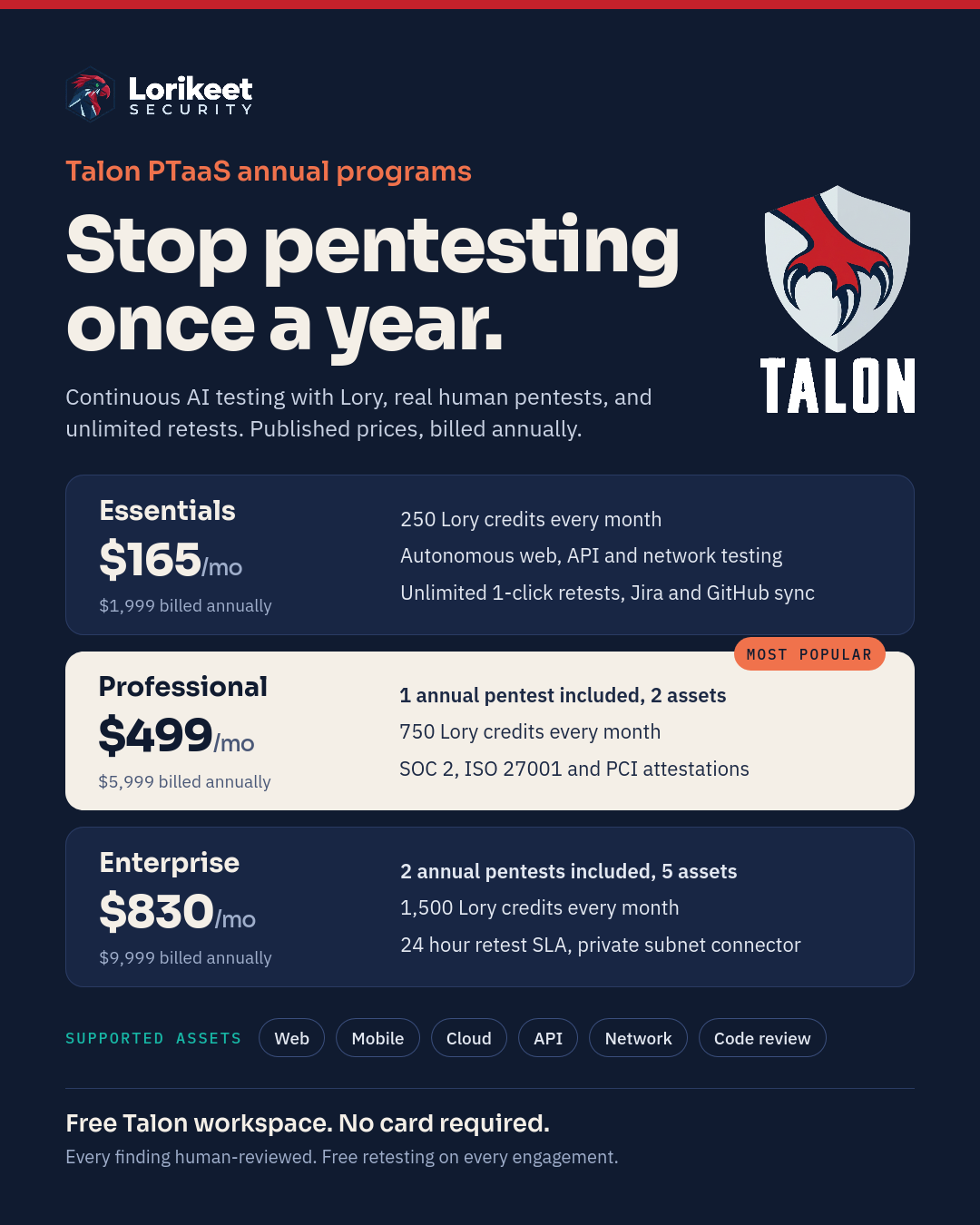
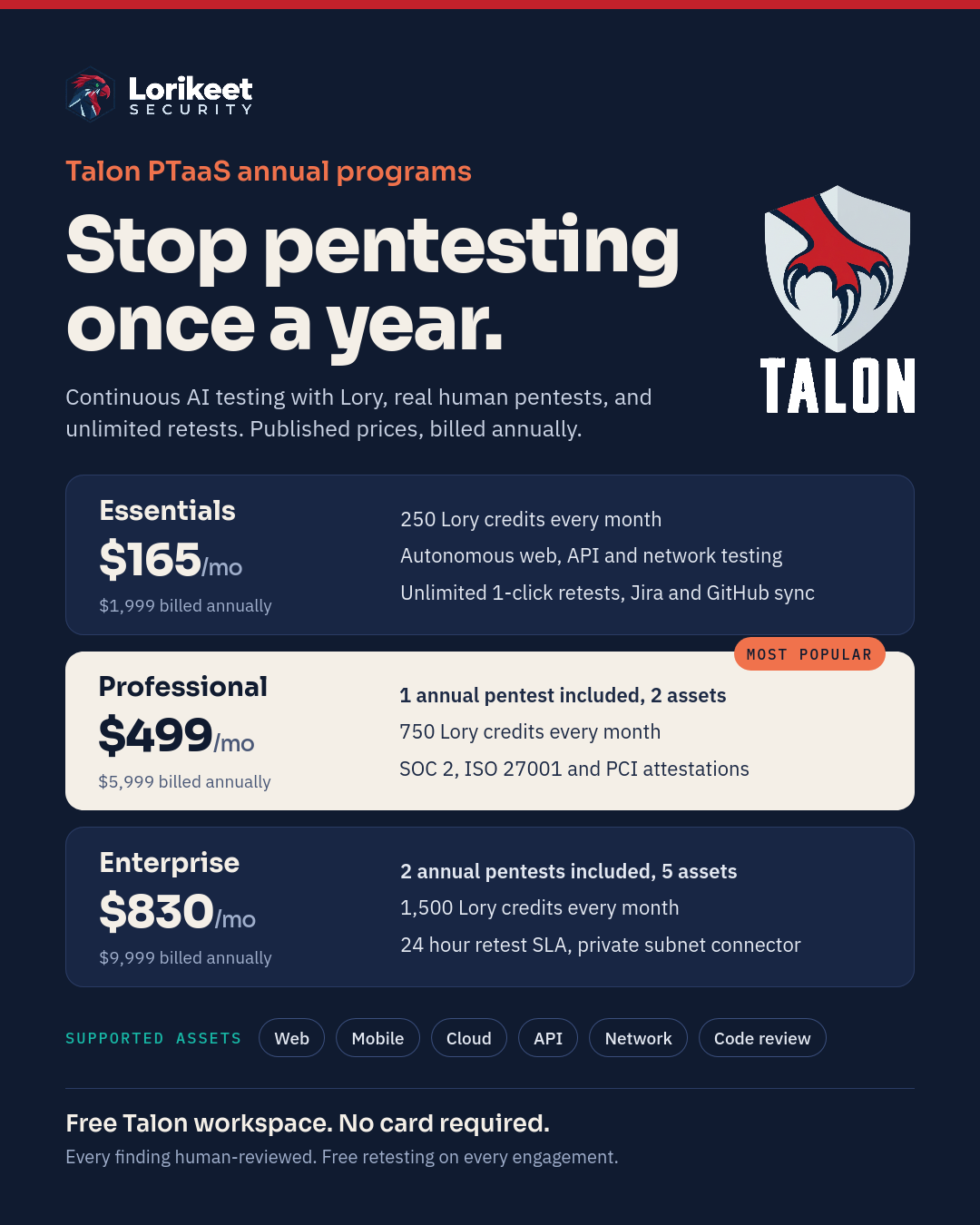
Eliminate your 364-day blind spot today. Experience continuous offensive security with Talon and Lory AI starting at $165/month, or calculate your full pentesting scope in seconds.