For early-stage and growth-stage SaaS founders in Silicon Valley, nothing accelerates company trajectory faster than closing a marquee enterprise customer. A single contract with a Fortune 500 financial institution, a national healthcare conglomerate, or a multinational tech giant can represent $100,000 to $500,000+ in Annual Contract Value (ACV), instantly validating your product-market fit and unlocking your next venture round from Sand Hill Road.
Yet for dozens of promising Bay Area software startups every month, these transformative enterprise deals die in the final mile. The product champion has signed off, the procurement department has agreed on pricing, and legal is reviewing the Master Services Agreement (MSA). Then, the enterprise Chief Information Security Officer (CISO) and Third-Party Risk Management (TPRM) team enter the conversation, delivering a 350-question security assessment and an uncompromising ultimatum:
"Please provide your current SOC 2 Type II report, an executive Letter of Attestation from a third-party penetration test conducted within the last 12 months, and proof that all Critical and High vulnerabilities have been remediated. Vendor review will pause until these artifacts are provided."
If your security posture consists of an outdated automated vulnerability scan or an expired point-in-time penetration test, your deal stalls. Sales cycles drag out by 90 to 120 days, competitors with certified security credentials swoop in, and your quarterly revenue targets evaporate.
This playbook outlines the exact blueprint Silicon Valley founders, CTOs, and heads of security use to pass enterprise vendor security reviews, satisfy strict investor due diligence, and operationalize SOC 2 Type II compliance through continuous Penetration Testing as a Service (PTaaS) with Talon PTaaS.
Sand Hill Road VC Expectations: The Economics of Security Due Diligence
Venture capital partners across Menlo Park, Palo Alto, and San Francisco—from Andreessen Horowitz and Sequoia to Founders Fund and Kleiner Perkins—evaluate startups through the lens of enterprise scalability. In the current funding climate, growth alone is insufficient; capital efficiency and enterprise net revenue retention (NRR) dictate valuations.
When investors conduct technical and operational due diligence for Series A and Series B rounds, security readiness is directly correlated with investment terms:
- De-risking the Sales Pipeline: If a startup's sales pipeline depends on enterprise deals, but the company lacks SOC 2 Type II and third-party pentest attestations, VCs apply a significant discount to projected forward revenue. Investors know from painful experience that deals without security compliance will slip quarters.
- M&A and Public Readiness: Acquirers (such as Microsoft, Salesforce, Cisco, and Google) audit a target company's security history as a primary condition of acquisition. A documented, multi-year record of continuous penetration testing and zero unresolved critical findings protects equity valuations during exit negotiations.
- Eliminating Breach Liability: With California regulatory scrutiny under CPRA and federal FTC enforcement reaching all-time highs, investors refuse to back software companies that treat customer data protection as an afterthought.
Deconstructing the Enterprise Vendor Risk Assessment
Enterprise security questionnaires are not arbitrary hurdles; they are standardized frameworks designed to transfer liability and assess supplier risk. When selling to the Global 2000, founders encounter three dominant assessment formats:
| Assessment Framework | Governing Body & Focus | Mandatory Pentest & AppSec Requirements |
|---|---|---|
| Shared Assessments SIG (Core / Lite) | Financial services, banking, insurance, healthcare | Mandates annual external network & web app pentesting; requires formal remediation validation and documented vulnerability timelines |
| CSA CAIQ v4 (Consensus Assessments) | Cloud Security Alliance; enterprise cloud buyers | Evaluates Application Security (AAC), Identity (IAM), and Threat Management (TVM); requires independent third-party offensive validation |
| Vendor Security Alliance (VSA) / Whistic | Tech giants, media conglomerates, retail enterprises | Demands independent third-party penetration test reports with verified CVSS v3.1 / v4 scoring and letter of attestation |
| Custom Enterprise Security Review | Fortune 500 in-house infosec teams | 200–500 bespoke questions; demands architectural diagrams, API authentication specs, and live auditor verification links |
Regardless of which questionnaire lands in your inbox, question after question converges on one critical requirement: Can you prove that an independent offensive security expert attempted to hack your production application and verified your defenses?
SOC 2 Type II: Why Point-in-Time Audits No Longer Suffice
Many early-stage founders confuse SOC 2 Type I with SOC 2 Type II. A Type I audit merely validates that your security policies were suitably designed on a single date (e.g., November 15th). Enterprise procurement officers routinely reject Type I reports as inadequate for production vendors.
Enterprise buyers demand a SOC 2 Type II examination, which evaluates whether your operational security controls functioned effectively throughout an observation period spanning 3, 6, or 12 continuous months.
Under AICPA Trust Services Criteria, continuous penetration testing directly fulfills three core criteria:
- CC7.1 (Vulnerability Detection & Assessment): The entity uses detection and monitoring procedures to identify changes to configurations that result in the introduction of new vulnerabilities.
- CC7.2 (Security Incident Monitoring & Testing): The entity monitors system components and the operation of controls to identify anomalies and security incidents.
- CC4.1 & CC8.1 (Change Management & Mitigation): Demonstrating that new features, API updates, and cloud infrastructure changes undergo rigorous security validation prior to or immediately following production release.
The Nightmare of the Traditional "Pre-Audit Scramble"
The legacy approach to penetration testing is fundamentally broken. Here is how the typical, painful cycle plays out at most Bay Area startups:
- Month 10 of Observation Window: The compliance manager realizes the SOC 2 Type II audit window closes in 30 days and the company has not yet completed its annual penetration test.
- The Boutique Consultancy Booking Rush: The startup frantically contacts legacy San Francisco security consultancies, only to discover a 4-to-6 week scheduling backlog. They pay an expedited fee, driving the cost up to $35,000–$50,000.
- The 60-Page PDF Drop: Two weeks before the audit deadline, the consultancy drops a dense, unformatted 65-page PDF report containing 12 High and Critical vulnerabilities (such as BOLA flaws, missing CORS configurations, and leaked tokens).
- Feature Freeze & Developer Burnout: Engineering leadership halts the product roadmap. Sprints are cancelled. Developers work late nights attempting to decipher vague PDF recommendations.
- The Retesting Impasse: The engineering team commits fixes, but the consulting firm demands an extra $5,000 retesting fee and informs the startup they cannot re-assign testers for another three weeks. The SOC 2 observation window closes, the auditor notes an unresolved security exception, and the enterprise contract remains unsigned.
Continuous PTaaS: How Silicon Valley Leaders Operationalize Security
Modern Silicon Valley SaaS companies reject the pre-audit panic by adopting Continuous Penetration Testing as a Service (PTaaS). Rather than treating security testing as a terrifying annual cliff event, Talon PTaaS integrates offensive testing into the daily rhythm of software development:
| Operational Dimension | Traditional Annual Pentest | Continuous PTaaS (Talon Platform) |
|---|---|---|
| Compliance Readiness | High-risk scramble at end of audit window | Permanent, 365-day continuous audit readiness |
| Auditor Evidence | Single stale PDF with unresolved point-in-time bugs | Live auditor portal showing continuous testing & fast MTTR |
| Developer Experience | Massive PDF dump interrupting sprint cycles | Real-time GitHub/Jira tickets with copy-paste exploit code |
| Retesting Friction | Weeks of scheduling delays + expensive retest fees | Instant 1-Click Retesting included at zero extra cost |
| Impact on Sales | Deals paused for 60–90 days awaiting report | Instant Letter of Attestation delivered to enterprise CISO |
The Secret Weapon: Unlimited 1-Click Retesting
In enterprise sales, time kills all deals. If an enterprise CISO identifies an open finding during vendor review, their requirement is simple: "Show me verified proof that this vulnerability is remediated."
With Talon PTaaS, your developers do not wait weeks for a consultant to return to their desk. When a patch is merged to your staging or production branch:
- The developer clicks "Retest" directly inside the Talon web platform.
- Our offensive engine immediately executes the exact reproduction exploit payload against the updated target endpoint.
- Lorikeet's Lead Offensive Security Engineers verify that the patch is effective and does not introduce regression bypasses.
- The finding is officially stamped as "Verified Remediated", and our platform automatically re-generates an updated Executive Letter of Attestation.
- Your account executive sends the updated attestation link directly to the prospect's security reviewer within 24 hours of code deployment.
The Founder's Enterprise Security Checklist
Before submitting your product to an enterprise vendor security review, ensure your team has completed these ten essential milestones:
1. Obtain an Active Third-Party Penetration Test
Ensure your test was conducted within the past 12 months by a certified third-party firm (CREST, OSCP). Automated vulnerability scans will be immediately rejected by enterprise TPRM teams.
2. Eliminate All Critical & High Vulnerabilities
Enterprise risk policies prohibit approving vendors with open Critical or High severity findings. If a finding cannot be immediately resolved, document an explicit mitigating control and remediation target date.
3. Prepare an Executive Letter of Attestation
Never email an unredacted 70-page penetration test containing sensitive exploit payloads to an external party. Enterprise procurement only requires the Letter of Attestation detailing methodology, scope, testing dates, and verified clean posture.
4. Enforce Enterprise Role-Based Access Control (RBAC)
Ensure your application supports granular tenant isolation, multi-factor authentication (MFA) enforcement, and enterprise Single Sign-On (SAML/SSO via Okta, Entra ID, or Google Workspace).
5. Publish a Public Trust Center
Leading Silicon Valley startups host a public-facing security trust portal (e.g., `trust.yourcompany.com`) displaying compliance badges, encryption policies, subprocessors, and NDA-gated report downloads.
Talon PTaaS Plans: Built for High-Growth Silicon Valley Startups
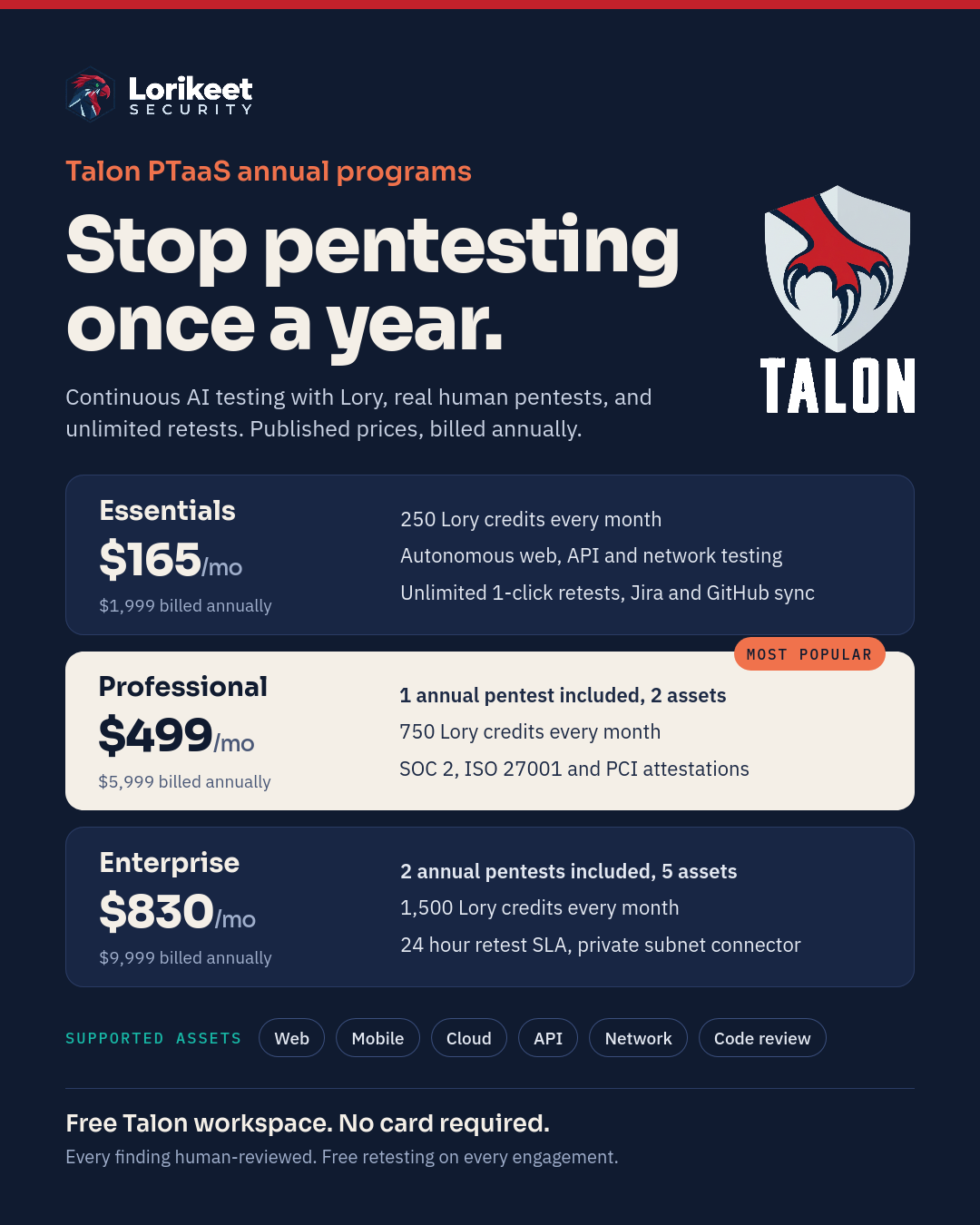
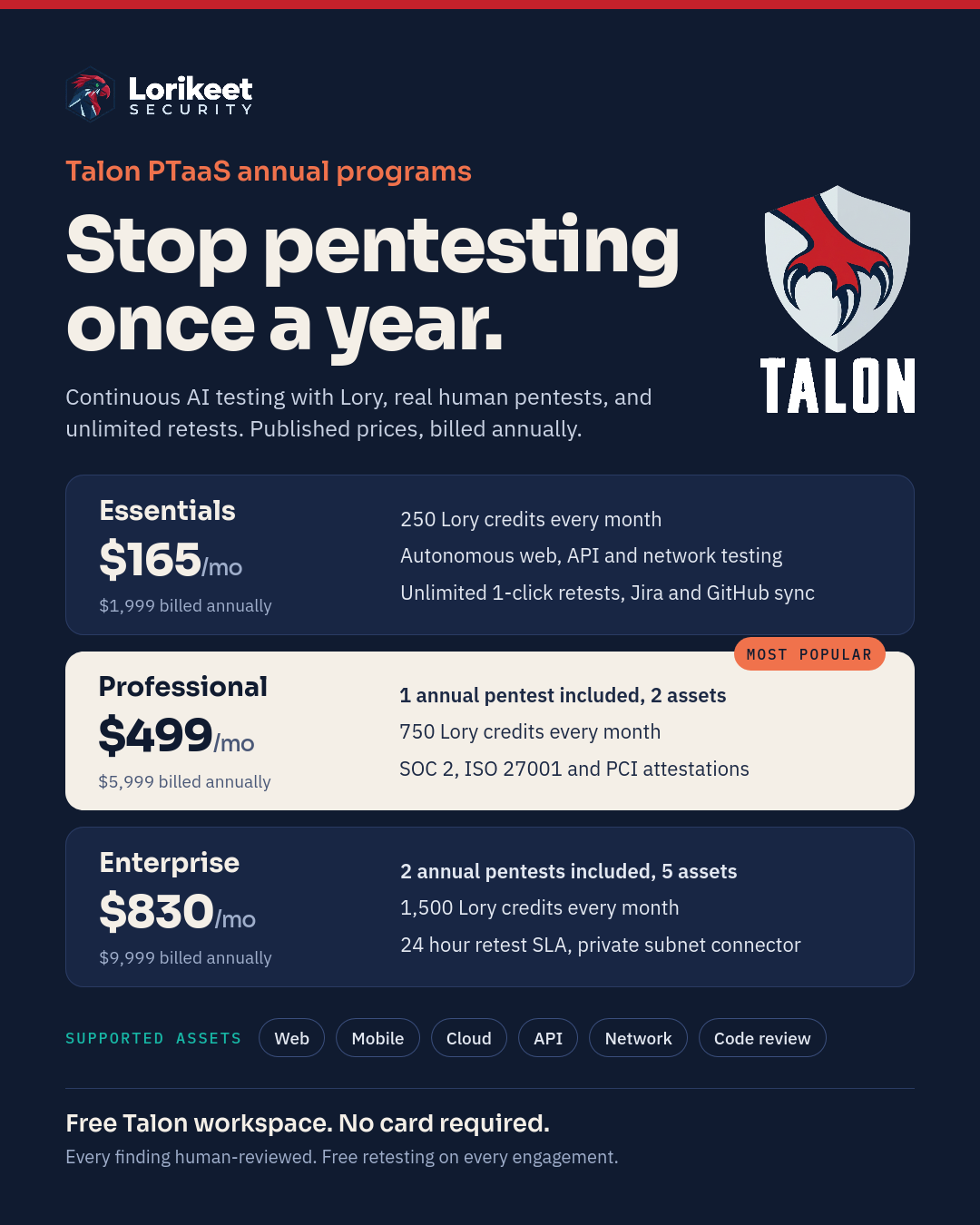
Lorikeet Security offers transparent, predictable annual pricing designed to fit startup cash flows while satisfying the strictest Fortune 500 audit standards:
Talon Essentials
Billed annually ($1,980/year). Ideal for Seed and Pre-Seed startups establishing continuous offensive hygiene before their first SOC 2 audit.
- Continuous external attack surface mapping
- Autonomous vulnerability sweeps
- GitHub, Jira, and Linear integration
- Cursor & Claude Code MCP server
- Unlimited automated retesting
Talon Professional
Billed annually ($5,988/year). The complete compliance package for Series A/B startups closing enterprise deals and pursuing SOC 2 Type II.
- Full Annual Human Pentest Included
- Continuous autonomous offensive testing
- Up to 2 primary web/API assets
- Unlimited 1-click retest verification
- Certified SOC 2 & ISO 27001 Attestation
- Direct Slack access to Lead Pentester
Talon Enterprise
Billed annually ($9,960/year). Designed for multi-asset SaaS companies with complex cloud infrastructure and strict vendor SLAs.
- Comprehensive coverage for multiple products
- Private VPC testing via WireGuard tunnels
- 24-hour SLA on critical retest verification
- Dedicated Security Advisory & SIG review support
- Board-level executive security presentations
Accelerate Your Enterprise Sales Cycles Today
Don't let vendor security questionnaires delay your revenue growth. Equip your sales and engineering teams with continuous offensive security, 1-click retesting, and certified auditor attestations.